












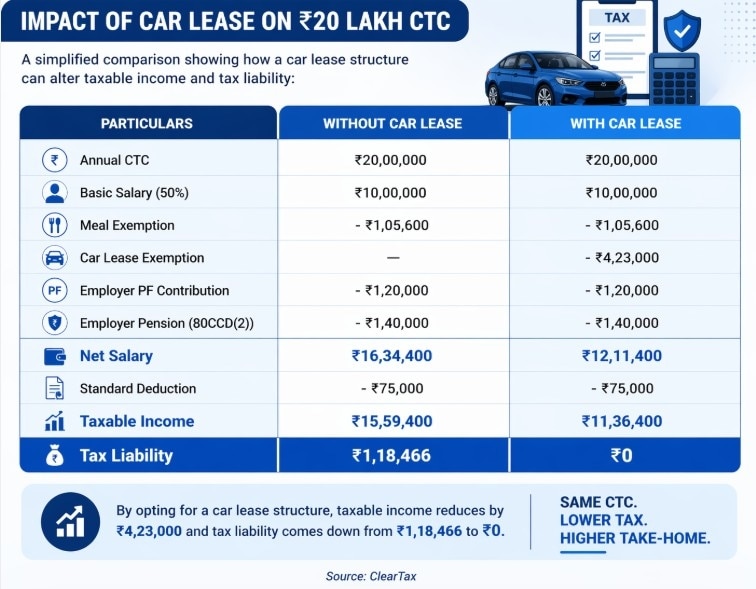



 Under car lease, a portion of the employee’s cash salary is replaced with a leased car benefit. This reduces the taxable income without altering the overall CTC.
Zero tax: A growing number of salaried professionals are realising that their tax outgo may depend less on annual increments and more on how their compensation is structured. The focus is shifting from “how much you earn” to “how efficiently you earn it.” At the centre of this trend is salary restructuring through benefits such as car leasing. Instead of increasing gross pay, employers are redesigning salary components to optimise tax efficiency under the new tax regime — without changing the overall Cost to Company (CTC).
How salary restructuring reduces tax burden

 FCNR(B) windfall lifts NBFCs, small private banks: Why these stocks may be the bigger winners
 India’s energy lifeline runs through the Indian Ocean: Why this maritime corridor matters
 20 Asia-Pacific stocks with up to 145% upside: Full ‘Going For Glory’ list, no Indian stock included
 Govt won't step into Singapore Airlines' Air India call, says Singapore minister
  Tax filing 2026: Missed crypto income in ITR? Why investors could receive an Income Tax notice
 Couples & Tax Planning: How Smart Expense Planning Can Help Reduce Family Tax Outgo
 Mutual Fund Allocation: How Much Should Investors Allocate To Large, Mid & Small Cap Funds?
 LIC CEO On Sustaining Blockbuster Q1 Growth Amid Market Uncertainty
 Travel Insurance Mistakes: Sub-Limits, Pre-Existing Conditions & Medical Evacuation Explained
 Home Loans & Insurance: How Couples Can Structure Them For Tax Efficiency
 APL Apollo, GNFC, Apar, Force Motors among stocks to turn ex-dividend next week; big payouts in focus
 LIC weighs NSE IPO strategy: CEO says market conditions, valuation to decide final move
 IHCL, LemonTree, Chalet among 5 hotel stocks to buy; analysts see up to 49% upsideFCNR(B) windfall lifts NBFCs, small private banks: Why these stocks may be the bigger winners20 Asia-Pacific stocks with up to 145% upside: Full ‘Going For Glory’ list, no Indian stock included
 Delhi rain this week: IMD predicts more showers and cooler days, with waterlogging a concern for commutersAPL Apollo, GNFC, Apar, Force Motors among stocks to turn ex-dividend next week; big payouts in focusCouples & Tax Planning: How Smart Expense Planning Can Help Reduce Family Tax Outgo
 Jio at 10: How Mukesh Ambani’s telecom bet transformed India’s digital economyLIC weighs NSE IPO strategy: CEO says market conditions, valuation to decide final move


