












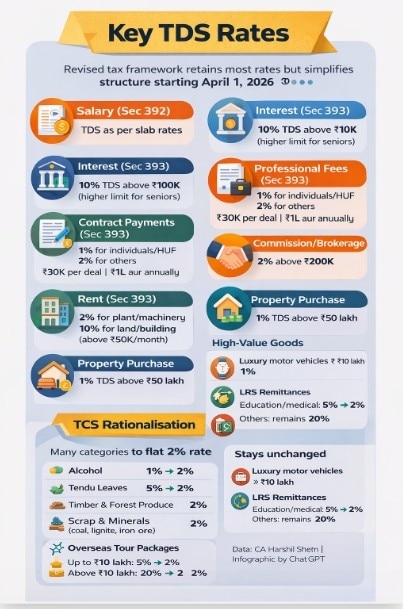



 The Income Tax Act 2025/Rules 2026 come into force, requiring updated systems. Key changes include renumbering sections into 392, 393, and 394.
TDS, TCS rates: India’s tax compliance framework is set for a structural overhaul in Tax Year 2026–27 (FY 2026–27), with sweeping changes to Tax Deducted at Source (TDS) and Tax Collected at Source (TCS) under the new Income Tax Act. Effective April 1, 2026, the reforms aim to simplify compliance, standardise rates, and introduce a clear cross-mapping of sections between the old and new regimes. Key provisions include renumbering of TDS sections into 392, 393, and 394, along with procedural simplification across multiple areas.
For property transactions involving NRI sellers, resident buyers and HUFs will no longer need a TAN from October 1, 2026, and can rely on PAN, easing compliance. The process for obtaining lower or nil TDS certificates will shift to a fully electronic system, replacing manual assessments, according to a detailed compilation by CA Harshil Sheth.

 SIR voter list: ECI extends claims deadline for Delhi, Maharashtra; check new dates
 US-China trade deal: China to buy 10 million tonnes of US coal in 2027, 2028; tariff relief for $30 billion goods
 Chandrababu Naidu on SIR row: Electoral decisions must follow institutional protocols
 NSE empanels Augmont as key partner to promote Electronic Gold Receipts
 Historic! Home loans in India are now cheaper than the US -- What NRIs must know
 R Veeramani Case: Granite Tycoon Faces Widening POCSO Probe In Chennai
 Gen Z And Money: Why Young Investors Want Quick Returns Over Long-Term Wealth Creation
 How Is Alexa+ Different? Will It have Ads Even If You Pay? Exclusive Chat
 Demand Robust Across Segments | Production To Ramp Up, Exports To Expand: Vivek Srivatsa
 GST Council To Meet On October 7: Invoice Matching, ITC & UPI MDR Tax In Focus
 IPO rush: Four IPOs conclude today; check subscription status, other details of issues still open
 Meesho shares slip 7% as Nomura assigns 'reduce' call; here's what the brokerage says
  Sensex, Nifty extend losing streak to seventh week, longest since 2020: What's next?
 Suzlon in bear grip: Oversold signals emerge near 52-week low for the stock
  EIL shares jump 7% to hit record high; stock up nearly 62% in six months: What's driving the rise?
 Insurance commissions vs premiums: Why distributor payouts are rising much faster
 Air India AI-171 crash: Pilots’ body seeks role in review of draft AAIB reportChandrababu Naidu on SIR row: Electoral decisions must follow institutional protocolsUS-China trade deal: China to buy 10 million tonnes of US coal in 2027, 2028; tariff relief for $30 billion goods
 Election Commission on SIR row: Agendas to be shared before meetings, minutes to follow


