









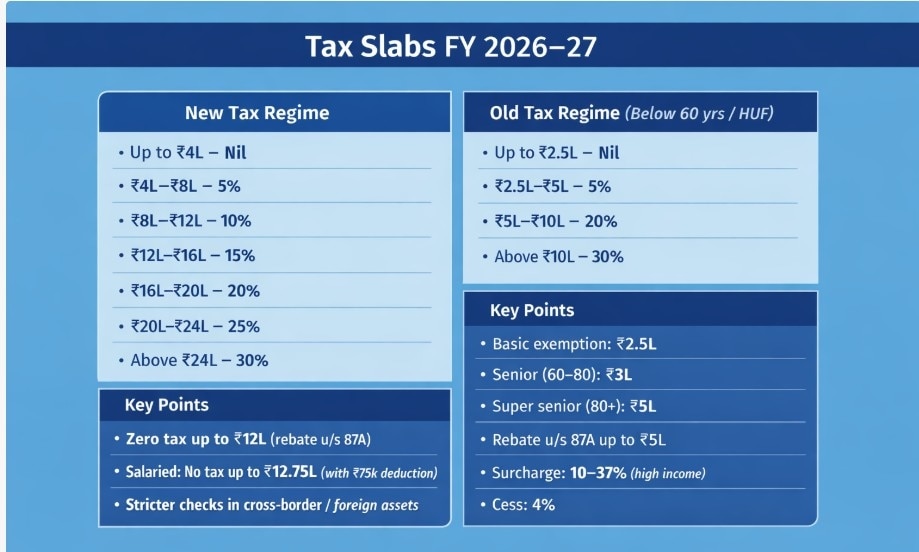



 The rules, effective April 1, 2026, raise PAN reporting limits for key transactions, expand perquisite thresholds, and others.
From April 1, 2026, India will move to a new direct tax framework as the Income Tax Act, 2025 comes into force, replacing the decades-old Income Tax Act, 1961. The government says the new law does not change tax rates but aims to simplify compliance, reduce disputes, and make the system easier to understand. However, the changes will still affect taxpayers in several practical ways, especially salaried individuals, people dealing in digital assets, and those claiming deductions such as house rent allowance (HRA).
> New Income Tax Act replaces old law
The biggest change from April 1 is structural. The new law reorganises the entire tax code into a simplified format with fewer explanations and clearer language. While most tax rates, deductions and limits remain the same, the government has rewritten the law to make it easier to read and interpret. The new Act runs into hundreds of sections but removes many redundant provisions to reduce confusion for taxpayers as well as tax officials.
> “Tax year” replaces financial year vs assessment year
One major change is the introduction of the concept of a tax year, which will mean the 12-month period starting April 1. This replaces the earlier system where taxpayers had to deal with both a financial year and a separate assessment year, which often created confusion while filing returns. The new system is expected to make return filing simpler.
> New HRA disclosure rule for salaried taxpayers
Salaried individuals claiming house rent allowance will have to provide more details from April 1. If annual rent exceeds ₹1 lakh, taxpayers must disclose the relationship with the landlord, especially when the house is rented from family members such as parents, spouse, or siblings. The rule is aimed at preventing misuse of HRA claims while still allowing genuine deductions.
> HRA exemption
From April 1, 2026, salaried taxpayers claiming House Rent Allowance (HRA) must disclose their relationship with the landlord if the annual rent exceeds ₹1 lakh, particularly when paying rent to family members such as parents, spouse, or siblings. This requirement comes under the Draft Income Tax Rules 2026, which introduce Form 124, replacing earlier forms like 12BB for HRA claims. The new form requires details such as the landlord’s name, PAN, and relationship with the taxpayer. Additionally, eight metro cities—Mumbai, Delhi, Kolkata, Chennai, Hyderabad, Pune, Ahmedabad, and Bengaluru—will continue to qualify for 50% salary HRA exemption, while other cities remain at 40%.
> Wider definition of digital assets, including crypto
The new law expands the definition of Virtual Digital Assets, which now clearly includes cryptocurrencies, NFTs and other digital assets notified by the government. This means transactions in such assets will come under clearer reporting and tax rules, and taxpayers dealing in crypto or online trading platforms may face stricter scrutiny.
> More powers for tax officials in digital searches
As financial activity increasingly moves online, the law allows tax authorities wider access during search operations. In certain cases, taxpayers may be required to provide access to emails, cloud storage, social media accounts, or digital trading platforms if they are relevant to an investigation. The government says this is needed to track undisclosed income in the digital economy.
> Changes in dispute resolution and recovery process
The new Act keeps the dispute resolution panel system but requires clearer written orders explaining decisions. The aim is to reduce litigation and make tax recovery and appeals more transparent, especially in cases involving foreign companies, non-residents, or transfer pricing disputes.
> What remains unchanged
Importantly, tax slab rates, capital gains rules, residential status criteria and most deductions remain the same as announced in recent Budgets. The government has emphasised that the new law is more about simplification than increasing taxes.
For most taxpayers, April 1 will not change how much tax they pay, but it will change how tax rules are applied, reported and verified. The new law aims to make compliance simpler, but it also brings tighter reporting requirements — especially for HRA claims, digital assets and online financial activity.

 Should you buy every IPO? Research suggests patience may be the smarter strategy
 Trump keeps military option open, says Iran is getting serious in nuclear talks
 PM Modi thanks youth for overwhelming response to late-night video on exam reforms
 Rajasthan Royals acquisition by Lakshmi Mittal sparks London court battle over shareholder claims: Report
 NTA sacks 47 officials as Centre launches major overhaul after exam paper leak row
 FD Vs Arbitrage Fund: Which Is Better For High Taxpayers?
 Manipal Health Enterprises Sets Price Band For Rs 9,275 Crore IPO, Opens July 29
 "Sack Education Minister First": Rahul Gandhi Vs Rijiju Clash Locks Parliament Over NEET Debate
 Anti-Paper Leak Amendment Bill Approved: 10-Year Jail, ₹10 Crore Fine & Fast-Track Courts Planned
 Tech Gear Show | Alexa Dot Max Review, iQOO Z11 Lite Unboxing & Best Phones Under ₹20K
 Should you buy every IPO? Research suggests patience may be the smarter strategy
 Sensex, Nifty extend losing streak to fifth day; analysts see cautious trend ahead
 Bank of Baroda Q1 profit slumps 72% to Rs 1,278 crore after one-time exceptional loss
 Tata Consumer Products Q1 earnings: Net profit rises 29%, revenue at Rs 5,349 crore
  Suzlon shares: Is the multibagger's dream run over? What investors should expect next
 'The Odyssey' Day 8 Collection: Nolan's blockbuster earns ₹116.49 crore in India, global total crosses $585 million
 Gold prices today, July 25: Gold slips below ₹1.45 lakh as global cues weigh; check latest ratesFD Vs Arbitrage Fund: Which Is Better For High Taxpayers?
 Top 10 unemployment rate countries in 2026: Check which nations have the highest jobless rates
 Special FD schemes in focus: How Bank of Baroda's 444-day deposit compares with SBI, PNB offerings