


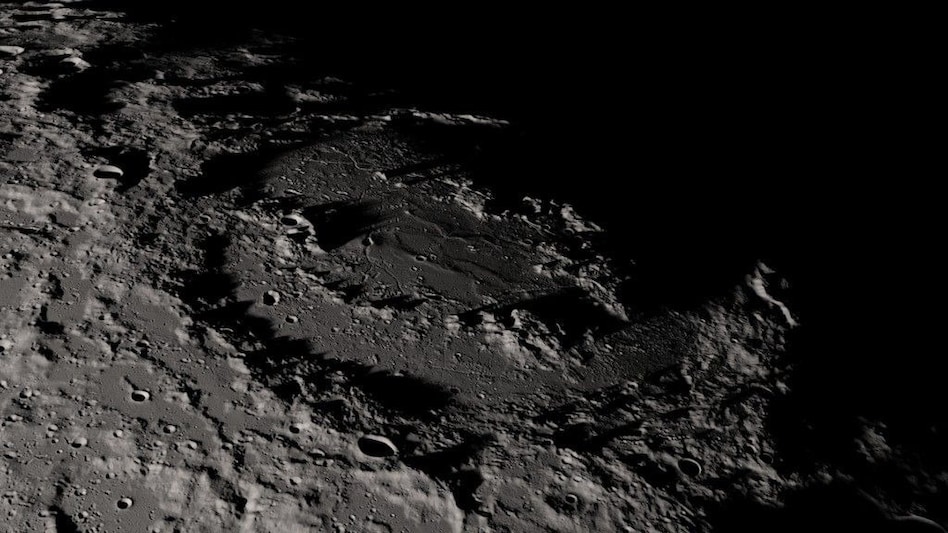
 Artemis II travels farther than any human beings ever/ PC: The Dark Side of the Moon, NASA
The four astronauts of NASA's Artemis II mission travelled deeper into space on Monday than any humans before them, conducting a rare flyby of the moon's shadowed far side. This journey revealed a lunar surface marked by constant cosmic bombardment.
“Artemis II has reached its maximum distance from Earth. On the far side of the Moon, 252,756 miles away, Reid, Victor, Christina, and Jeremy have now traveled farther from Earth than any humans in history and now begin their journey home. Before they left, they said they hoped this mission would be forgotten, but it will be remembered as the moment people started to believe that America can once again do the near-impossible and change the world,” said NASA Administrator Jared Isaacman.
During the six-hour survey of the normally hidden hemisphere of Earth's only natural satellite, the astronauts observed impact flashes from meteors striking the dark and heavily cratered surface.
About two dozen scientists monitored the lunar phenomena in real time from NASA's Johnson Space Center in Houston as the Orion spacecraft, roughly the size of an SUV, orbited the moon approximately 402,000 kilometres from Earth.
The flyby, which brought the crew within 6,550 kilometres of the lunar surface, occurred six days into the spaceflight. This mission marks the first time astronauts have travelled near the moon since the Apollo missions of the late 1960s and early 1970s.
Artemis, the successor to Apollo, aims to return humans to the moon by 2028 and establish a sustainable lunar presence in the following decade, including a base to support future Mars missions.
Along the way, the Artemis crew assigned provisional names to lunar features without official designations. Canadian astronaut Jeremy Hansen proposed naming one crater Integrity, after their Orion capsule, and another near the moon's cusp Carroll, in memory of mission commander Reid Wiseman's late wife.
MUST READ | BT Explainer: Why NASA’s Artemis II crew calls their Orion spacecraft ‘Integrity’
As the Orion capsule passed the moon’s far side, the crew witnessed the lunar surface eclipsing a distant Earth. Because the moon rotates synchronously with its orbit, the far side always faces away from Earth, making direct observation by humans rare.
Equipped with professional cameras, the astronauts captured detailed photographs of the moon’s surface and a rare celestial sight of Earth setting and rising over the lunar horizon. The flyby included a 40-minute communications blackout as the moon blocked signals from NASA's Deep Space Network.

 Exam reforms: Tech titan Nandan Nilekani picked by PM Modi to fix national public examination system
  'Tax officers struggled for own land': Nirmala Sitharaman slams laidback attitude of govt depts
 CBDT issues new crypto reporting guidance: No new tax, but exchanges must track and report all transactions
 Did Cockroach Janta Party's 'Chalo Sansad' 2.0 threat trigger Dharmendra Pradhan's resignation? What we know so far
 'Will discharge my responsibilities with complete humility': Pralhad Joshi after being appointed Education Minister
 AI Data Centers, Aerospace & Gas Turbines: What's Powering Indo-MIM's Future Growth?
 Best Healthcare Stocks: Gaurang Shah's Outlook On Apollo Hospitals, Fortis & The Manipal Health IPO
 Is Indo-MIM's IPO Valuation Justified? Here's Why The Company Sees Strong Growth Ahead
 Treasury Bills Explained: Why T-Bills Are One Of The Safest Short-Term Investment Options
 FDs vs Markets: Where Should You Keep Your Short-Term Money?
 Gland Pharma stock: Price target of Rs 3,250 likely in medium term, says analyst
  Metal recycling stocks to buy: Gravita, Pondy Oxides, Jain Resource among top picks
 TRIL shares: Should you average the falling stock? Here's 'fixed and final' stop loss
 Adani Power: 45 GW target, Rs 2 lakh crore capex plan among conference call highlights
  ITC Hotels, Chalet, Ventive, IHCL, SAMHI: Hotel stocks to buy despite travel disruptions
 Beyond mutual funds: Why analysts see SBI Funds' alternative asset business as a long-term growth engine
 'Ashamed of it...': Manoj Muntashir calls Adipurush his biggest mistake, seeks country's forgiveness Exam reforms: Tech titan Nandan Nilekani picked by PM Modi to fix national public examination system 'Tax officers struggled for own land': Nirmala Sitharaman slams laidback attitude of govt depts
 Delhi targets traffic bottlenecks on Aruna Asaf Ali Marg with ₹1.97 crore elevated road study









