








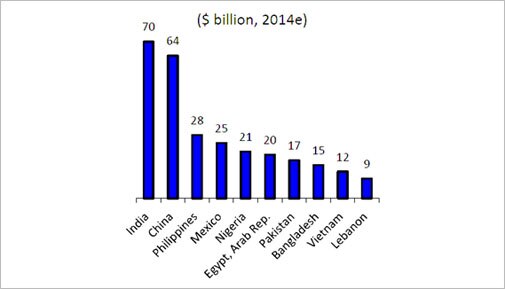
India tops the chart in global remittances in 2014 receiving $70 billion from its immigrants abroad, according to recently released World Bank data. India was followed by China ($64 billion) and Philippines ($28 billion).
Inflow of remittance to developing countries has reached $436 billion in 2014, a rise of 4.4 per cent from last year. However, World Bank expects growth to slow down to 0.9 per cent growth in 2015. The major factors that might impact remittances in 2015 are (a) the uneven recovery in developed countries; (b) lower oil prices and economic developments in Russia; (c) tighter immigration controls; and (d) conflicts that are driving forced migration and internal displacement.
Overall global remittance receipts, including by both developing and high-income countries, are estimated at $583 billion in 2014, and is expected to rise to $586 billion in 2015 and reach $636 billion in 2017.
India and Israel have raised over $40 billion, through their diaspora communities to support balance of payments needs. Israel for instance, used its diaspora money to finance infrastructure, housing, health, and education projects. Several other countries such as Philippines, Sri Lanka, Kenya, Ghana, Nepal and Ethiopia - have issued diaspora bonds to raise money for various needs.
"Israel and India have shown how macro liquidity crises can be managed by tapping into the wealth of diasporas communities. Mexican migrants have boosted the construction sector. Tajikistan manages to nearly double its consumption by using remittance money. Migrants and remittances are clearly major players in today's global economy." said Kaushik Basu, World Bank Chief Economist and Senior Vice President.
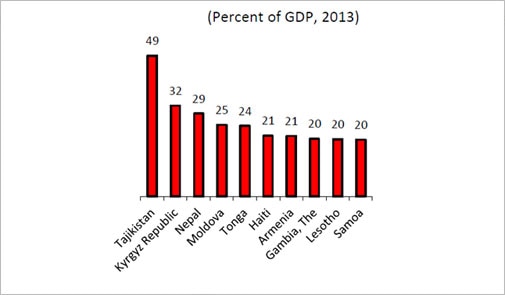
Remittances as a percent of GDP are quite high in smaller economies especially in Central Asia and Pacific Islands. Remittances in Tajikistan, for instance is 49 per cent of their GDP, highest amongst all. It's followed by Kyrgyz Republic where remittances constitute 32 per cent of their GDP in 2013.
 India-US interim trade agreement: 'No GM modified product allowed, agri sector protected,' says Piyush Goyal
 'Decided to give 0% tariff on some cancer medications, neuro treatment': Piyush Goyal on what US got
 Cyberattack impact on Tata Motors PV earnings crosses Rs 3,200 crore; losses still mounting
 India-US interim trade pact: 'Boeing, Airbus looking at India as largest OEM partner,' says Piyush Goyal
 US trade deal to boost Indian aerospace manufacturing
  Golf & Life: Handling Every High And Low
 It’s Time More Women Picked Up The Club. Golf Welcomes Women At Every Stage Of Life.
 RBI Says Trade Deals With EU, US & Others Strengthen India’s External Sector Outlook
 Jeffrey Sachs Praises Modi On India-US Trade Deal: “Trump Blinked, India Must Not Depend On U.S.”
 Agra’s ₹127 Cr Housing Project In Ruins: Flats For Poor Rot Before Occupation
 SBI Q3 Results: Profit jumps 24% to Rs 21,028 crore; asset quality improves
 IDBI Bank stake sale: Kotak Mahindra Bank says ‘has not submitted a financial bid’
 BDL, Mazagon Dock, MRF, Hindustan Copper, RVNL, others to turn ex-dividend next week
 Q3 results: HAL, Titan, M&M, HUL, ONGC, Lenskart to post earnings next week; check dates
 'Think about it': Deepak Shenoy warns indices mask stress as majority of Nifty 500 stocks lag