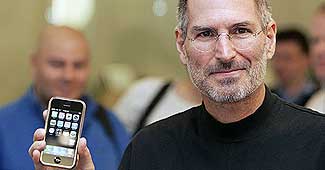
On January 9, 2007, when Apple Computer CEO Steve Jobs held up the iPhone, competitors and analysts scoffed. Apple was venturing into new territory by making a phone, and established players would have it for lunch, they said. Forrester Research analyst Charles Golvin was quoted as saying: "The iPhone will not substantially alter the fundamental structure and challenges of the mobile industry."
Ouch! Even though the iPhone still remains 'a niche product', as Nokia CEO Olli-Pekka Kallasvuo termed it, what a niche it is! The iPhone has become the model smartphone, and the success of Apple's iTunes applications store is driving both device manufacturers and telecom operators today.
And Apple has not stopped on the device front: its iPad tablets have prompted others to rush into the market with a host of knock-offs. But nobody expects the iPhone to lead the 3G device revolution in India. Legal versions of the iPhone 3GS sold by Airtel and Vodafone cost upwards of Rs 30,000. India, as Nokia India Managing Director D. Shivakumar points out, is a value-conscious market. But that does not mean that Indians cannot have access to affordable touch-screen devices. Nokia's South Korean rival Samsung recently launched one for Rs 4,500.
"The interesting thing with applications and software on a mobile phone is that your phone and my phone can have the same hardware but be completely different... the ability to personalise will be the main driver for mobile devices," says Asim Warsi, Chief Marketing Officer of Samsung India.
Manu Nagar, CEO of Longcheer India Technology, the mobile development arm of a Chinese major, cites two critical aspects. "For most Indians a phone has to look good, say something about them. The reason qwerty-keypad devices became popular was not so much because they are easy to type on but because they look expensive," he says.
But he also points out that Indian marketers (all 'Indian' mobile brands import devices from China and Taiwan) have a great sense of the mass market's pulse. "But the massmarket is not an innovative segment; innovation will still come from the top-end of the market," says Nagar.
Microsoft India's Head of Consumer and Online Business Hemant Sachdev believes that innovation will be driven by faster and more affordable data, or the way mobile devices are used. "There will be uses in healthcare and education. There are 1.72 million educational institutions across India but only a handful have high-speed data connections.
Cheap computing devices that can access the Internet through mobiles will liberate them," he says. The big driver - and this is akin to what has happened in the West - will be entertainment, or movies, sports and video. Google India's Product Head, Vinay Goel, says several Indian television companies are already on YouTube with legal content. When mobile data speeds get faster thanks to 3G and broadband wireless access (BWA), more people will access video on their phones.
But phones will need to be smarter to handle all this video. Enter Qualcomm, the American technology company. Apart from winning the licences for BWA services in four circles, Qualcomm is one of the world's largest manufacturers of chipsets for mobiles. Kanwalinder Singh, Managing Director of the Indian arm, says the price-performance barrier is moving lower every day. "The Snapdragon processor we have gives high-end smartphones massive performance, but we also have our 7000 series that allows cheaper devices to run smartphone platforms."
Google and Qualcomm both expect a smartphone running Android to be launched at around Rs 8,000 in India very soon. Chinese telecom company ZTE recently launched an Android-powered handset 'Runner' at this pricepoint in the United Kingdom. By 2011, Android handsets could be retailing for around Rs 5,000 in India. But the big thing in India, according to Singh, will be "real-time switching" between networks of various technologies and standards.
But what about tablets and the cloud? Proliferation of video will lead to greater peer-to-peer video sharing of events such as family occasions, argues Sanjay Kapoor, CEO of Bharti Airtel. So tomorrow's mass-market device in India will be cheap versions of the iPhone and iPad. They will have large touch-screens and be able to work on several standards simultaneously.
They may not be as smart as Apple's, but could have a replaceable battery, slots for high-capacity smart-cards and front and rear cameras for video calls (see The Phone of Tomorrow). Thanks to fast and cheap processors, such a device could have a smartphone operating system, possibly Android since it is freeware. All this for a lot less than an iPhone.
THE OPERATING SYSTEM WARS
Android: Developed by Google, the Android operating system is free to use but if manufacturers want access to the Android marketplace they need to sign a contract with Google. The system supports third-party applications and can also run on less-capable devices. It might come up on top in India simply because of the number of devices that will use it. Google is also developing the Chrome OS for tablets and netbooks
iOS: Apple's operating system for the iPhone, iPod Touch and iPad. Apple wants to remain in the low-volume but very high margin top-end of the market. The same will apply in India
Windows Phone 7: Microsoft's latest mobile software has been showcased and according to initial reports looks stunning, but its success in India depends on the device ecosystem. Microsoft plans lower-priced devices on its outdated Windows Mobile 6.5 platform. But success will depend on pricing and availability of apps
Symbian S60: Nokia's venerable smartphone operating system was brilliant when launched almost a decade ago, but today is as outdated as Windows 95. However, familiarity helps in India and Nokia plans to use the system in its cheaper handsets. Nokia is updating Symbian for some of its newer devices such as the N8, but Symbian is losing developers to Android and iOS globally
MeeGo: A Nokia-Intel joint collaborative effort to take on Android and iOS, and like Android this is a version of Linux that will power smartphones, tablets and netbooks. If apps developed for Android and iOS can be easily ported on to the system it might have some success in India
BlackBerry OS 6.0: With Indian security agencies raising a stink about BlackBerry services, who knows? But BlackBerry needs more than an operating system refresh. Despite some exciting new devices in some Western markets, it is losing its lustre
Bada: Samsung's new proprietary operating system will power most of their devices but the Korean company will continue to use Android and Windows on some of their high-end products
For Unparalleled coverage of India's Businesses and Economy – Subscribe to Business Today Magazine















