


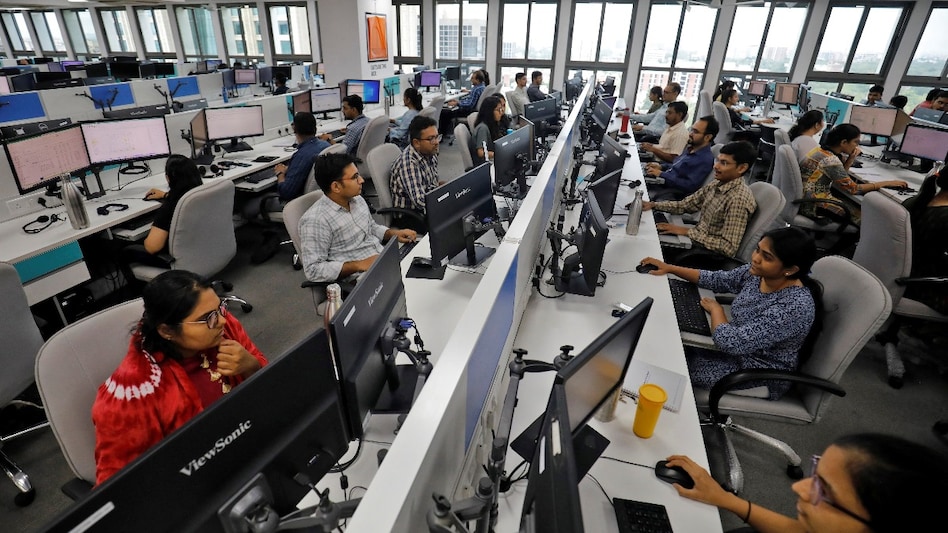
 The broader hiring environment, especially for entry-level roles, remains under pressure.
For years, growth in India’s IT sector followed a familiar formula, win more deals, hire more people. The size of a company’s workforce, especially the number of freshers it onboarded from campuses, was often a proxy for its future growth trajectory.
That equation is now beginning to change.
At recent quarterly earnings calls, India’s largest IT services firms pointed to a sharp uptick in artificial intelligence (AI)-driven projects and deal pipelines and said this momentum is expected to build through 2026. At the same time, they spoke of reskilling employees, redeploying talent internally, and becoming more selective about hiring, a clear signal that AI is starting to reshape the industry’s traditional manpower-heavy model.
The breaking link between deals and headcount
In mid-2025, Tata Consultancy Services (TCS) announced a workforce restructuring initiative. This quarter, the country’s largest IT services firm let go of around 1,800 employees who it said could not be redeployed internally.
“We continue to hire and seek top talent, both from the lateral market and campuses,” Sudeep Kunnumal, Vice President and CHRO at TCS, said at a post-earnings analyst call. “We continue to look for people with deployment into future roles. Wherever we are not finding success in re-deployment, that is where we are releasing the workforce.”
A recent IT sector report by HDFC Securities said this AI-driven transition is already showing up in hiring trends.
“This AI-driven shift is directly impacting jobs, which is visible in the muted hiring across the sector over the last 8–10 quarters,” the report noted. “At the same time, AI is unlocking new layers of hyper-specialisation that are beginning to define the future of work in technology services.”
The changing dynamics are also visible among peers. Tech Mahindra reported a decline in overall headcount during the quarter, even as attrition stabilised and deal volumes improved, pointing to a weakening link between deal wins and hiring. Mohit Joshi, CEO, Tech Mahindra, said that instead of backfilling roles that were opening up through attrition, the company was redeploying existing employees.
"Thanks to our new software infrastructure, we have much better visibility of individual-level talent and where they can be redeployed," Joshi told analysts during a post-earnings call.
Hiring priorities are changing
Instead of large-scale bulk hiring, companies are now prioritising lateral recruitment in niche and high-demand areas.
TCS said it will focus on experienced hiring in cybersecurity, enterprise solutions, cloud, AI and data. Over half of its experienced hires now come with next-generation skill sets, while the company is also onboarding AI-native fresh graduates.
“We hired a significant number of AI-native fresh graduates,” Kunnumal told analysts.
However, the broader hiring environment, especially for entry-level roles, remains under pressure.
“The demand for entry-level and fresher talent has been low since 2023,” said Kamal Karanth, co-founder of staffing firm Xpheno. “The current active demand for entry-level talent in India is under 50,000 across all sectors, with less than one-third of it coming from the tech sector.”
“The state of fresher and entry-level hiring continues to be under stress as industries attempt to stabilise their talent plans and costs,” he added.
Even when companies do return to campuses, the numbers are far lower than in the boom years.
During Wipro’s post-results earnings call, CEO and MD Srini Pallia said the company would resume campus hiring after a brief pause. “We are going to go to the campuses again. We have taken a bit of a hiatus this quarter, next quarter,” he said.
Infosys said it has onboarded 18,000 of the 20,000 freshers it planned to hire this fiscal, while continuing to build capacity for the future.
AI changes the economics of IT services
The deeper change underway is not just about hiring volumes; it is about how IT services are delivered.
Salil Parekh, CEO and MD of Infosys, told analysts that while client demand is rising in areas such as legacy modernisation, the delivery model itself is being transformed.
“We will have our people working and these software agents, which make the overall economics for the client much better,” Parekh said.
Over time, this shift is expected to have a direct impact on operating margins as companies use technology to deliver more with fewer employees.
Still, industry watchers caution that this transformation is only beginning.
“The maturity of enterprise use of GenAI and agentic workflows can speed up a change in the landscape of employment, from a talent volume and velocity point of view,” said Karanth. “However, the real impact of AI on permanent employment will not be felt until wider adoption of AI happens in enterprise processes.”
Reskilling over hiring
For now, the dominant strategy across the industry is reskilling rather than mass hiring.
TCS said over 217,000 of its 582,163 employees have now been trained on advanced AI skills. HCL Technologies has trained more than 38,000 employees on GenAI and over 600 on responsible AI.
Xpheno’s data shows that two-thirds of active talent demand is still coming from technology and engineering roles, but less than a quarter of that is for AI-specific positions.
“This clearly points to a focused internal upskilling and reskilling process in play,” Karanth said. “Given the limited supply of specialist and senior talent in AI roles, enterprises have shifted their talent strategy. Building internal AI talent is seen as more sustainable than buying from the market, which is both rare and expensive.”
For Unparalleled coverage of India's Businesses and Economy – Subscribe to Business Today Magazine

 Who is Pralhad Joshi? Modi names veteran Karnataka BJP leader to lead Education Ministry after Pradhan's exit
 Third round of talks: CJP ends 49-day-long protest, says govt accepted 'key demands'
 Dharmendra Pradhan resigns, says decision taken to protect students' future amid NEET row
 All about Dharmendra Pradhan's educational qualification, wealth, assets and more
 India's first REIT mutual fund is here. Can it change how Indians invest in real estate?
  FDs vs Markets: Where Should You Keep Your Short-Term Money?
 Why Term Insurance Is Essential for Every Earning Member | Sum Assured & Coverage Explained
 Pakistan's Alleged Terror-Politics Nexus: Lashkar Links Spark Questions Over Fazlur Rehman
 Think Life Insurance Is Optional? Here's Why Every Indian Family Needs It Today
 FD Vs Arbitrage Fund: Which Is Better For High Taxpayers?
 Adani Power: 45 GW target, Rs 2 lakh crore capex plan among conference call highlights
  ITC Hotels, Chalet, Ventive, IHCL, SAMHI: Hotel stocks to buy despite travel disruptions
 ITC shares: Rs 307 a key short-term level to watch; here's target price
 Mphasis shares: FY27 guidance maintained; brokerages keep 'Buy' after Q1; check target price
 Should you buy every IPO? Research suggests patience may be the smarter strategy
 New York's $400 million climate bet: How a million trees are cooling a city the city from extreme heat Who is Pralhad Joshi? Modi names veteran Karnataka BJP leader to lead Education Ministry after Pradhan's exit
 Houthis target Saudi Aramco sites in Jizan and Yanbu as Red Sea tensions take a new turn
  Lifestyle inflation, delayed investing, high-interest debt: 3 biggest money mistakes young professionals makeThird round of talks: CJP ends 49-day-long protest, says govt accepted 'key demands'









