












 TranslateGemma has been trained and evaluated on 55 languages, covering major global languages such as Spanish, French, Chinese and Hindi
Google on January 16 launched TranslateGemma, a new family of open-source artificial intelligence (AI) models designed to make high-quality translation faster, cheaper and more accessible across devices. Built on the company’s latest Gemma 3 architecture, the models support translation across 55 languages and are designed to run on everything from smartphones to cloud servers.
The launch comes just hours after OpenAI debuted a dedicated ChatGPT-powered translation tool on January 15, underscoring how fast the race is heating up to dominate AI-powered language services.
OpenAI’s new product, called ChatGPT Translate, lives on a standalone webpage and allows users to translate text, voice and images into more than 50 languages. It also includes automatic language detection and allows users to rewrite translations in different tones, such as more fluent, business formal, child-friendly or academic. The tool says it understands “tone, idioms and context,” pushing beyond simple word-for-word translation.
But unlike Google’s new models, ChatGPT Translate currently requires an internet connection and has no dedicated mobile app or on-device support. That limits its usefulness for travellers in rural areas or regions with poor connectivity. It also does not yet support real-time conversation translation, an area where Google is already pushing ahead through features such as live voice translation on its Pixel phones.
Against that backdrop, Google is positioning TranslateGemma as a foundation for translation systems that can run locally, cheaply and at scale.
Smaller models, bigger performance
In AI, model size is often equated with intelligence. Larger models typically deliver better results, but they are costly to run and difficult to deploy widely. TranslateGemma challenges that assumption by showing that compact models, if trained correctly, can match or even exceed the performance of far larger systems.
The models are available in three versions: a lightweight 4-billion-parameter model for mobile use, a 12-billion-parameter version aimed at consumer laptops, and a 27-billion-parameter model designed for cloud servers and high-end AI hardware such as Nvidia’s H100 GPUs and Google’s TPUs.
Parameters represent the ‘knowledge’ gained by the model during its training phase. More parameters generally result in more accurate predictions because the model has access to more contextual information.
According to Google’s technical evaluation, the 12B TranslateGemma model outperforms the much larger 27B Gemma 3 baseline on the WMT24++ benchmark, a widely used industry dataset for measuring translation quality. The models were evaluated using MetricX, an advanced scoring system that measures how closely machine translations match high-quality human translations.
This means developers can now achieve high-fidelity translation while using far less computing power. In practical terms, that translates into lower costs, faster response times and the ability to deploy advanced translation on everyday devices.
The smallest 4B model also delivers strong results, matching the performance of the older 12B baseline, making it suitable for mobile and edge computing, where power and memory are limited.
Training AI to think like a translator
Google attributes TranslateGemma’s efficiency to a specialised two-stage training process that transfers the knowledge of its Gemini models into a smaller, open architecture.
In the first stage, known as supervised fine-tuning, the base Gemma 3 models were trained on large collections of parallel texts. These are sentence pairs where the same content appears in two different languages. The dataset combines human-translated material with high-quality synthetic translations generated by Gemini, Google’s flagship AI system.
The second stage uses reinforcement learning, a technique in which models improve through feedback rather than direct instruction. Instead of being told what the correct translation is, the model generates multiple candidate translations and is rewarded based on how natural, accurate and contextually appropriate they are.
Google used advanced evaluation systems such as MetricX-QE and AutoMQM, which act as automated reviewers that score translations in a way that closely mirrors human judgment.
The result is a model that not only translates accurately but also produces more natural-sounding language.
Focus on global language coverage
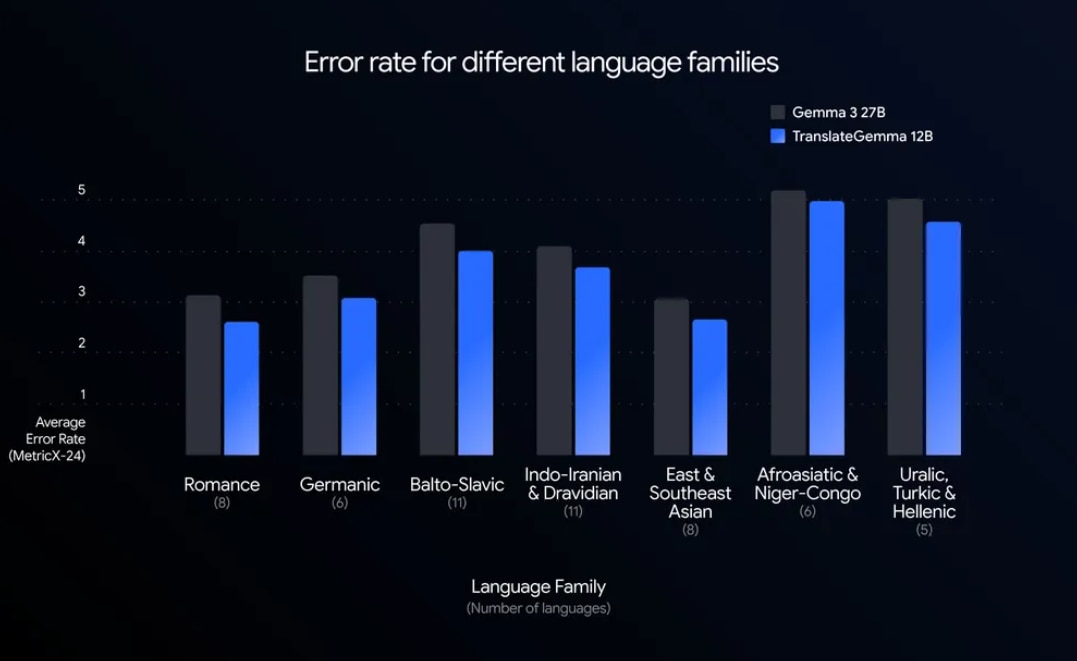
TranslateGemma has been trained and evaluated on 55 languages, covering major global languages such as Spanish, French, Chinese and Hindi, as well as many mid- and low-resource languages that are often neglected by commercial AI systems.
Google says the models consistently reduced error rates across all tested languages compared with the baseline Gemma models, delivering higher quality while using fewer computing resources.
Beyond the core 55 languages, the company has also trained the system on nearly 500 additional language pairs. While these extended pairs have not yet been fully evaluated, they are included in the technical report to encourage researchers and developers to build on the models and improve support for underrepresented languages.
Translation beyond text
TranslateGemma also inherits the multimodal capabilities of Gemma 3, meaning it can work with text embedded inside images. On the Vistra image translation benchmark, the models demonstrated improved ability to translate text found in photographs and scanned documents, even though they were not specifically trained on multimodal data during the TranslateGemma process.
This opens the door to applications such as translating street signs, menus, documents and screenshots directly from images.
A new phase in the AI translation race
Together, the launches from Google and OpenAI signal a new phase in the global AI translation race. OpenAI is betting on flexibility, tone control and conversational rewriting through its ChatGPT interface, while Google is pushing for efficient, open models that can run anywhere.
For Unparalleled coverage of India's Businesses and Economy – Subscribe to Business Today Magazine

 Sterlite Technologies: What every investor should know about the stock post Q1 earnings
  BT Explainer | PVR Inox shares: Analysts bet big on Odyssey, Ramayana, Avengers & others post solid Q1
 ‘Merely because there is agitation…’: Supreme Court says right to peaceful protest is guaranteed
 First-time homebuyers beware! Five common home loan traps that could cost you big
 OpenAI's GPT-5 was labelled a high-risk AI model over biohazard concerns
 Should You Buy The Echo Dot Max? Full Review & Honest Verdict
 Smartphone Brain: How Excessive Screen Time May Harm Children's Health | Sneha Mordani Explains
 Oil Shock Looms As Hormuz Crisis Meets Houthi Threat To Bab El-Mandeb Shipping Route
 Air Pollution And Dementia: How Dirty Air Could Affect Your Brain Health | Sneha Mordani Explains
 Is Alexa Always Listening To You? Best Smartphones Under ₹20,000 | Tech Gear
 Tata Consumer stock: Tata Group's FMCG arm reacts to Q1 earnings show
  Why KFin Technologies shares surged 9% today
 Sagility shares surge 8%; brokerages retain 'Buy' despite Q1 revenue dip QoQ; check target pricesSterlite Technologies: What every investor should know about the stock post Q1 earnings BT Explainer | PVR Inox shares: Analysts bet big on Odyssey, Ramayana, Avengers & others post solid Q1
 'My wife's rib was fractured by a policeman': Comedian Raunaq Rajani posts video alleging police assault in Mumbai protestTata Consumer stock: Tata Group's FMCG arm reacts to Q1 earnings show
  'Politics has become deeply polluted': Former Karnataka CM Siddaramaiah announces electoral retirementShould You Buy The Echo Dot Max? Full Review & Honest Verdict
 Bank of Baroda hit by cyberattack; 1TB of sensitive data allegedly leaked