








 After White House advisor pitches US AI model globally, Zoho’s Vembu flags brain drain cost
 After White House advisor pitches US AI model globally, Zoho’s Vembu flags brain drain cost
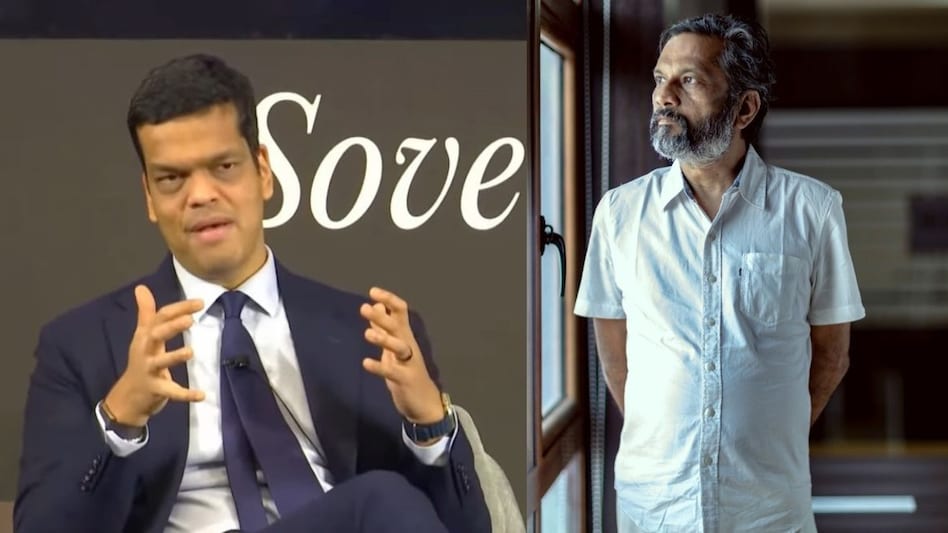
India AI Impact Summit 2026 | Zoho founder and chief scientist Sridhar Vembu on Thursday reacted to remarks by Senior White House Policy Advisor on AI Sriram Krishnan, saying India must guard against losing its next generation of technology talent.
On Wednesday, Krishnan, speaking at the India AI Summit in Delhi, shared Washington's artificial intelligence strategy and said the United States wants the world to use the "American AI stack".
"This is why brain drain is costly, and we must fight hard to retain the next generation of talent in India," Vembu wrote on X.
Also read: AI is like modern-day Akshay Patra from the Mahabharata, says Mukesh Ambani at AI
During a panel discussion, Krishnan described Washington's AI action plan built around three pillars and positioned the "American AI stack" as the foundation on which allies - including India - should build.
"When the (Trump) administration took over 13 months ago, we came in with the perspective that AI is something we want to embrace with optimism, that it is useful in all of our daily lives. There is a key role for America and all of our allies to play in it," Krishnan said.
He said the administration introduced what it calls an AI action plan, with two pillars that are primarily domestic. He said the US wants to build infrastructure. "AI needs energy. It needs data centers to power the GPUs and the TPUs, and we want to make sure we can unlock the building of infrastructure. So if you want to nerd out about grids and gas turbines and nuclear power, I'm your person."
The second pillar, he said, focuses on encouraging innovation and reducing regulatory barriers. "The second pillar is we want innovation. We want to make sure we unlock the Geminis of the world, the OpenAIs of the world, the Groks of the world, the Anthropics of the world - and a lot of startups that may not even been created yet. I want to make sure we unleash them, and they're not dealing with some of the regulatory red tape that we used to see."
The third pillar, which he described as most relevant to India, concerns global adoption. "But the final piece, and I think most relevant to India and this conversation, is we want to make sure the world uses the American AI stack. And that means from the bottom up, it means our semiconductors and advanced AI chips, Nvidia, AMD, and Google's GPUs, so on and so forth."
He said the US wants to make sure the world uses its AI models. "And third, it uses our applications and builds applications on top. And we want to be sure we are amazing and easy to do business with."
Krishnan also pointed to the scale of investment planned in the United States. He said America is going to have a minimum of $600 billion dollars in investment across the hyperscalers next year. "That could be a conservative estimate, and this is going to power AI training runs, data centers, and compute."
He said allies should build on that infrastructure while maintaining autonomy. "All of our allies - and India is a key ally - should be leveraging and building on top of this infrastructure. Now this does not mean giving up on strategic autonomy."
The Indian-American advisor, however, noted that Indian companies would need to adapt solutions locally. "Indian companies will need to bring in local language support. It needs to bring in local culture. It needs to have inference for low latency built on the infrastructure here. But at the end of the day, we want the American AI stack to be the bedrock that everyone builds on."
Capitalmind CEO Deepak Shenoy also agreed with Vembu's response and said, "Indeed. India should and will build foundational models, and in general, we need things that cannot be denied to us if America doesn't like us."
For Unparalleled coverage of India's Businesses and Economy – Subscribe to Business Today Magazine
 Shipping crisis deepens: Maersk pauses key services, cargo bookings across West Asia
  ‘Some people will die’: Trump says Americans may face attacks at home amid Iran war
  'We are the largest intercity player already': Prabhjeet Singh as Uber launches bus ticketing in India
 Dubai gold trade hit as Iran-Israel-US conflict delays shipments; bullion sold at $30 discount, says report
 Oil at $150, gas prices to quadruple? Qatar warns West Asia war could crash global economy
 BT Golf 2025-26 Mumbai Awards Ceremony Marks A High-Energy, Successful Conclusion
 Managing Money Amid Geopolitical Uncertainty | Wealth Leaders Share Golf & Investing Lessons
 Iran War Threatens India’s LPG Supply As Hormuz Risk Rises, Russian Oil Returns
 Shashi Kiran Shetty On Golf Lessons, Global Crisis & Why Businesses Must Stay Lean
 Iran War Hits Global Airlines: Major Aviation Hubs Shut, Flights Cancelled, Fuel Prices Soar
 LT Foods shares: Mukul Agrawal stock falls in 12 of 14 sessions; Geojit target hints at 32% upside
 Amid global geopolitical shock, time to look inwards and focus on domestic-oriented sectors, says Motilal Oswal's Siddhartha Khemka
 Rs 13 lakh cr m-cap gone in 4 days! Sensex, Nifty tank over 1% on fag-end selling; what’s ahead?
 Jefferies’ Chris Wood cites 2 triggers for FPI return; one may unsettle retail investors
 Iran war lift crude oil prices: What geopolitical tensions mean for Indian bond market?