









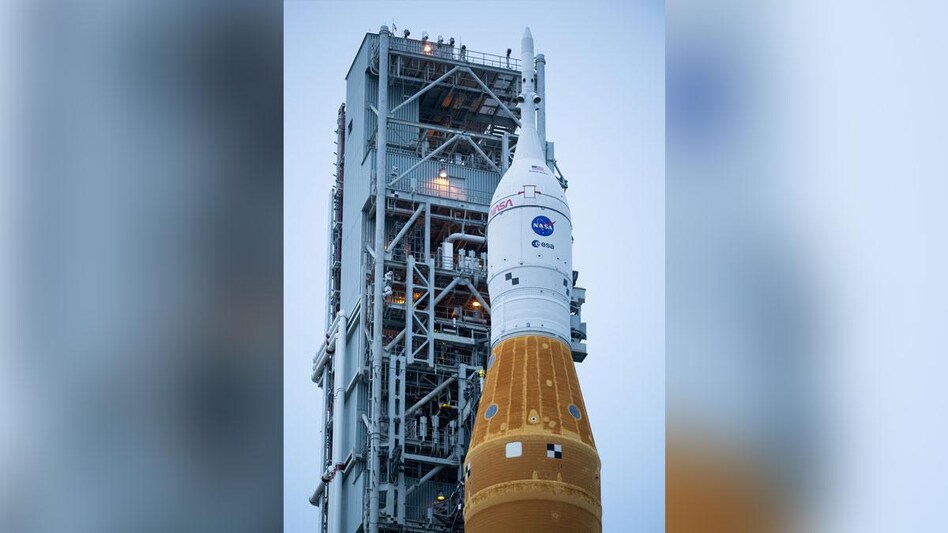
 Artemis, a NASA's program to return astronauts to the Moon, is the first one in five decades since Apollo 11 in 1969. (Photo: TWITTER)

 Artemis, a NASA's program to return astronauts to the Moon, is the first one in five decades since Apollo 11 in 1969. (Photo: TWITTER)
NASA is aiming for another launch attempt of Artemis 1 million on November 14. Artemis, a NASA's program to return astronauts to the Moon, is the first one in five decades since Apollo 11 in 1969. The space agency is expected to launch the Space Launch System (SLS) rocket and the Orion spacecraft during a 69-minute launch window which will start at 12.07 AM EST (9.37 AM IST) on the disclosed day.
According to NASA, the primary goals for Artemis I are to demonstrate Orion’s systems in a spaceflight environment and ensure a safe re-entry, descent, splashdown, and recovery prior to the first flight with crew on Artemis II.
Inspections and analyses done so far confirm that the rocket and spacecraft will be able to roll it back onto Launch Pad 39B at the Kennedy Space Centre in Florida once the minimum required work is done. Earlier, Artemis 1 stack was rolled back on September 27 to protect it from Hurricane Ian.
Mike Sarafin, Artemis I mission manager at NASA Headquarters in Washington, said: “This is a mission that truly will do what hasn’t been done and learn what isn’t known. It will blaze a trail that people will follow on the next Orion flight, pushing the edges of the envelope to prepare for that mission.”
Regarding its future missions, NASA has said that another flight will take crew on a different trajectory and test Orion’s critical systems with humans aboard. The SLS rocket will evolve from an initial capability of sending more than 26 metric tons to the Moon, to a final configuration which will make it possible to send at least 45 metric tons to the Moon. "Together, Orion, SLS and the ground systems at Kennedy will be able to meet the most challenging crew and cargo mission needs in deep space," NASA added.
Also read: Google celebrates NASA DART mission with a cool animation. Just do a Google search
Also read: NASA-hit asteroid leaves 10,000 kilometre-long trail of debris
For Unparalleled coverage of India's Businesses and Economy – Subscribe to Business Today Magazine
 EPFO revamps Unified Member Portal; UAN activation shifts to UMANG: What it means for subscribers
 NSE issues investor advisory against 'dabba', illegal trading services: What it means
 No more 2-day WFH, staggered timings for Delhi govt employees: Rekha Gupta
 'We gave them a week off': Trump takes swipe at Iran during July 4 speech
 Online food delivery isn't slowing down: Why Indians are ordering more than ever
 Persistent CEO Explains Why Nagarro Was The Perfect Global Acquisition For The Company
 Can A Kill Switch Exist In Electric Vehicles? Here’s What EV Owners Should Know
 Persistent Systems CEO Sandeep Kalra Says Nagarro Acquisition Will Drive Long-Term Growth
 Tech Gear Show | Latest Tech News, Moto Razr Fold Review, Sony INZONE H6 Air, OnePlus Nord Buds 4 | EP 9
 I.T. Sector Recovery Ahead? Feroze Azeez On AI, Acquisitions & The Next Growth Phase
 NSE issues investor advisory against 'dabba', illegal trading services: What it means
 Sensex, Nifty extend winning streak to 3rd day; investor wealth jumps over Rs 6.1 lakh crore
 L&T, Ashok Leyland and MCX: How to trade these 3 buzzing stocks?
 HCLTechnologies shares extend gains, climb nearly 8%: Two factors behind today's rise
 TCS, Infosys, KPIT Tech, Mphasis, HCL Tech, Wipro: Kotak cuts IT estimates; check targets