If the Budget feels like a maze of schemes, reforms and committees, one easy way to decode it is to treat it like a glossary.
Here’s the Budget 2026-27 A-Z, a quick, clean guide to what the government is signalling across technology, finance, jobs, manufacturing, tourism, exports and governance.
A: AI Mission (Tech)
The Budget sharpens India’s intent to make artificial intelligence a mainstream economic tool, with an emphasis on scaling AI across sectors as part of the wider digital infrastructure narrative.
B: Banking for Viksit Bharat (Finance)
A proposed high-level committee is expected to steer the next phase of banking reforms, aligning the financial sector with the “Viksit Bharat” ambition and future-ready credit systems.
C: Champion SMEs (MSME/Jobs)
A ₹10,000 crore plan has been outlined to create stronger, globally competitive small businesses, signalling a sharper push on scale, productivity, and job creation through MSMEs.
D: Digital knowledge grid (Tourism/Tech)
Tourism gets a tech upgrade pitch through a digital knowledge grid designed to strengthen how destinations are planned, managed and improved using data-backed systems.
E: Education to Employment and Enterprise (Jobs/Education)
The Budget proposes a Standing Committee to build tighter linkages between learning, skilling and services-sector jobs, reinforcing the education-to-income pipeline as a growth priority.
F: Foreign investment rules review (Finance)
The government plans to review FEMA non-debt instruments rules to make foreign investment smoother, indicating an intent to reduce friction in the investment framework.
G: Growth connectors (Infra)
Seven high-speed rail corridors are planned to connect major cities faster, underlining infrastructure as the Budget’s core growth engine and a multiplier for jobs and productivity.
H: Health tourism hubs (Health/Tourism)
Five regional hubs are proposed to boost medical value tourism, with the idea of positioning India as a high-volume, high-quality destination for healthcare-linked travel.
I: Integrated textile programme (Manufacturing)
Textiles get a structured five-part programme focused on scale, jobs and domestic growth, placing manufacturing depth and industrial competitiveness on the Budget’s front page.
J: Jamnagar WHO medicine centre (Health)
The Budget proposes an upgrade of the WHO Global Traditional Medicine Centre in Jamnagar, strengthening India’s effort to scale traditional medicine with global credibility.
K: Kartavya (Governance)
The document frames the government’s direction through the three Kartavya philosophy, anchoring the Budget around growth, competitiveness and inclusion.
L: Legacy industrial clusters (Industry)
A revival plan for 200 older industrial clusters in FY27 signals a push to unlock idle capacity, improve productivity and create jobs in established manufacturing zones.
M: Municipal bonds (Urban finance)
A ₹100 crore incentive has been proposed for municipal bond issuances above ₹1,000 crore, indicating a nudge for cities to deepen market-linked urban financing.
N: National Quantum Mission (Deep tech)
Quantum technology is flagged as a high-priority national capability, reinforcing India’s push to invest early in frontier sectors that shape future competitiveness.
O: Orange economy (Creative economy)
The Budget includes support for creative industries through content labs across 15,000 schools, suggesting the creative economy is being treated as a talent pipeline, not just a soft sector.
P: Portfolio investment for PROI/PIOs (Markets)
People resident outside India have been allowed to invest in listed Indian equities, widening participation and potentially broadening long-term ownership in domestic markets.
Q: Quality control orders (Regulation)
Quality-led reforms are listed as part of the “reform express” journey, pointing to standards and compliance as a key competitiveness tool for the Indian industry.
R: Research, Development and Innovation Fund (Innovation)
RDI support is positioned as a core pillar of tech-led growth, reinforcing the push to convert research into industrial and economic outcomes.
S: Services sector push (Jobs/Growth)
The Budget renews focus on the services sector as India’s next big employment engine, aligning with the broader intent to create more formal, scalable job pathways.
T: TReDS (MSME/Payments)
TReDS is set to become the transaction platform for CPSE purchases from MSMEs, a move aimed at improving payment discipline and strengthening MSME cash flows.
U: University townships (Education/Infra)
Five university townships are proposed near major industrial logistics centres, linking education infrastructure with employment ecosystems and industrial demand.
V: Viksit Bharat (National vision)
The Budget repeatedly anchors initiatives to the “developed India by 2047” goal, keeping the long-term national vision as the backbone of policy messaging.
W: WHO-linked traditional medicine upgrade (Health)
Ayush pharmacies, labs and WHO-linked traditional medicine facilities get an upgrade push, positioning traditional medicine as both a healthcare capacity and a global soft-power lane.
X: eXports via e-commerce (Trade)
The courier export value cap has been removed to help small sellers ship globally, signalling a strong push to make exports easier for startups, artisans and small businesses.
Y: Youth workforce reality (Jobs/Demographics)
The Budget flags India’s youth scale and the need for clearer job pathways, reinforcing the Yuva Shakti theme as central to economic planning.
Z: Zero-friction dispute closure (Ease of living)
Taxpayers will be able to close disputes by paying an extra amount instead of penalty, positioning dispute resolution as a smoother, less adversarial process.



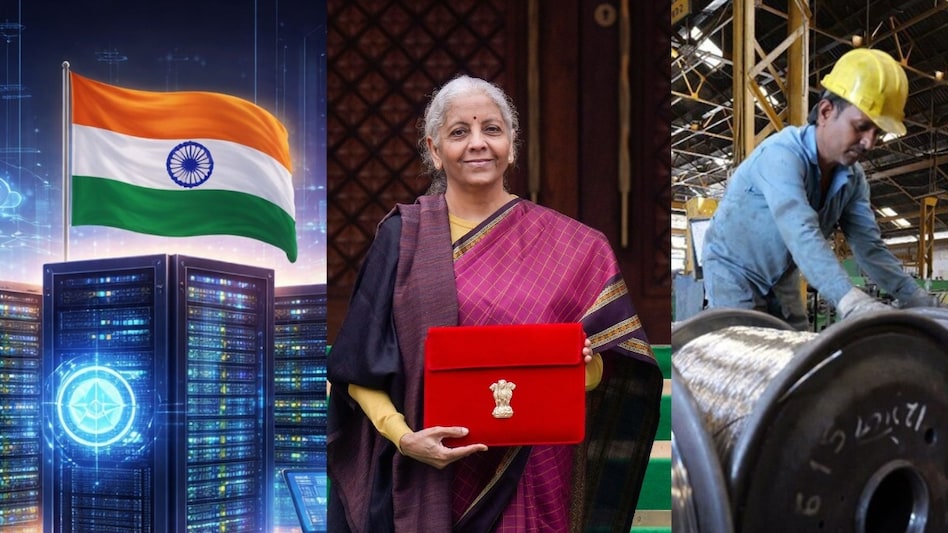 Budget 2026–27 A–Z: Viksit Bharat, youth push and customs reset, every big theme in 26 bites
 India to overtake Japan as world’s fourth-largest economy in 2027: IMF projections
 BT Explainer: What the SC verdict on Yes Bank’s AT-1 bonds means for the lender and will it alter AT1 bonds as such?
 Stock market: India back on investors’ radar as they warm to ‘non-AI stories’, says HSBC
 India’s FY27 growth seen at 7.1–7.3%, but private investment must pick up: Deloitte
 85% of housing loans now carry 7-9% interest rates, down from higher bands in 2023; what does this mean
 Market Recovery: Gaurang Shah Picks Banking, Defence, Power And Cement Stocks For Fresh Bets
 Will IDBI Employees Lose Jobs? DIPAM Secretary Arunish Chawla Clears The Air On Pension & Benefit
 Yes Bank AT1 Bond Verdict: What It Means For Bondholders, Lenders And Shareholders
 Can Goa Become India’s Next Tech Hub? Rohan Khaunte On AI, Jobs & Investment
 What’s Hot: Stocks, Gold & Big Money Moves | Daily Markets Show | October 16 | Business Today
 CCL Products shares fall 9% on Q2 results; brokerages see up to 30% upside
 PNB Q2 earnings: Net profit rises 13%, asset quality improves
  BT Explainer: What changes for investors post revision of new Closing Auction System
  PC Jeweller shares hit 52-week high; stock jumps 75% YTD; what analysts say
 Federal Bank Q2 earnings: Net profit at record high, asset quality improves












