

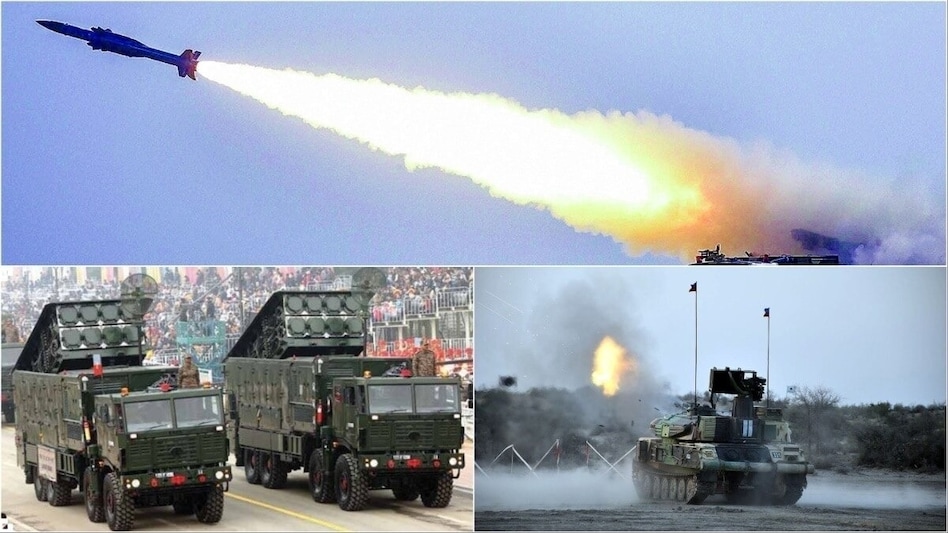
 Union Budget 2026:According to experts, the defence sector is set for greater focus, supported by the Centre’s creation of a committee to boost allied defence capabilities.
As Finance Minister Nirmala Sitharaman prepares to present the Union Budget for FY 2026–27 on Sunday, February 1, market participants expect the government to place strong emphasis on priority sectors that can drive long-term growth and strategic resilience. Among them, the defence sector is emerging as a key area of focus.
Experts point to the Centre’s recent move to form a dedicated committee to strengthen allied defence capabilities as a signal of sustained policy intent. According to Pranay Aggarwal, Director and CEO of Stoxkart, Budget support could accelerate the sector’s growth if it prioritises indigenisation and exports.
“Expanding the Positive Indigenisation Lists, strengthening defence industrial corridors with fiscal incentives and infrastructure, simplifying licensing and export procedures, and increasing allocations for R&D and technology transfer can significantly boost the sector,” Aggarwal said. He added that targeted export incentives and credit support would be crucial to scaling defence exports over the long term.
In the Union Budget 2025–26, the government allocated ₹6.81 lakh crore ($81 billion) to the Ministry of Defence, marking a 9.5% increase from the previous year. With rising geopolitical tensions—from conflicts in the Middle East to global strategic realignments—experts believe defence spending could rise further in the upcoming Budget.
Market participants are now anticipating a 20% increase in defence allocations. “We are in a particularly tough neighbourhood and will be seeking closer to a 20% higher allocation,” Mahesh M Ojha, VP (Research & Business Development) at Kantilal Chaganlal Securities, said, referring to Defence Secretary Rajesh Kumar Singh’s remarks last November on moving beyond incremental 10% annual increases.
Ravi Singh, Chief Research Officer at Master Capital Services, expects the Budget to reinforce support for indigenisation through higher capital expenditure, stronger preference for domestic procurement, and policies that encourage exports. “Measures that speed up procurement timelines or provide long-term order visibility would be especially helpful,” Singh noted. He also highlighted the importance of export financing support and government-backed deals to help Indian firms compete globally.
Within the sector, defence electronics and aerospace are expected to benefit the most, given the growing reliance on advanced electronics, sensors, radars, missiles, aircraft, and engine programmes. Aggarwal believes companies with strong execution capabilities and policy tailwinds—particularly in aerospace, defence electronics, and naval shipbuilding—are best positioned for long-term growth.
Singh added that select players such as HAL, BEL, and BDL could see stronger growth as outsourcing rises and exports gather momentum, cautioning investors to focus on execution and alignment with the government’s indigenisation roadmap rather than short-term Budget reactions.
 Where are the jobs: Youth unemployment remains high; fewer jobs for those with higher education in India
 Infosys, OFSS, Coforge shares rally up to 4%; all 10 Nifty IT index stocks rise
 Nitin Gadkari moves Bombay High Court against viral E20 deepfakes, hits Meta with suit
  Brezza goes turbo: Maruti Suzuki packs more power, more tech to woo Gen Z SUV buyers with a starting price tag of ₹7.4 lakh
 Tata Consumer stock: Tata Group's FMCG arm reacts to Q1 earnings show
  Top Small-Cap Bets Revealed! Why InCred Asset Management Is Bullish On These Stocks
 Fund Manager Reveals Top Portfolio Bets! Stocks Backed For Long-Term Growth
 PM Modi's 3 Key Announcements For Students | Exam Reforms, Fast-Track Courts, & Nandan Nilekani
 CJP Protest Ends As Pradhan Steps Down, Tougher Anti-Leak Bill Set For Parliament
 Upcoming IPO Boom: Why Investors Should Not Apply For Every New IPO Blindly
 Upcoming IPOs: Zepto, Shiprocket, Truhome & others eye to raise Rs 25,000 crore in August
 Caliber Mining shares extend rally, jump 18% to hit fresh high after strong listing; analysts advise caution
 Healthcare sector: Bullish on HCG, Thyrocare and FDC shares, says InCred AMC CIO Infosys, OFSS, Coforge shares rally up to 4%; all 10 Nifty IT index stocks rise
 Infosys fined €175,000 by French authority over employee time tracking system; says no material business impact
 Apple may stop accepting iPhone Upgrade Program sign-ups; New ‘Apple Upgrade’ plan coming this week
 Govt says youth employment indicators improved in 2025; unemployment rate falls to 9.9%Top Small-Cap Bets Revealed! Why InCred Asset Management Is Bullish On These Stocks
 Virat Kohli surprises Jos Buttler with One8 shoes, Instagram erupts in joyFund Manager Reveals Top Portfolio Bets! Stocks Backed For Long-Term Growth









