From 're-arm Europe' to AI warfare: Bharat Forge's Amit Kalyani maps risks, opportunities at Davos 2026
From 're-arm Europe' to AI warfare: Bharat Forge's Amit Kalyani maps risks, opportunities at Davos 2026
Speaking to Business Today on the sidelines of the forum, Bharat Forge Vice Chairman and Joint Managing Director Amit Kalyani said the usual confidence associated with Davos has given way to visible anxiety
Global business leaders arriving at the World Economic Forum in Davos are confronting a sharply altered mood, with geopolitical risk, trade tensions, and defence spending now dominating boardroom calculations.
Speaking to Business Today on the sidelines of the forum, Bharat Forge Vice Chairman and Joint Managing Director Amit Kalyani said the usual confidence associated with Davos has given way to visible anxiety, as companies reassess markets, supply chains and investment priorities in an increasingly unstable world.
“People are walking with slumped shoulders. There is concern everywhere,” Amit Kalyani, Vice Chairman and Joint Managing Director of Bharat Forge, said in a conversation with Business Today. “The air of confidence and buoyancy that you would normally associate with Davos just isn’t there.”
Tariffs, geopolitical issues emerge as great obstacles for Business leaders
Speaking against a backdrop of geopolitical instability, trade tensions and slowing global confidence, Kalyani talked about how business leaders are grappling with risks that were barely on the radar a few years ago.
“The worries range from geopolitics to tariff issues to uncertainty about where the next flashpoint might emerge. Many of these are risks that businesses didn’t even have to think about earlier,” he said.
Advertisement
Europe under major stress
Europe, long seen as a stable market, is now facing its own stress test. “Europe itself is under stress, questions around defence spending, who will protect Europe going forward, and now the emerging tariff tensions between Europe and the US,” Kalyani noted, adding that this uncertainty is forcing companies to rethink both markets and supply chains.
For Bharat Forge, the response has been twofold. “First, we are increasing our focus on India. It is the fastest-growing major economy in the world, and the opportunity there is enormous,” he said. At the same time, the company is positioning itself in sectors where new demand is emerging globally, particularly in defence.
“The whole ‘re-arm Europe’ theme creates large opportunities, both to manufacture in Europe and supply locally, and to manufacture outside Europe and supply into it,” Kalyani said.
Advertisement
He outlined the scale of the opportunity in stark terms. Europe’s GDP is roughly $18 trillion. “If defence spending moves to even 2.5–4% of GDP, that’s roughly $400–$780 billion. Today, Europe spends under $200 billion,” he said. “That gap represents massive capex and opex requirements. Europe cannot meet this demand alone.”
A shift from traditional suppliers
This, he argued, is already reshaping global defence partnerships. “Countries are looking beyond traditional suppliers, not just for defence equipment, but for political and strategic support as well,” Kalyani said. “If India wants to be a serious global defence exporter, we also need to leverage political relationships and financial instruments to support our industry.”
When asked what kind of support would matter most, his answer was blunt. “Credit. Simple as that.” Drawing a comparison with China, he said, “China has mastered this. They provide lines of credit, build infrastructure, and supply equipment across Asia, Africa, and beyond. We are competing with them.”
US in the long run
On the United States, Kalyani said the push to reshore manufacturing faces structural constraints. “The reality is that the US lacks basic manufacturing ingredients, raw materials and skilled talent,” he said, pointing out that US steel capacity is lower than India’s despite the economy being many times larger. “Their virgin aluminium production capacity is effectively zero.”
Advertisement
“Unless the US builds capacity in raw materials and develops a new manufacturing talent pool, this shift will be very hard,” he said, adding that America “stopped focusing on manufacturing nearly 35 years ago” and has “lost more than a generation of skills.” While artificial intelligence can improve productivity, “the structural gaps remain,” he cautioned.
Where does India stand?
On India’s defence preparedness, particularly after Operation Sindoor, Kalyani said there is now greater clarity and urgency. “There is far greater clarity now on what we are up against, technologically and strategically,” he said. “Make in India, Buy and Make India, partnerships with DRDO, all of this has accelerated.”
He pointed to a decisive shift after 2014. “Orders were once the missing link. That changed after 2014, especially when Manohar Parrikar became defence minister and put enabling policies in place,” Kalyani said. “That momentum has continued, with strong backing from the Prime Minister, the government, and the armed forces.”
On air power, however, he struck a realistic note. “Realistically, we are about ten years away” from being a first-rate domestic manufacturer of advanced fighter jets, he said. The AMCA programme would be a turning point, “because it brings private players in as prime manufacturers.” But in the interim, “we are short of aircraft today, and that’s why acquisitions like Rafale, or an equivalent, are unavoidable.”
Advertisement
AI-warfare
Looking ahead, he said, the nature of warfare itself is changing. “Future wars will be decided before the first bullet is fired,” Kalyani said. “Cyber operations, social destabilisation, drones, AI: all of these will weaken an opponent long before physical conflict begins.”
As warfare becomes more asymmetric and technology-driven, Kalyani said, “AI-enabled drone swarms, integrated with conventional weapons, can reduce collateral damage while improving effectiveness.” That, he added, “is where warfare is headed.”
Sonali is a journalist and Senior Sub Editor at Business Today, leading the NRI and Education sections with a keen focus on visas and global mobility trends. She delivers accessible, actionable stories on visa reforms, travel opportunities, and the experiences of Indians abroad. Beyond the newsroom, Sonali is an avid singer and passionate food and travel enthusiast, often drawing inspiration from her journeys and culinary discoveries. Her work combines in-depth reporting with a love for exploring cultures, making her stories especially relevant for readers navigating global opportunities.



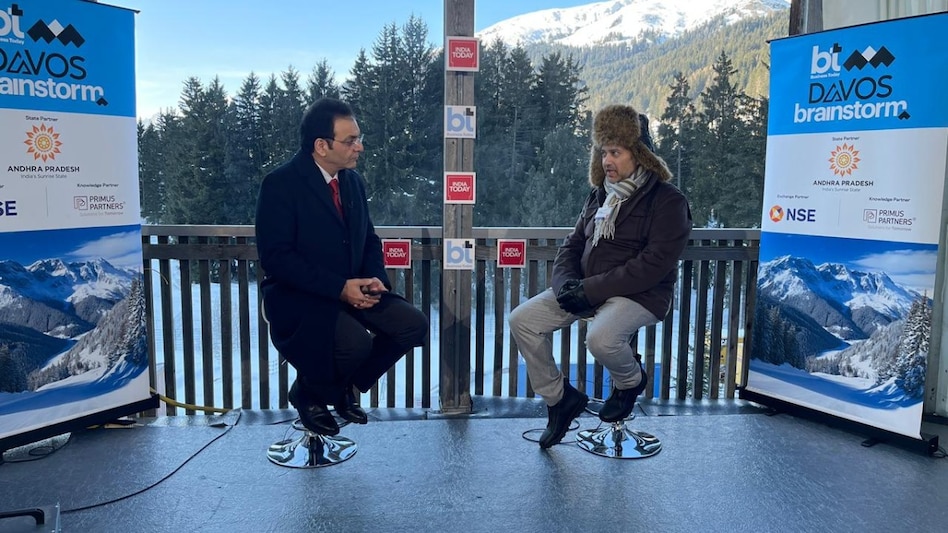 Wef 2026: Amit Kalyani, Vice Chairman & Joint Managing Director, Bharat Forge
 TCS to acquire Porsche’s IT consulting arm MHP for €320 million, signs five-year strategic deal
 Tata Sons board likely to meet on September 17, Chandrasekaran exit may take center stage
 'Our trade is growing again, thanks to PM Modi': Putin tells EAM Jaishankar
 Trade war escalates: Trump announces 50% tariffs on Canadian autos & steel from Jan 1
 Saudi attacked by Houthis, Turkey targeted by Israel: So what is the Mecca Pact doing?
 Market Masters | Aniruddha Sarkar On Top Sectors, Market Outlook & Where To Invest
 Daily Calls: Ask Your STOCK MARKET TODAY QUERIES | Market Update | Share Market News Today
 All About Debt Funds: Types Of Debt Funds & How To Invest | Mutual Fund Guide | Money Today
 “India Can Attract Global Space Talent Like A Magnet”: PM Modi To Startup CEOs
 CM Yogi Responds To Rahul Gandhi Over Manusmriti Remarks, India's Youth, And Heritage
 Tempsens Instruments IPO: Issue subscribed over 184 times on final day; check latest GMP
 Cupid's Aditya Kumar Halwasiya ups stake to 33.53%; buys 11 lakh shares
 Auto, auto ancillary stocks: Is it time to book profits? What Centrum's Nilesh Jain says
 This mid-cap metal stock zooms 15% on Rs 2,700 crore order announcement; do you own?
 RVNL shares a buy? Accumulate railway stock as valuations cool, says Kranthi Bathini
 FCNR(B) deposits: IDFC FIRST, IndusInd offer 6.75%; top PSU banks offer 6.60% as RBI forex window nears closure
 ₹5 lakh crore flexi-cap universe reveals wide risk gap: Here’s how 22 funds are positioned
 Gurugram issues work-from-home advisory for Tuesday following heavy rain and flooding
 Tarique Rahman's Bangladesh is returning to BNP's Islamist roots, warns Brahma Chellaney
 ‘The real life batman’: Rahul Gandhi posters featuring LoP & caped crusader put up near Congress HQ












