


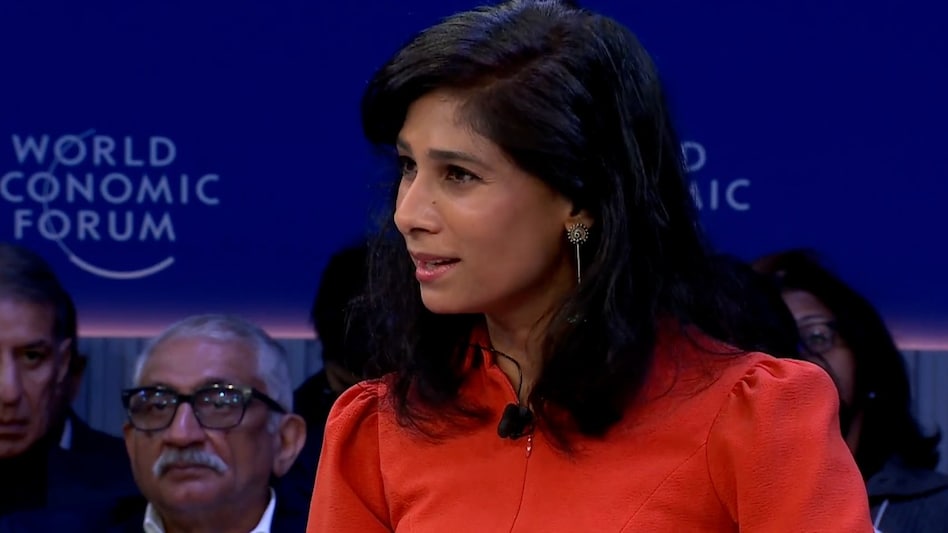
 WEF Davos 2026: Gita Gopinath served as IMF Chief Economist from 2019 to 2022 and later as Deputy Managing Director from 2022 to 2025
Economist Gita Gopinath has said that, during her time at the International Monetary Fund, she found no evidence to suggest that India's GDP numbers were flawed. Gopinath, who served as IMF Chief Economist from 2019 to 2022 and later as Deputy Managing Director from 2022 to 2025, made the remarks while speaking to India Today's Rajdeep Sardesai on the sidelines of the World Economic Forum in Davos.
"When I was chief economist of the IMF, we used to ask ourselves this question all the time. And the truth is, for pretty much most emerging and developing countries of the world, they would get close to a C-grade on their national account statistics. Because they don't have very good producer price indices, they don't do the right kind of double deflation that needs to be done and so on," she said.
Gopinath explained that the IMF routinely looks beyond headline GDP figures, examining high-frequency indicators to check for inconsistencies or warning signs. Based on those assessments, she said India's data did not stand out negatively. "So when you try to look at other kinds of high-frequency data, and we didn't see any smoking gun evidence that there was something particularly bad about India's GDP numbers versus any other countries," she said.
Asked why the Fund assigned a C-grade if it did not necessarily indicate a serious problem, Gopinath clarified that the grading framework is absolute, not comparative. "The grades are an absolute measure, not a relative measure. My previous point was that most emerging markets find themselves in that bracket because they don't have the national statistics being done the way it can be done. That requires investment," she said.
The economist added that the IMF is already working with Indian authorities to address these gaps. "IMF is working together with the Indian statistics office to improve on this kind of data collection," she said, pointing to ongoing efforts to strengthen methodology and coverage.
Gopinath, currently serving as the Gregory and Ania Coffey Professor of Economics at Harvard University, also highlighted that a major rebasing exercise is currently underway, which could significantly improve data quality going forward. "There's an important round that's being done right now in terms of rebasing, which will help improve the quality of the statistics," she said.
In its annual staff report for 2025, the IMF retained its C grade for India's national account statistics or GDP data, which suggested that the data provided to the Fund may have "some shortcomings that somewhat hamper surveillance."
BJP's Sanju Verma, however, said the IMF's 'C' grade is merely routine caution, not condemnation. It simply means, she added, there are broad areas that need improvement. She also said that the IMF's Asia-Pacific Department issued a statement saying the new data "validates our view that India remains the standout performer among emerging markets."
The IMF earlier this week raised its India's growth forecast for the 2025–26 financial year. In its latest outlook, the global agency revised India's GDP growth estimate for FY26 upward by 0.7 percentage points to 7.3 per cent. In its previous staff report, the IMF had projected 6.6 per cent growth for FY26.

 Tata Consumer stock: Tata Group's FMCG arm reacts to Q1 earnings show
  Sterlite Technologies: What every investor should know about the stock post Q1 earnings
  NEET to be conducted through a computer-based model? Here’s what we know
 ‘Merely because there is agitation…’: Supreme Court says right to peaceful protest is guaranteed
 BT Explainer | PVR Inox shares: Analysts bet big on Odyssey, Ramayana, Avengers & others post solid Q1
 IPO Rush Ahead! Should You Invest In Manipal Health & Upcoming IPOs? Avinash Gorakshakar Explains
 Why IndiGo Stock Is Rallying | Impact Of Falling Crude Oil On Aviation Stocks
 Pralhad Joshi Takes Charge As Education Minister | Big NTA Reforms After NEET Row
 Nirmala Sitharaman Slams Govt Apathy After Tax Dept's 50-Year Land Struggle In Mumbai
 PM Modi’s Big Message To Youth: Border Villages Are India’s First Villages
 Infosys, OFSS, Coforge shares rally up to 4%; all 10 Nifty IT index stocks rise
 Infosys fined €175,000 by French authority over employee time tracking system; says no material business impactTata Consumer stock: Tata Group's FMCG arm reacts to Q1 earnings show
  Why KFin Technologies shares surged 9% today
 Sagility shares surge 8%; brokerages retain 'Buy' despite Q1 revenue dip QoQ; check target pricesInfosys, OFSS, Coforge shares rally up to 4%; all 10 Nifty IT index stocks rise
 Nitin Gadkari moves Bombay High Court against viral E20 deepfakes, hits Meta with suit
  Delhi’s ₹6,969.67-crore tunnel corridor: Route, length and benefits explained
 Delhi to Nepal in just 8 hours! This highway project could boost tourism growthIPO Rush Ahead! Should You Invest In Manipal Health & Upcoming IPOs? Avinash Gorakshakar Explains









