


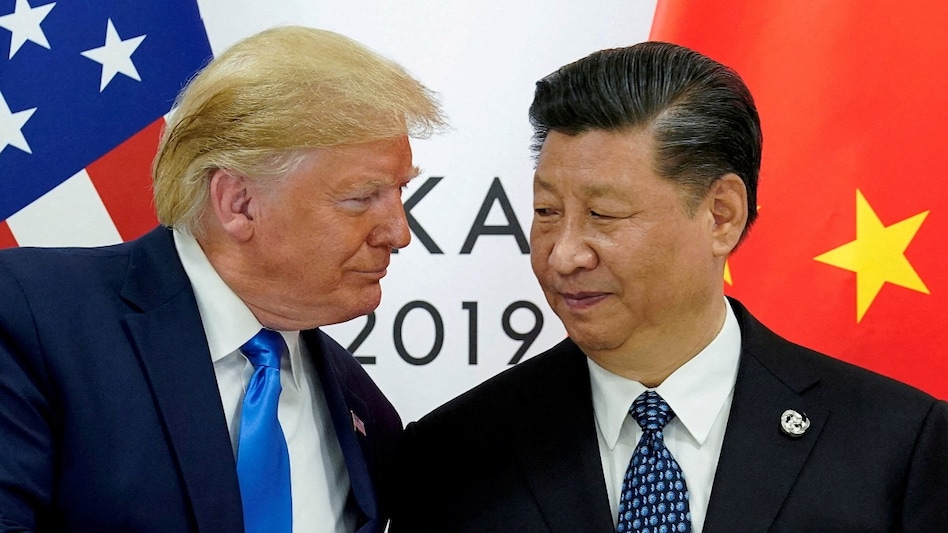
 Trump also issued a pointed warning over China’s rare earth policy, following export restrictions introduced in April.
 US President Donald Trump on Monday said the United States and China “are going to have a great relationship” — but warned that if he played the “incredible cards” at his disposal, it would “destroy China,” according to remarks made during a meeting with South Korean President Lee Jae Myung.
Speaking from the Oval Office, Trump declared that the U.S. holds a superior position in its ongoing economic contest with Beijing. “They have some cards. We have incredible cards, but I don't want to play those cards. If I play those cards, that would destroy China,” he said.

 Infosys, Tech Mahindra, TCS, Wipro: Why IT shares are down in a rising market today
  AI safety or market control? Anthropic, OpenAI, Google SpaceXAI accused of slowing AI progress
 Cyber hits to fake news: Vaishnaw warns of foul play against India’s semiconductor push
  Raymond, Welspun Living, Alok Industries shares rise up to 8%; here's why
  IIT-B prof to be summoned by police; Director signs 18-point charter amid students’ demands
 Gold Price Target 2026: Expert Sees MCX Gold At ₹1.8 Lakh By Year-End Amid Strong Demand
 Health Insurance: Why Pre-Existing Diseases And Waiting Periods Matter For Buyers
 Crude Oil Above $100: How High Energy Prices And Rupee Weakness Impact Gold Prices In India
 CEA On India’s Manufacturing Rise, Atmanirbhar Bharat And Modi’s Economic Policy
 Health Insurance Buying Guide: 7 Things First-Time Buyers Must Check Before Choosing A Policy
 Dilip Buildcon emerges L-1 bidder for Rs 1,265 crore transmission project; stock reactsRaymond, Welspun Living, Alok Industries shares rise up to 8%; here's why
  Tata Capital shares: Systematix retains 'Buy'; sees scope for valuation gap to narrow; check target
 Weather forecasting push: Ceinsys Tech, Genesys International, MapmyIndia in focus; stocks move up to 6%
 Jindal Supreme IPO: How to check allotment status on Bigshare, BSE, NSE, fresh GMP & listing dateDilip Buildcon emerges L-1 bidder for Rs 1,265 crore transmission project; stock reactsIIT-B prof to be summoned by police; Director signs 18-point charter amid students’ demandsAI safety or market control? Anthropic, OpenAI, Google SpaceXAI accused of slowing AI progressRaymond, Welspun Living, Alok Industries shares rise up to 8%; here's why Tata Capital shares: Systematix retains 'Buy'; sees scope for valuation gap to narrow; check target












