









Big mergers in banking are coming. That was something the market has been waiting for with bated breath over the last few years. SBI's merger of five associate banks and also the Mahila Bank is the only official announcement so far. The process of merger is already on. The government has already indicated consolidation in the public sector banking (PSB) space by creating three-four large banks with substantial size.
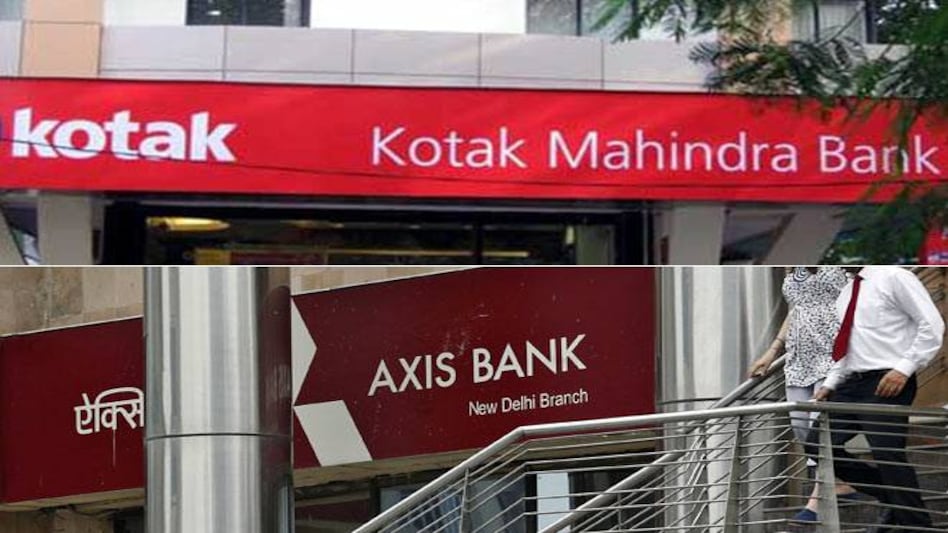
Nobody had thought of a merger possibility of two large banks in the private banking space. That too, well run Axis Bank and Kotak Mahindra Bank (it recently acquired ING Vysya Bank).
Even as the two banks have denied the merger talks as mere speculation , the market is refusing to believe them. The speculators are betting on this big merger which will create a bank of the size of ICICI Bank and HDFC Bank , with total assets of over Rs 7 lakh crore. But the merger is not all about size. On the face of it, the odds are against the merger.
1) Size no longer matters
Banking is all set to change with digitisation, big data, artificial intelligence, robotics , digital wallets and app banking. Banks no longer bet on physical infrastructure ( like branches , ATMs and people ) to acquire new customers or business. The leaner you are , the better it is for you while competing in the new changing banking space. Globally , the app only banks are a reality. In India , too , players like PayTM are creating an altogether new model of 'digital wallet' banking.
2) The next big thing is differentiated banks
The new payments banks and small finance banks are going to call the shots in the banking space by focusing on transaction and payments space. Kotak, too, has taken a stake in Airtel Payments Bank. These new banks are not planning to create a large physical infrastructure but are betting big on new technology.
3) ING Vysya merger integration
Kotak Bank has recently gulped ING Vysya , which was almost equal to the size of the bank. There are many integration challenges in such a large merger. Kotak has got SME , Agri and MNC clients and also a new geography , South of India, to explore. In such a large merger , the benefit always accrue over a longer period of time. The top priority for Kotak currently is to increase the efficiency of the new branches acquired and also improve the productivity of people. Kotak Bank has a large suite of products including insurance , mutual fund, etc. to sell through these newly acquired branches. This process itself would take 3-4 years to get the maximum out of this merger.
4) Rough operating environment
The entire banking industry is on the cusp of change. In fact , given the speed at which changes are taking place in the industry especially on the digitisation front, the banks need management bandwidth to react and also keep ahead of the change. At this juncture, the other business challenges are taking a back seat. Axis Bank , however , has been facing issues on asset quality especially in its corporate book. In fact , the bank's asset quality has been deteriorating over the last few year. The bank has a very high restructured book of close to 4 per cent of its advances. Given the challenging environment , it would be difficult to make a recovery. The resolution mechanism has also slowed down a bit. ARCs with limited capital are busy resolving the existing backlog and tools like SDR and S4A have also not seen any traction because of valuation differences and lack of buyers.
5) No new geography or product suite
The mergers always take place either for acquiring product basket or for getting a new geography. ING Vysya merger provided a huge network of branches in the South where Kotak was not present. Similarly , ING gave access to SME , Agri and MNC portfolio , where ING Vysya was strong. In case of Axis , the duo have similar presence in urban , semi-urban and rural with Kotak having larger presence in metros.
 Hormuz shut, Bab el-Mandeb next? Houthi warnings put another chokepoint at risk
  US-Israel-Iran war: Will oil prices rise on Monday? Here’s what we know
 Hours before Bengal poll dates, Mamata announces Rs 500 hike in honorarium for purohits, muezzins
 'Guests may rebook or seek refund': Air India cancels multiple UAE flights after airport restrictions
 ‘Geography favours Iran’: US Professor says Trump is caught in the ‘escalation trap’
 Golf Blends Passion With Business Conversations
 Startup Or ₹100 Cr Film: What’s Harder? Malaika Arora Answers In Rapid Fire | BT Podcast
 Will Gold Prices Hit ₹1 Lakh Again? Sachin Jain Explains The Future Of Gold
 Ashank Desai: Accountability Is Squarely On You' In Golf Just Like In Business
 Maye Musk On Motherhood, Career & Happiness | India Today Conclave 2026
 IPO listing: India tweaks IPO rules to help big tech, digital firms list with smaller stake dilution
 Stay patient during volatility, markets remain resilient despite global shocks: SEBI chief Tuhin Kanta Pandey
 Helium shortage: Dixon Tech, Lal PathLabs, Vedanta, HAL, MTAR shares take a hit; here's why
  RIL stock falls 14% from January high; what lies ahead for the index heavyweight?
 Rs 2,000 crore daily loss! OMCs take Rs 20 per litre hit on petrol, Rs 45 on diesel