









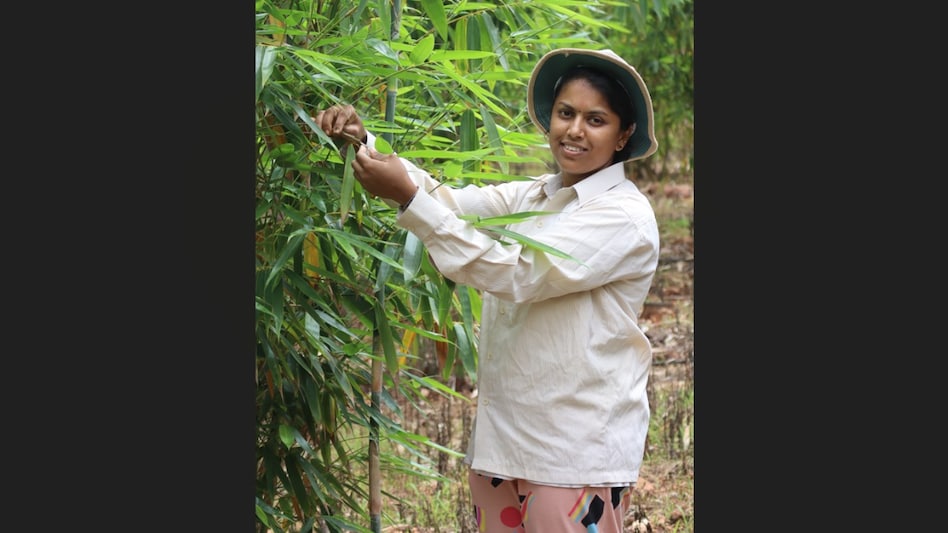
 Bamboo is one of the most strategic and scalable nature-based solutions, says Industree CEO Neju George Abraham
 Bamboo is one of the most strategic and scalable nature-based solutions, says Industree CEO Neju George Abraham
 There's a particular kind of farmland that doesn't show up in most conversations about India's agricultural future: small, fallow, often-forgotten plots at the edge of smallholder farms, too dry, too degraded, or simply too small to feed a family. It's an unglamorous problem, yet one organisation has built its biggest bet yet around exactly this patch of earth, and around a crop most people associate with scaffolding or garden fencing rather than rural prosperity.
That organisation is Industree Foundation, and the person walking through the thinking behind it is its CEO, Neju George Abraham. Ask him what convinced him bamboo deserved this scale of commitment, and he doesn't start with a market projection. He starts with land. "Bamboo sits at the unique intersection of ecological restoration and livelihood generation," he says, "making it one of the most strategic and scalable nature-based solutions for climate-resilient livelihoods." It sounds like a pitch deck line until you sit with the numbers behind it.
That plan has a quiet elegance to it. Bamboo grows where other crops struggle, needs little water or fertiliser, and sequesters carbon well enough to be genuinely climate-positive. For a farmer, the appeal is patience rewarded: "Plantations yield from the fourth year and continue for over four decades," Abraham notes, turning a single planting decision into income that outlasts a generation. Bamboo isn't a one-trick crop either, its fibre feeds furniture making, construction, textiles, and packaging, industries with steady demand, so a farmer isn't betting on one buyer or one season. It's a shift in kind too: from subsistence farming, where a bad year can mean migration, to participation in an organised, traceable value chain where a harvest has a documented path to market.
The scale Industree is attempting is hard to overstate. Working with government rural livelihood missions, the foundation aims to reach around 10 lakh smallholder women farmers, positioned as part of the Mission's "LakhpatiDidis," encouraging each to plant bamboo on up to a third of their landholding. The reasoning ties to India's land reality: 86 percent of Indian farmers are small or marginal, owning less than a hectare, and over 65 percent of those own less than an acre. "Much of this land is left fallow or becomes degraded, as it cannot meet even the basic food needs of their families," Abraham says, a gap climate stress widens through forced migration. Bamboo, in this telling, is a way of putting unproductive land back to work.
The architecture behind the ambition is just as deliberate. The plan involves 500 farmer clusters of 2,000 women each across ten to twelve states, with 30 Primary Processing Units planned over five years in Telangana, Andhra Pradesh, Odisha, Tripura, Arunachal Pradesh, and Jharkhand. Each unit, fully operational, is projected to process around 5,000 tonnes of bamboo annually, generate ₹5 to 8 crore in revenue, and employ over 50 women earning ₹15,000 to ₹20,000 a month. A woman cultivating bamboo on a third of an acre could earn an additional ₹60,000 to ₹1.2 lakh a year from previously idle land. There's a national interest angle too: scaled processing reduces India's reliance on imported raw and finished bamboo products, while giving local industries, often starved of traceable raw material, a domestic supply chain they can count on.
None of this was dreamed up overnight. The model was piloted in Karnataka and Maharashtra, refined with backing from corporate partners such as HSBC, HDFC, Rainmatter Foundation, SAP, Wells Fargo, Infosys, Citibank, BNP Paribas, IndusInd, and others, before Industree felt confident taking it nationwide under the National Rural Livelihood Mission's Bamboo Subsector Initiative. "We feel grateful to the various partners who have backed our vision and intention from the earliest phase," Abraham says.
The bamboo initiative sits inside a wider portfolio that tells a similar story of patient scaling. Industree currently runs about 50 collectives nationally, a base it intends to grow into 500 plantation clusters, 150 primary processing facilities, and 750 secondary processing facilities over the next five to ten years. Its flagship venture, GreenKraft, brings together roughly 1,800 full-time and 3,600 part-time women producers across Tamil Nadu, Odisha, and Karnataka, working with banana, sal, siali, and bamboo fibres. Abraham is particular about the language used: "We consciously move away from terms like 'craft' or 'handicraft' and instead describe this work as creative production." Industree has also secured India's first Forest Stewardship Council (FSC) certification for privately owned bamboo plantations, enabling approximately 6,671 smallholder and marginal farmers across the states of Karnataka and Maharashtra to obtain FSC certification and access international export markets for their bamboo.
Ask him which numbers matter most, and Abraham points to a very different set of metrics, namely people. "Over 65 percent of them are employed for the first time," he says, "and 90 percent are either primary school educated or illiterate." Most, working with Industree for three to four years, see incomes double or triple. That growth is now being institutionalised through Regenearth, a cohort-based capacity-building programme built around the organisation's 6C framework, Construct, Capacity, Capital, Create, Channel, and Connect, paired with a Learn-Experience-Apply-Practice pedagogy for building value chains that last.
For an industry often discussed in pilots and proofs of concept, what Abraham describes feels distinctly past that stage. The question isn't whether bamboo works as a livelihood model, Karnataka and Maharashtra answered that. It's whether India's processing infrastructure, market linkages, and policy support can keep pace with how fast Industree intends to grow it.
 After WhatsApp, Telegram and Signal face government scrutiny over ‘usernames’ features
 'Iran agreed to just about everything': Trump claims deal close as Doha talks skip nuclear issue
 Mojtaba Khamenei unlikely to attend father Ayatollah Ali Khamenei’s funeral: Iranian representative
 Virtual digital assets like cryptocurrency a threat to economy: RBI tells parliamentary panel
 US alerted Iran of Israeli plot to assassinate top peace deal negotiators: Report
 EPF Overhaul: Voluntary Contributions Above ₹1,800, New Withdrawal Rules Explained
 Raipur Demolition Row: 90+ Families Homeless For MLA Colony, Villagers Protest Amid Tears!
 Market Volatility Ahead? Fund Manager Sunil Shah Reveals His Portfolio Strategy & Top Investment Bet
 Silver Supply Crisis In India? Physical Market Premiums Rise As Imports Slow
 Kunal Shah Says, Gold May Rally Ahead After Recent Correction | Check Upside Potential
 Bank of Baroda shares slide 8% in two days: What's weighing on the stock?
 Nestle India announces special dividend FY26: Check dividend amount, record date
 Coforge, Mphasis, Hexaware, TechM, LTM, Infosys, TCS among Nuvama's top IT stock picks
 KPIT Technologies shares: Price targets and earnings expectations post weak Q1 guidance
  PC Jeweller shares extend gains: Here's why the stock is rising