









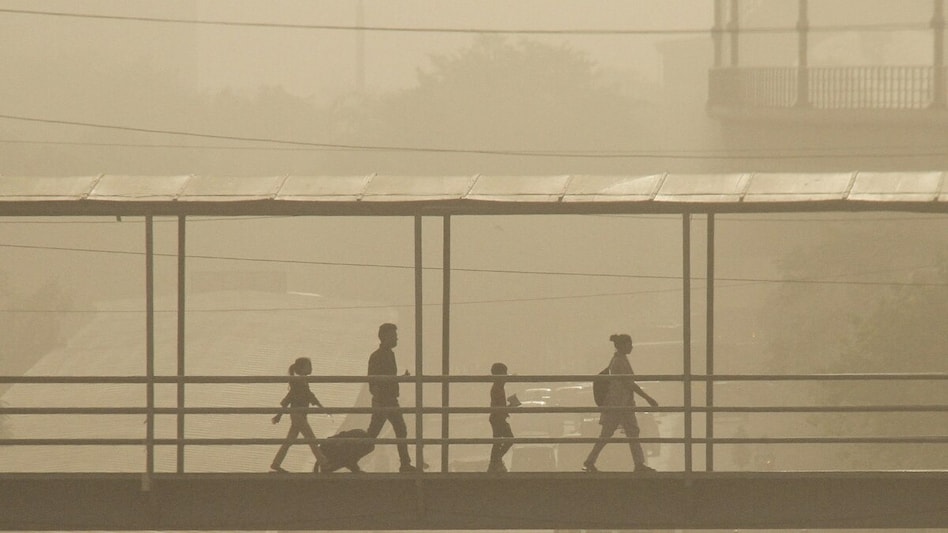
 Five Indian cities including Loni, Byrnihat, Delhi, Ghaziabad and Ula featured among the world’s ten most polluted.
 Five Indian cities including Loni, Byrnihat, Delhi, Ghaziabad and Ula featured among the world’s ten most polluted.
The World Air Quality Report 2025 released on Tuesday ranking India as the sixth most polluted country, with Uttar Pradesh’s Loni identified as the most polluted city in the world and Delhi placed fourth.
Published by Swiss air quality technology company IQAir, the report analysed data from monitoring stations across 9,446 cities in 143 countries, regions and territories.
Pakistan was ranked the most polluted country, followed by Bangladesh, Tajikistan, Chad and Congo, with India at sixth.
Five Indian cities including Loni, Byrnihat, Delhi, Ghaziabad and Ula featured among the world’s ten most polluted.
“The world's 25 most polluted cities were all located in India, Pakistan and China, with India home to three of the four most polluted. Loni, India, was the most polluted city, recording an annual average PM2.5 concentration of 112.5 µg/m³, a nearly 23 per cent increase from 2024 and more than 22 times the WHO guideline,” the report said.
The global trend remained mixed. Compared with last year, 54 countries recorded a rise in annual PM2.5 levels, while 75 saw a decline. Two countries remained unchanged and 12 were newly added to the dataset.
Only 14 per cent of cities worldwide met the World Health Organization’s annual PM2.5 guideline of 5 µg/m³, down from 17 per cent the previous year.
As per the report, only thirteen countries or territories met the WHO annual average PM2.5 guideline, French Polynesia, Puerto Rico, US Virgin Islands, Barbados, New Caledonia, Iceland, Bermuda, Réunion, Andorra, Australia, Grenada, Panama, Estonia.
Wildfires, intensified by climate change, were a major factor affecting air quality in 2025.
Record biomass emissions from Europe and Canada contributed about 1,380 megatons of carbon.
Canada recorded its second worst wildfire season, making it the most polluted country in North America for only the second time in the report’s eight-year history. The impact spread across parts of the United States and Europe.
Across Europe, 23 countries recorded a rise in PM2.5 levels, while 18 saw a drop. Switzerland and Greece saw increases of over 30 per cent due to wildfire smoke and Saharan dust, while Malta recorded the largest decline at nearly 24 per cent.
The report also flagged concerns over reduced monitoring. The end of the US State Department’s global air quality monitoring programme at embassies and consulates in March 2025 affected access to data for millions.
The Centre for Research on Energy and Clean Air said monitoring efforts weakened in 44 countries, with six left without any systems.
(With inputs from PTI)
 Centre to launch new series WPI, producer price indices on June 15
 Oyo parent Prism gets Sebi nod for ₹6,650-cr IPO; eyes $7-8 bn valuation
 Mother Dairy expects 5% growth in FY27; eyes expansion beyond Delhi-NCR
 IT stocks stage a comeback: Five factors supporting the strong upmove
 ‘This is an incredible time to be a…’: Nvidia CEO Jensen Huang said on ‘SaaSpocalypse’
 From Global Uncertainty To India's Opportunity: The Big Economic Outlook
 Godrej Industries Is Entering The Wealth Management Space As It Looks To Scale Up Financial Services
 SIP Vs SWP: The Two-Step Mutual Fund Strategy That Could Help Become A Millionaire & Retire Early?
 Daily Calls LIVE: Ask Your STOCK MARKET TODAY QUERIES | Market Update LIVE | Share Market News Today
 Retired At 39! How Sanjay Kathuria Turned A ₹2,000 SIP Into Complete Financial Freedom
 Tata Tech, Bharti Airtel, PFC, BLS International shares: Should you enter at current levels?Oyo parent Prism gets Sebi nod for ₹6,650-cr IPO; eyes $7-8 bn valuation
 Rs 75/share dividend by Tata Group stock – Record date next week IT stocks stage a comeback: Five factors supporting the strong upmove
 CMR Green Technologies IPO: GMP zooms 130% in a week; should you subscribe?