








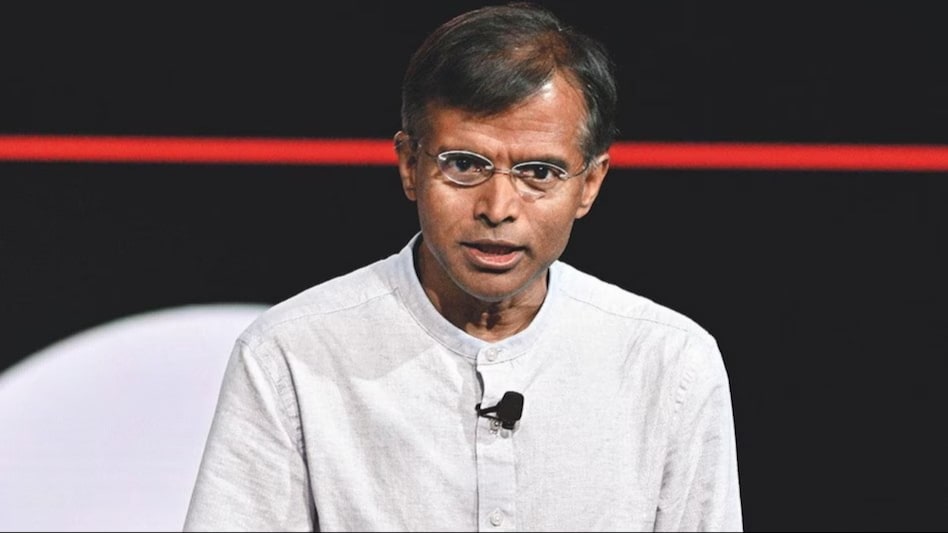
 Despite all the challenges, Damodaran said he was upbeat about India as it was uniquely positioned.
 Despite all the challenges, Damodaran said he was upbeat about India as it was uniquely positioned.
Valuation guru Aswath Damodaran has said he visits India once a year which allows him to observe the changes, both good and bad, that have taken place in the country. Among things that have turned worse, Damodaran cited the condition of the traffic, particularly in Chennai, where he grew up. In the Sensei Kujaku podcast, aired last month, the professor at New York University's Stern School of Business said everyone knew it was a problem and needed to be fixed.
“India has an infrastructure problem. We all know it. You know it the minute you step out of the office because to get home it takes you four times as long as it did 20 years ago and 10 times as long as it did 40 years ago. Why? Because the roads look exactly the same in Chennai, in the city,” Damodaran said.
Damodaran confessed he did not enjoy doing much during his visits because of the bad traffic condition. He added that highways aside not much had changed in the city’s roadways.
“I know the highways have been upgraded but when I go back to Chennai and I look at those roadways they look exactly like the roads I grew up in the 1970s, when there were 120th the number of cars. I confess, I don't much enjoy doing anything in India because everything becomes a production. Going to the restaurant becomes a four hour round trip. It’s an hour and a half drive and it's a seven mile drive, five mile drive. You're stuck.”
Damodaran mentioned that if India had to step up to as the driving force behind global GDP growth, these issues had to fixed.
“This is an infrastructure problem and if India wants to step into the bridge those problems need fixing. We know it. We all know it,” he said. “I know the government tries but this has got to be something that is more systemic. It's built into every level. And it's got to be done faster,” he added.
He said he had left in India in 1979 and had been observing the changes that had take place since then during his visits.
“I mean the advantage I have is I fly to India one week every year. To me, the India I left in 1979 is still the India that frames references for me. I can see the things that have changed, how they've changed for the better or the worse. I mentioned the traffic as being for the worst, but there are lots of things that have changed for the better.”
“There are lots of things Indians should feel good about that have changed over the last 40 years. In the last 40 years, more people have been moved out of poverty in India than in the previous two thousand years put together. Something fundamental changed in India. And I think that that's got to be celebrated even as we start asking the question what do we need to do better? I think we need to think about the things that have changed for the better.”
‘CHINA IS DONE’
Even as he called out the challenges, Damodaran acknowledged India was the only contender to drive the next round of global economic growth. He attributed India’s potential to the country’s population.
“This is an extraordinary time for India. If you think about the last 25 years, half of all global GDP growth came from China. China can't pull that off anymore. They're done. So, the question is: Who's next? And let's face it, there's only one candidate here. Can't be Brazil, it can't be Eastern Europe, it has to be India, simply because the numbers.”
“It's not even something that India earned to get at the table. A billion and a half people gives you a place at the table that no other country can have. It's well positioned but it's not guaranteed. Things have to work.”
‘OVERBLOWN BY HINDENBURG’
Damodaran also spoke on corporate India. He cited the fixation of big corporate families to keep control as one of the weak links in the India growth story.
“Part of the India story is a lot of Indian companies are still controlled by a family group, by an insider, by an individual who doesn't want to let go and that can create negative consequences…Remember, if you own 74% of a company you have complete control, what's this fixation about wanting to control 78% of the company? What's the extra 4% doing?”
“When I wrote about the Adani group last year and people critiqued me saying you know you're Indian how can you say bad things about India. I think it's precisely because I'm Indian that I want to push at what I call the weakest links in the India story. And [in] many ways the Adani fiasco, and I think it was vastly overblown by Hindenburg, because it is something that a lot of family groups in India do, pushes at the weakest links in the India story.”
Last year, Damodaran had said short seller Hindenburg's description of Adani as ‘the biggest con’ in history was a ‘hyperbole’ but Adani Group had “exploited the seams and weakest links in the India story, to its advantage, and that there are lessons for the nation as a whole, as it looks towards what it hopes will be its decade of growth”. Adani Group had denied all allegations made by Hindenburg.
‘CORRUPT BUREAUCRATS, SLOW LEGAL SYSTEM’
Among other 'weak links' in the India story, the NYU professor flagged the reluctance of bureaucrats to take action and a slow legal system.
“It's a country where I think bureaucrats, some of them are corrupt, but a lot of them just don't want to make decisions because you get all downside, no upside. Because you make a bad decision, people pounce on you. Make no decision, then nothing happens to you. So, everything gets pushed through. The old days was just files being pushed through by bureaucrats, in the new days it's digital files being pushed through.”
“The final thing about the Indian system is you got a legal system that's incredibly slow to act. For any kind of organised functioning economy, you need legal system that's not just effective but timely. So, we know what the weak links are. They can be fixed. They'll need resources. And I think India while its position needs to work on its weakest links.”
‘UPBEAT ABOUT INDIA’
Despite all the challenges, Damodaran said he was upbeat about India as it was uniquely positioned, but warned it should not focus only on the positives.
“Don't keep selling me that you have a billion and a half consumers, that you have a middle class. I know that. That's your good side, I need to know what you're doing to work on your bad side. The side that is getting in the way of being the next great growth engine for the world. But I think India is uniquely positioned to be that growth engine.”
“I'm upbeat about India as a country, but it doesn't mean I'm going to buy every Indian stock that comes along because the market is already priced in that story. And when you're priced to deliver perfection, there's not much I can hope for as an upside. Only bad surprises can hang out there.”
 SEBI draws line between listing norms and RBI rules in guidance to PNB
 Cyber attacks, AI misuse and data privacy rules emerge as top boardroom risks for India Inc
 'India has played it pretty safe, deal is very balanced': Top agri economist on India–US trade agreement
 Funding Viksit Bharat: Govt to set up high-level panel to prepare banks for big-ticket growth
 'Uncomfortable subtext is conditionality': Ex-foreign secretary on US monitoring clause for Russian oil
 BT Golf 2025-26 Kochi, Kerala Awards Ceremony Marks A High-Energy, Successful Conclusion
 Golf Is An Addiction. We Eat And Sleep Golf!
 The Fairway Fixes Everything. Mindset, Life, Relationships
 BT Golf LIVE: Join AU Small Finance Bank Presents BT Golf 2025-26 For Its 4th Leg In Kochi, Kerala
 AI Will Change MBAs, Not Leadership: IMD President On India’s Global Education Rise
 RIL, SBI, Kotak Bank, Kalyan, HAL, BEML, BDL among stocks in focus next week; here’s why
 NSE IPO may unlock mega gains for billionaire investors RK Damani, Premji
 SBI Q3 Results: Profit jumps 24% to Rs 21,028 crore; asset quality improves
 IDBI Bank stake sale: Kotak Mahindra Bank says ‘has not submitted a financial bid’
 BDL, Mazagon Dock, MRF, Hindustan Copper, RVNL, others to turn ex-dividend next week