


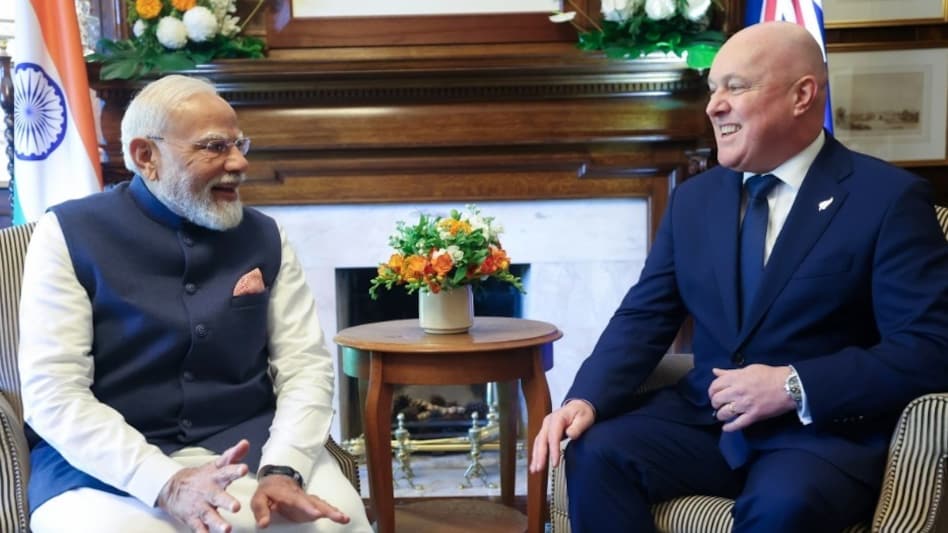
 The visit followed the recent signing of the India–New Zealand Free Trade Agreement (FTA).
India and New Zealand on Saturday took a major step towards deepening their partnership, signalling a shared vision for stronger economic and strategic ties in an increasingly uncertain global landscape. Following talks between Prime Minister Narendra Modi and his New Zealand counterpart Christopher Luxon, the two countries elevated their relationship to a strategic partnership and set an ambitious target of doubling annual bilateral trade in goods and services to Rs 35,000 crore by 2030.
The meeting yielded 18 concrete outcomes, including 10 agreements. Among the key announcements were a roadmap to expand bilateral ties over the next four years, a framework to enhance Indo-Pacific maritime cooperation, and a reciprocal logistics support pact between the Indian Navy and the New Zealand Defence Force.

 HDFC Bank's new CEO Anup Bagchi faces two big tests: Governance and investor trust as stock slides 27%
 Noel Tata reached out to India's top business tycoons ahead of Tata Sons board showdown: Report
 Elon Musk is back in Trump's government. His new Pentagon job: Study the future of war
 HDFC Bank appoints Anup Bagchi as MD & CEO for three-year term from October 27
 Global bond yields hit multi-decade highs as oil, inflation and debt worries mount: Report
 Oral GLP-1 Drugs: Novo Nordisk, Eli Lilly Eye India Launch In 2027 | Pharma Stocks In Focus
 U.S. Leaves Iraq After 23 Years: Who Will Fill The Power Vacuum?
  IOC Buys Iraqi Crude At $32 Discount: What It Means For Refining Margins & Profitability
 New-Age Stocks: Why Quick Commerce Could Be The Next Big Consumption Opportunity
 CDMO Stocks: Why The Sector Could See Strong Long-Term Growth
 Goldman Sachs pushes back on 'short-AI' India narrative, says report; 42 stocks in focus
 PB Fintech shares crash 48% in six sessions; stock barely holds above IPO price
 Welspun Living shares gain 5%; Jefferies retains 'Buy' call; check target price
 Nifty extends slide to eighth straight week, longest in 25 years; TMPV, Maruti, M&M, Jio Financial among top drags
 Rs 2.7 lakh crore gone! Tata Sons tussle wipes out 10% value of Tata group stocks
 Mahindra, Embraer advance plans for C-390 military transport aircraft in India, pick Nagpur for assemblyElon Musk is back in Trump's government. His new Pentagon job: Study the future of war
 ICC World Cup 2027: Check India's full match list, Men in Blue to face Australia, Pakistan in 'Group A'
 India's power deficit hits 10-year Sept high as weak monsoon drains hydropower and heat lifts demand
 ICC World Cup 2027 schedule announced: India's first clash with Australia on Oct 7; final on November 21












