The transformation has been driven by rising incomes, economic liberalisation, market competition, technological innovation and government policy. Together, they have turned air conditioning into one of India's biggest consumer growth stories while making it increasingly energy efficient.
Income threshold that unlocked demand
India's AC boom began when household incomes crossed a crucial affordability threshold.
Economists describe air conditioners as a "threshold good" — a product that sees limited demand until incomes reach a certain level. In India, adoption accelerated once GDP per capita crossed roughly $1,300-1,600.
Higher disposable incomes, rapid urbanisation and wider electrification expanded the customer base, while competition steadily lowered prices. As a result, air conditioners shifted from aspirational purchases to mainstream household appliances.
By 2040, nearly one in two Indian homes is projected to own an AC, making cooling one of the country's defining consumer growth stories.
Competition transformed the market
Three decades ago, Indian consumers had only four AC brands to choose from.
Economic liberalisation opened the market to global manufacturers and encouraged domestic production. Today, more than 65 brands compete across premium, mid-range and budget segments.
Competition delivered exactly what markets are expected to do: lower prices, better products and faster innovation. Consumers now benefit from improved cooling performance, higher energy efficiency, inverter technology and far greater choice than ever before.
From window units to smart cooling
India's cooling journey began with imported window air conditioners in the 1950s, largely serving hotels, cinemas and government buildings.
The market evolved steadily, but the biggest shift came after the 1990s. Split ACs overtook window units, inverter technology sharply reduced electricity consumption, and smart features improved convenience. At the same time, stricter efficiency standards pushed manufacturers to deliver more cooling with less power.
Modern air conditioners are quieter, smarter and significantly cheaper to operate than earlier generations.
Reliable electricity made the AC boom possible
Growing demand alone could not have created India's cooling revolution.
In the early 2000s, double-digit electricity shortages meant frequent summer power cuts, limiting the usefulness of air conditioners.
Years of investment in power generation, transmission and grid modernisation have transformed that picture. India's electricity deficit has effectively fallen to zero, making reliable cooling a practical reality rather than an occasional luxury.
Without a stronger power system, India's expanding AC market would not have been possible.
Policy focused on better cooling, not less cooling
India's approach has centred on improving efficiency rather than discouraging air-conditioner ownership.
Over the past two decades, policymakers have steadily tightened standards through BEE star labelling, the India Cooling Action Plan, higher minimum energy performance standards and production-linked incentives for domestic manufacturing.
The strategy has been straightforward: ensure every new generation of air conditioners consumes less electricity while remaining affordable. Instead of restricting access to cooling, policy has encouraged cleaner and more efficient cooling.
Efficiency can flatten future power demand
Research shows that stronger efficiency standards could significantly reduce electricity demand even as AC ownership continues to rise.
Under a business-as-usual scenario, room AC electricity consumption could reach 341 TWh by the mid-2030s. Accelerated efficiency improvements could limit demand to about 223 TWh, saving well over 100 TWh every year.
Those savings would reduce pressure on the grid, lower electricity bills and avoid the need for substantial new power generation. The solution is not fewer air conditioners — it is better ones.
Better ACs also cut emissions
Efficiency improvements would also deliver major climate benefits. Business-as-usual projections suggest room air conditioners could emit around 142 million tonnes of CO₂ by the mid-2030s. Faster adoption of efficient technologies could reduce that figure to roughly 93 million tonnes — nearly 35% lower while millions of additional households gain access to cooling.
India's experience shows that expanding access to cooling and reducing emissions do not have to be competing goals.
A different path from Europe
India's cooling debate differs sharply from that in many developed economies.
Despite experiencing significantly higher average temperatures than much of Southern Europe, India's household AC penetration remains far lower. As incomes continue to rise, demand for cooling is expected to grow rapidly.
The policy challenge, therefore, is not whether Indians should own air conditioners, but how to ensure those air conditioners are efficient, affordable and powered by an increasingly cleaner grid.
India's cooling revolution is ultimately a story of economic development. Rather than choosing between comfort and climate, India is demonstrating that the two can advance together. As cooling becomes a household necessity for millions more families, the country's focus remains clear: deliver greater comfort with less electricity, lower emissions and smarter technology.


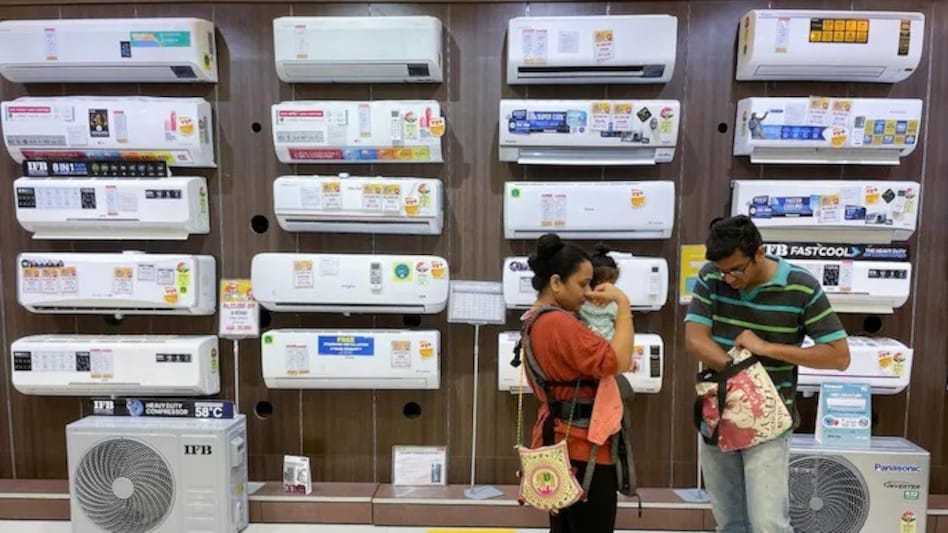 India's cooling journey began with imported window air conditioners in the 1950s, largely serving hotels, cinemas and government buildings.
  'Kolkata has become a city of old age pensioners': FM Swapan Dasgupta on Bengal's decline and skill shortage
 Trump made 1,000-plus trades in June: Here's what he bought and sold
 Escalating Hormuz crisis: Boris Johnson sees India as key to US exit strategy in Iran
 Gold jewellery to property: Radhika Gupta on what actually counts as an investment
 Delhi H1N1 outbreak: No cause for panic, currently circulating strain not a new one, says ICMR
 Commuted Vs Uncommuted Pension: Know The Difference And How Each Is Taxed After Retirement
 Motor Insurance Add-Ons You Actually Need Explained: Zero Depreciation, RSA & Return-To-Invoice
 No Claim Bonus Explained: When Should You Claim Or Pay For Repairs Yourself?
 Motor Insurance Premium: What Factors Determine How Much You Pay?
 How Is Retirement Income Taxed For Senior Citizens? Key Rules Explained
 Hold YES Bank, Federal Bank; buy HDFC Bank, Kotak Mahindra, Axis: ICICI Securities
 ABH Healthcare IPO: Check key dates, price band, issue size, latest GMP, listing details & more
 India stocks lag global markets in 2026: BofA data shows 9.1% decline in USD terms
 'FOMO, fixed return': SEBI proposes revamped ad code for bond portals from misleading investors
 Greenland is losing ice at a rapid pace. Could its meltwater be supercharging Europe’s heatwaves?
 UP factory test-fires first 100% indigenised AK-203 rifle, Army trials set for September
 Tariff, technology & FDI: India Inc flags key concerns in draft nuclear rules












