









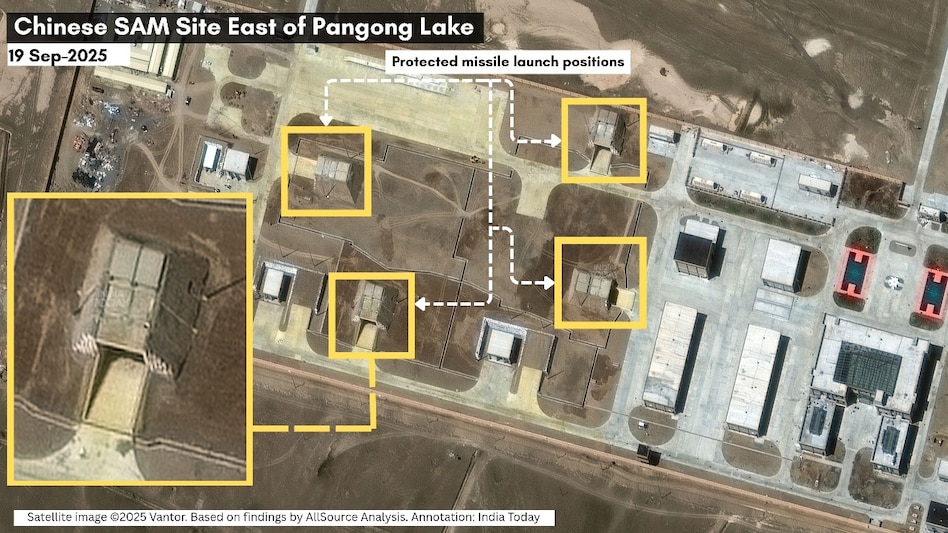
 While such protected launch positions mark a novel deployment along the India‑Tibet frontier, analysts note that similar hardened facilities have already been reported at Chinese military outposts in the South China Sea. While such protected launch positions mark a novel deployment along the India‑Tibet frontier, analysts note that similar hardened facilities have already been reported at Chinese military outposts in the South China Sea.
 At the banks of the eastern part of Pangong Lake in Tibet, roughly 110 km from one of the 2020 border clash hot‑spots, satellite imagery reveals a new Chinese air‑defence complex under construction.
Images collected by the OSINT arm of India Today and US‑based space intelligence provider Vantor show a facility at the lake’s eastern shore — near a friction point from the 2020 clashes — with buildings identified as command‑and‑control, barracks, vehicle sheds, munition storage and radar positions.
The most remarkable feature of the site, defence analysts say, are covered missile‑launch positions equipped with sliding or retractable roofs designed for Transporter Erector Launcher (TEL) vehicles. These bays appear capable of hosting two launch vehicles each and conceal their deployment until launch.
Analysts at US‑based geospatial intelligence firm AllSource Analysis suggest the shelters may house the Chinese long‑range HQ‑9 surface‑to‑air missile (SAM) system, providing both concealment and hardened protection for launch assets.
A replica of this complex was identified at Gar County — around 65 km from the Line of Actual Control (LAC) and opposite India’s upgraded Nyoma airfield in Ladakh. Satellite footage from Vantor dated September 29 shows at least one open roof at a launch bay, possibly revealing the TEL launchers themselves.
“This covered missile launch positions feature a roof with hatches, allowing the launchers to remain concealed and protected while firing through the hatches when opened,” AllSource Analysis states. “This configuration reduces opportunities to detect the presence or exact positions of TELs within the complex and shields them from possible strikes.”
While such protected launch positions mark a novel deployment along the India‑Tibet frontier, analysts note that similar hardened facilities have already been reported at Chinese military outposts in the South China Sea.
India’s military infrastructure build‑up along the northern border has emphasised mobility and logistics, but this latest imagery highlights that China is now investing in deeper air‑defence and hardened launch architecture in front‑line zones.
 Here’s what the new IIP series shows about FY27 factory output
 Here’s how vaccine alliance Gavi committed to speed Ebola vaccine
 Vodafone Idea: After 32% in a month, is the stock headed for more upside in June?
 Annamalai was offered Rajya Sabha seat, declined; likely to quit BJP: Report
 Zee secures FIFA World Cup rights for India, just 10 days before the tournament kicks off
 Piyush Goyal: Most India-U.S. Trade Issues Already Resolved
 India’s $11 Billion Semiconductor Plan | Extreme Summer Gadget Tips + MacBook Neo Review
 "Complete Nonsense…": NVIDIA's Jensen Huang Explains Why AI Won't Steal Software Engineering Jobs
 Gold Demand Falls 70% After Duty Hike; What Lies Ahead For Gold And Silver Prices?
 India Inc. Posts 15% Profit Growth In Q4FY26 As Revenue Expands At Fastest Pace
 NHPC OFS opens June 2 as govt sets ₹71 floor price for up to 6% stake sale
  NMDC Steel shares jump 14% on Q4 profit revival; more steam left in the stock?
 Zee Entertainment shares jump 16% in five sessions; key triggers, target price
 Prestige Estates: Multibagger realty stock rises 24% from 52-week low; buy, sell or hold?
 Why Sensex, Nifty plunged for fourth straight session today; what investors should watch next