


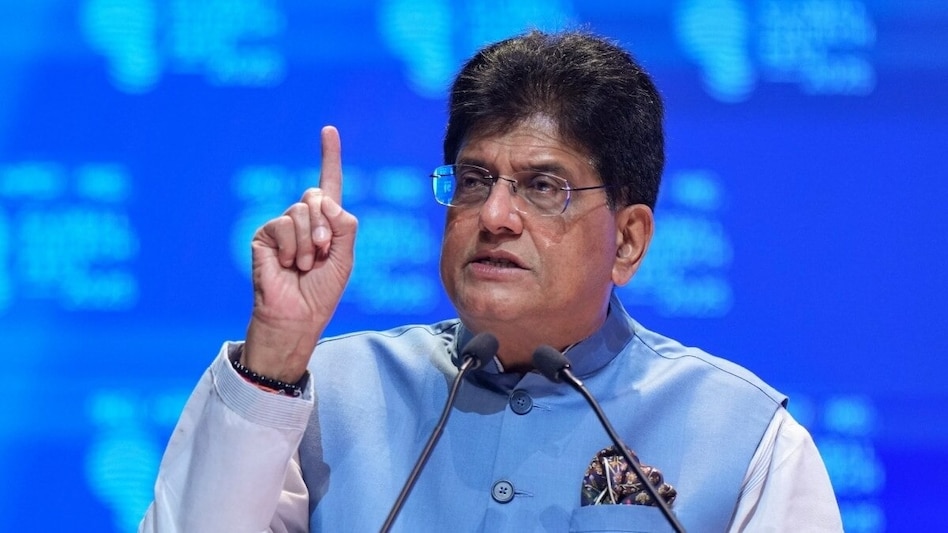
 Goyal stressed that the framework does not mandate who buys what or from where, but merely provides a smooth pathway for trade and preferential access. (File photo)
Buying crude oil, LNG and LPG from the US is firmly in India’s own strategic interest as the country diversifies its energy basket, Union Commerce and Industry Minister Piyush Goyal said, asserting that such decisions are driven by commercial considerations and not dictated by the India-US interim trade agreement.
Speaking in an exclusive interview with ANI, Goyal stressed that the framework does not mandate who buys what or from where, but merely provides a smooth pathway for trade and preferential access. He strongly rejected allegations that India has “ceded sovereignty” under the deal, calling the criticism “absolute nonsense” and describing the agreement as a “labour of love” aligned with India’s long-term goal of becoming a developed nation by 2047.
On the trade pact, Goyal said sourcing energy from the United States helps India reduce dependence on limited suppliers, but reiterated that actual purchases are made independently by buyers and companies. He underlined that free trade agreements are designed to improve competitiveness.
“FTAs are all about preferential access to your competition. So, today when we got an 18% reciprocal tariff, we have a preference over other developing nations who are usually our competition,” Goyal said.
The minister said the interim agreement would open up vast opportunities across sectors and social groups.
“It will provide immense opportunities for our youth, our sisters, our women, huge opportunities for our farmers and fishermen, our MSMEs will flourish, they will become the provider of a lot of material that is required by the USA, our textile sector, our footwear and leather sector, our toys sector, handloom, handicraft, auto components, furniture — sky's the limit as Sergio mentioned this is a partnership with unlimited potential,” Goyal added.
India and the United States recently announced a framework for an Interim Trade Agreement on reciprocal and mutually beneficial trade, reaffirming their commitment to a broader Bilateral Trade Agreement (BTA) launched by US President Donald Trump and Prime Minister Narendra Modi on February 13, 2025.
Under the framework, India has agreed to eliminate or reduce tariffs on all US industrial goods and a wide range of agricultural and food products, including dried distillers’ grains (DDGs), red sorghum for animal feed, tree nuts, fresh and processed fruits, soybean oil, wine and spirits, along with other items.
In return, the United States will impose an 18 per cent tariff on select Indian exports such as textiles and apparel, leather and footwear, plastic and rubber products, organic chemicals, home décor, artisanal goods and certain machinery.
Subject to the successful conclusion of the interim pact, Washington has indicated it will later remove reciprocal tariffs on select Indian exports, including generic pharmaceuticals, gems and diamonds, and aircraft parts, and also lift national security-linked tariffs on certain aircraft and aircraft parts from India.
As part of the broader framework, India has also expressed its intention to purchase $500 billion worth of US energy products, aircraft and aircraft parts, precious metals, technology products and coking coal over the next five years.

 Tata Consumer stock: Tata Group's FMCG arm reacts to Q1 earnings show
  Sterlite Technologies: What every investor should know about the stock post Q1 earnings
  NEET to be conducted through a computer-based model? Here’s what we know
 ‘Merely because there is agitation…’: Supreme Court says right to peaceful protest is guaranteed
 BT Explainer | PVR Inox shares: Analysts bet big on Odyssey, Ramayana, Avengers & others post solid Q1
 IPO Rush Ahead! Should You Invest In Manipal Health & Upcoming IPOs? Avinash Gorakshakar Explains
 Why IndiGo Stock Is Rallying | Impact Of Falling Crude Oil On Aviation Stocks
 Pralhad Joshi Takes Charge As Education Minister | Big NTA Reforms After NEET Row
 Nirmala Sitharaman Slams Govt Apathy After Tax Dept's 50-Year Land Struggle In Mumbai
 PM Modi’s Big Message To Youth: Border Villages Are India’s First Villages
 Infosys, OFSS, Coforge shares rally up to 4%; all 10 Nifty IT index stocks rise
 Infosys fined €175,000 by French authority over employee time tracking system; says no material business impactTata Consumer stock: Tata Group's FMCG arm reacts to Q1 earnings show
  Why KFin Technologies shares surged 9% today
 Sagility shares surge 8%; brokerages retain 'Buy' despite Q1 revenue dip QoQ; check target pricesInfosys, OFSS, Coforge shares rally up to 4%; all 10 Nifty IT index stocks rise
 Nitin Gadkari moves Bombay High Court against viral E20 deepfakes, hits Meta with suit
  Delhi’s ₹6,969.67-crore tunnel corridor: Route, length and benefits explained
 Delhi to Nepal in just 8 hours! This highway project could boost tourism growthIPO Rush Ahead! Should You Invest In Manipal Health & Upcoming IPOs? Avinash Gorakshakar Explains









