









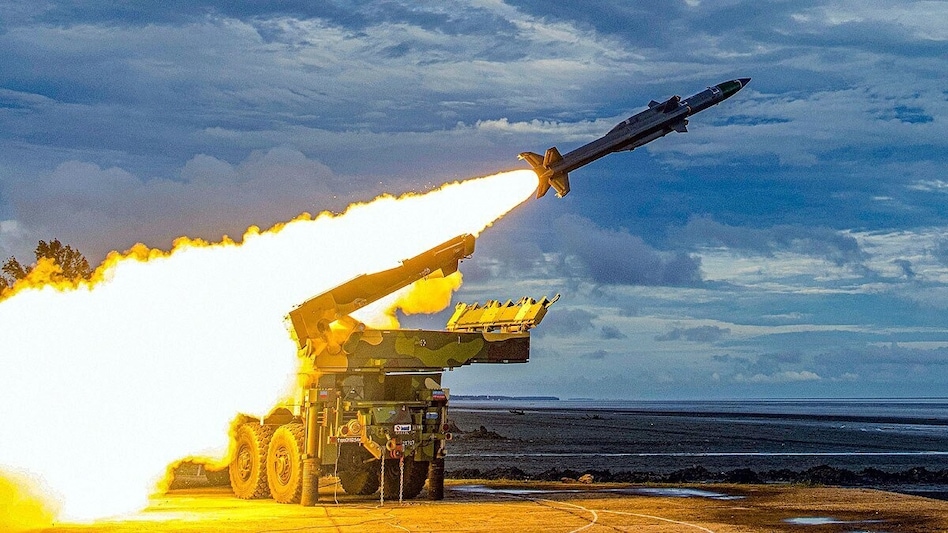
 Some military veterans have even argued that India should raise defence spending to 4% of GDP.

 Some military veterans have even argued that India should raise defence spending to 4% of GDP.
Prime Minister's Economic Advisory Council member Sanjeev Sanyal has strongly backed India's defence spending. He argues that economic growth and national security should not be seen as competing priorities.
"Many people make this point about guns versus libraries tradeoffs. So, let me say that one of the points about policymaking is to make those trade-offs. That's the basis of economics," Sanyal said during a podcast conversation with SRCC Principal Professor Simrit Kaur.
Sanyal was asked how he sees Viksit Bharat with growth vis-à-vis re-allocating resources to manage aspects such as conflicts. The economist said policymaking is ultimately about making trade-offs but warned against reducing military spending in the pursuit of other goals.
"One of the lessons of our history is that libraries without armies are destined to be burnt down. That is what happened to Nalanda," he said. "It is no point in cutting down on the guns part if you are going to be able to defend what you are building through the libraries or the butter production."
Sanyal said India must ensure it can defend itself in difficult circumstances and "some amount of sacrifice, say 2% of GDP or thereabouts, for that is in my view a completely sensible investment."
"I am not one of those economists who kind of look on defense as a waste of time, and this is one of the reasons, by the way, I think that economists should read history."
Must Read | Why current education model won't work in AI age, explains PM-EAC member Sanjeev Sanyal
Drawing on India's past, Sanyal said economic strength alone was not enough if a country could not protect itself. "We were at one point, it is true, 1/3 of the world economy, but then we were colonized repeatedly, and that number went down to four and then continued to decline even after we became independent," he said.
"So, keeping ourselves free and independent and being able to decide our own destiny is a very good economics in the long run," the economist noted.
There have been debates over India's defence spending - and whether it should be increased, considering threats from China.
India's defence allocation for FY2026-27 is about Rs 7.85 lakh crore, roughly 2% of projected GDP, including defence pensions and other expenditure under the Ministry of Defence. Excluding pensions, the figure is around 1.6%.
Some military veterans have even argued that India should raise defence spending to 4% of GDP.
Don't Miss: India's fertility rate falls below replacement. Sanjeev Sanyal's warning: Peak births were in 2001
In June last year, former Lieutenant General H S Panag said that India should "double our defence budget to 4 per cent of the GDP" to build a technological edge over Pakistan and counter China in the event of a collusive threat.
Former Chief of Defence Staff General Anil Chauhan also rejected the traditional "guns versus butter" argument. During a conversation earlier this year, he said defence spending can support economic growth through domestic manufacturing, employment generation, and industrialisation.
Citing an example, he said that in the last three years, most of the army's procurements were from domestic sources only - otherwise, this money would have gone outside. In 2023, almost 100% of the government orders from the capital were taken out from the Indian industry, and thereafter, about 80-85%.
"We pay 18% GST, which goes back to the government funds - it helps generate employment and revenue. It helps industrialisation. So money spent on the gun is not money versus butter. It may contribute towards butter also."
On what percentage of the budget would be ideal, the former CDS said presently the defence allocation of the budget is about just less than 2% of the GDP. "So, if the GDP continues to grow at about 8%, the inflation rate is low, and we get a 10% year-on-year increment, the present modernisation plan should go well." He, however, said that a one-time fund may be required for some high-ticket purchases.
 WhatsApp's Username feature under govt scanner over online fraud concerns: Sources
 Jio Platforms IPO: How Ambani's secret Jupiter paved the way for India's biggest listing
 India tops global AI talent, but trails in meaningful outcomes
 Union Cabinet approves ₹14,115 crore Delhi tunnel, UP highway projects to boost connectivity
 JioBlackRock's ₹10 lakh-entry Prism fund opens a new investment avenue. Here's how it works, its risks and who should invest
 LIVE What’s Hot: Stocks, Gold & Big Money Moves | Daily Market Show | Business Today TV
 Uber Launches Ambulance Assistance & Ride Recording
 PM Modi’s High-Level Strategy Meet: Is A Major Cabinet Shake-Up On The Cards Before Monsoon Session?
 NPS Retirement Shake-Up: RIS Vs Annuity Vs SLW — Which Option Should You Choose?
 Donald Trump’s $1.4 Billion Crypto Haul Sparks Questions Over Power And Profit
 Sensex, Nifty rebound: What's fueling the recovery and what investors should watch next
 Paisalo Digital shares zoom 20%, hit 52-week high; here's why
  Infosys, TCS, Wipro, HCLTech shares hit 52-week lows as Nifty IT slides over 2%
 Dual shock for KPIT Technologies stock; analysts see more weakness, share price targets
 Vedanta Oil & Gas, Power, Iron shares zoom up to 20%; should investors chase the rally?