


 India was the cradle of civilisation, not Mesopotamia, says maritime historian
India was the cradle of civilisation and not Mesopotamia, unlike what is commonly believed. Maritime historian, Nick Collins, said by the time Mohenjo-daro was discovered in 1922, the narrative was already set.
In a blog post, Collins said 19th century archaeologists dug up Mesopotamia because the climate preserved the artefacts, biblical sources pointed them there, and the Ottomans allowed the excavations. He said that is the entire basis of the myth of Mesopotamia.
Collins argued that nobody applied the same rigour to India, and by the time Mohenjo-daro was discovered, it was a bit too late to change the narrative.
“The Indus-Sarasvati civilisation was not derivative. It was the largest and most economically productive society of the ancient world,” he said in the blog. By 2600 BC the biggest civilisation of the ancient world had 300 cities, 50,000 people each, said Collins. When the scale became impossible to dismiss, the theory was tailored to suit the “pale-skinned nomads”, he said. There is no evidence that these people who arrived around 1500 BC brought civilisation with them, and the chronology doesn’t work. “The Vedas describe no invasion,” he said.
A Harvard-led genetic study revived the claim in 2019, and stated that the builders of these cities were indigenous. “So, where they chose to dig was mostly an accident of climate and access. The Aryan invasion theory was constructed because an Indian civilisation that owed nothing to Caucasians was a fact the late nineteenth century could not accommodate,” said Collins.
THE CITIES
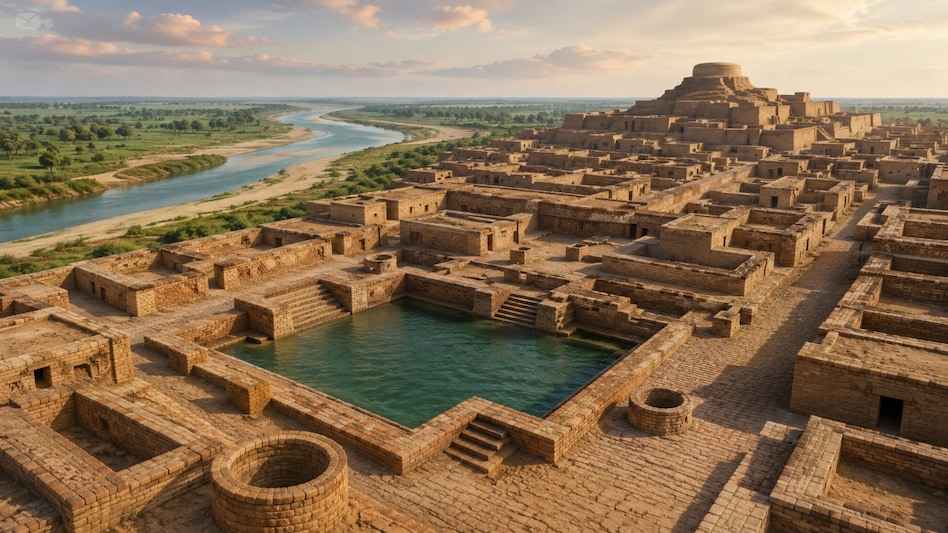
Collins said the cities of the Indus-Sarasvati civilisation were mapped out with mathematical precision, and the streets ran in a grid from north to south. Drains were covered, houses were made of brick and had bathrooms, weights followed a binary system, money was spent on civic amenities, manufacturing and trade, and not on temples, palaces and royal tombs. The civilisation was organised around commerce and not around god-kings.
“Urban planning and fire altar design required advanced algebraic geometry, preserved in the Shulba Sutras and predating Greek geometry by thousands of years. What we call Pythagoras’s theorem was used to change altar sizes according to the nature of the sacrifice, a thousand years before Pythagoras was born,” he said.
The dock at Lothal on Rann of Kutch, measuring 214 metres long, 37 metres wide and 4.5 metres deep, may have been the largest dock in the ancient world. It could hold 30 ships of 60 tonnes.
“However they interacted, Europe would not match anything like it for four thousand years,” said Collins.
Evidences of the drowned city beneath the Gulf of Cambay, sonar readings of an urban centrebelief of the old city of Mahabalipuram that’s said to have submerged about 6,000 years ago are evidences that the “Indus-Sarasvati civilisation was the surviving continuation of a much older India-wide maritime tradition”, he said.
THE NARRATIVE
“Once the Indus-Sarasvati cities began to be excavated in the twentieth century, a problem presented itself. They were too sophisticated, too old and too large to fit comfortably into a Mesopotamia-first narrative. So the narrative was adjusted to accommodate them,” said Collins.
Friedrich Max Müller argued that pale-skinned Indo-European nomads or Aryans, invaded northern India around 1500 BC. These invaders brought literature, mathematics, astronomy and philosophy with them, thereby discrediting the Vedic civilisation.
“This theory preserved the assumption that complex civilisation must originate from European racial stock. It also conveniently justified the colonial presence in India: the British were merely the latest in a long line of light-skinned Aryans bringing civilisation to the subcontinent,” he said, arguing that there was no evidence of any of it.

 Trump announces import tariff up to 200% on generic drugs after 2026 window; India's $9.7bn exports at risk
 JP Nadda, Jitendra Singh meet Sonam Wangchuk: Here's what transpired behind closed doors
 Adani, GMR flights? Govt mulls letting airport operators own, run airlines, says report
 Stuck since 2016, now moving: Haryana clears Rs 29 crore six-lane road project in New Gurugram
 YES Bank share price target: What can trigger a re-rating for the stock?
 Will The Rupee Fall Further? Expert Explains Oil Prices, FII Flows & Dollar Pressure
 Why This Fund Manager Is Betting on I.T. Stocks, CapEx & Consumption
 Pharma Stocks Outlook: CDMO, Patent Cliff And China Plus One Opportunity Explained
 I.T. Stocks Ready For A Comeback? Expert Picks Persistent, LTIM & Coforge For Long Term
 Ram Temple Donation Theft Case: Cars, Bullet Bike Seized as SIT Probe Deepens
 IndiaMart share price targets: Why this stock fell 8% after Q1 results; is it still a Buy?
 Nestle India shares climb 4% to hit record high after Q1 results
 Adani Power, Adani Green, IndusInd Bank, Eternal Q1 results today: Key expectations
  Cube Highways Trust IPO opens today: Should you subscribe to this InvIT issue?
 Titan Company shares hit record high amid market crash; here's why









