









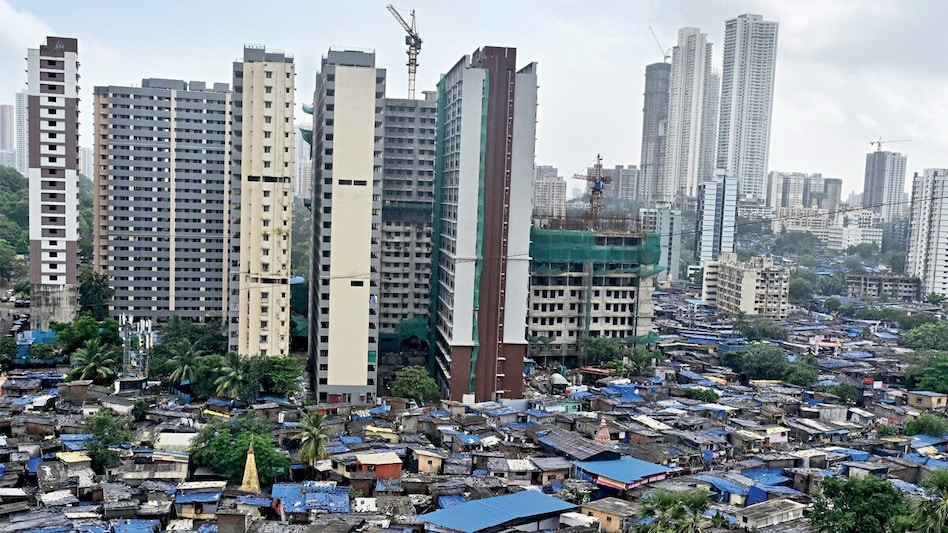
 Maharashtra scraps individual consent rule for Mumbai slum cluster redevelopment

 Maharashtra scraps individual consent rule for Mumbai slum cluster redevelopment
In a major policy shift aimed at accelerating Mumbai's transformation into a slum-free city, the Maharashtra government has announced that individual consent from slum dwellers will no longer be required for the group redevelopment of slum clusters, the Free Press Journal reported.
According to the government resolution (GR), the Slum Rehabilitation Authority (SRA) will serve as the nodal agency for implementing "cluster redevelopment" projects on contiguous land parcels of at least 50 acres (20.25 hectares) where at least 51% of the area is occupied by slum dwellers or structures.
The policy allows the inclusion of private, government, and semi-government lands and extends to old hazardous buildings, chawls, rental tenements, and properties under development cess.
For the first time, the state has also allowed the inclusion of central government-owned land, stating: "Land owned by the central government may also be included upon obtaining necessary permissions from concerned authorities," the GR said.
The order further clarifies that land leased by government or semi-government bodies can be covered under the scheme, provided that rehabilitation adheres to Development Control and Promotion Regulations (DCPR) 2034 and that compensation is paid to the respective authorities.
Importantly, the scheme extends to coastal regulation zones, marking a significant expansion of redevelopment eligibility. "Slums on CRZ I and II may be integrated, with in-situ or alternative rehabilitation permitted within a 5-km radius as per CRZ and DCPR norms," the order added.
Under the new model, private developers can be appointed through public-private partnerships or open tendering by public agencies. Developers who already hold 40% or more of the cluster site will be given priority to execute the project. Additionally, if existing multi-storey buildings stand on non-slum parcels within the designated cluster, the developer will be required to secure development rights for those structures.
A high-level committee, chaired by the Minister of Housing and Urban Development, will oversee the project approvals. Members will include the Secretary of Housing, the Commissioner of the Brihanmumbai Municipal Corporation (BMC), the CEO of the SRA, and a representative of the public authority owning the land.
The move is expected to streamline the redevelopment process, which has long been slowed by fragmented ownership and consent delays. By eliminating the need for individual approvals, the government aims to fast-track large-scale slum rehabilitation, integrating infrastructure upgrades with modern housing in Mumbai’s densest areas.
 India's monsoon runs on a double engine: The hidden weather tag team deciding where the rain falls
 Same 43°C temperature, different reality: Why Europe's heatwave is more deadly than India's
 'Think of yourselves like stocks': WhatsApp chief Kunal Shah's advice for youth - what he means
 Dixon Technologies shares: Four factors why JM Financial upgraded the EMS stock
  From engineers to product managers: Here's how much Anthropic pays, with salaries up to ₹13.02 crore
 HP EliteBook X G2a Review: An AI PC in 2026 With 64 GB RAM And A Price To Match
 China’s Modern Inequality System | Akshita Nandgopal Unpacks The Brutal Reality Of The Hukou System
 India Food Label Scam Explained By Sneha Mordani | FSSAI Issues Strict Action
 Should You Get Your Heart Check Before Gym? Sneha Mordani & Dr Devi Shetty Explain
 Biggest Water Dispute In Asia | India-Pakistan Indus Crisis Update
 Dixon Technologies shares: Four factors why JM Financial upgraded the EMS stock
  Coforge, KPIT Tech, Cyient among top IT stocks to buy for upto 44% upside amid AI recovery
 Infosys, Hindalco, Redington: How FPI-heavy stocks fared in June as outflows hit ₹53K crore
 Last chance next week to buy four Bajaj Group stocks for dividend; check payout, record dates
 Coforge, Mphasis, Persistent, LTIMindtree: Share price targets as IT stocks under pressure