








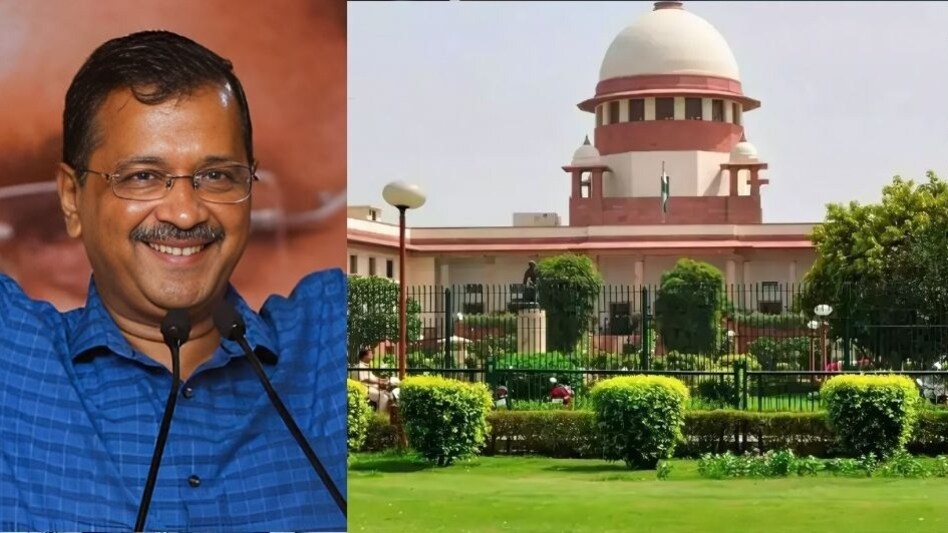
 The Supreme Court on Thursday reserved its judgement on bail plea filed by Delhi Chief Minister Arvind Kejriwal
 The Supreme Court on Thursday reserved its judgement on bail plea filed by Delhi Chief Minister Arvind Kejriwal
The Supreme Court (SC) on Thursday reserved its judgement on the petitions filed by Delhi Chief Minister Arvind Kejriwal challenging his arrest by the Central Bureau of Investigation (CBI) and seeking interim bail in connection with the now-scrapped liquor policy. During the hearing, the apex court pulled up the central probe agency for arresting Kejriwal while he was in judicial custody in the ED case.
"When you are in custody, if you are arresting him again, then you need the permission of the court. There is something in the criminal procedure code," the bench of Justices Surya Kant and Ujjal Bhuyan stated.
Appearing for Arvind Kejriwal, senior advocate Abhishek Singhvi told the court that every other co-accused in the case, including Manish Sisodia, Vijay Nair, and K Kavitha, had been released. However, CBI counsel additional solicitor general SV Raju raised objections to the bail plea, stating that the session court was not approached first.
Both Kejriwal and the CBI were at loggerheads today over whether the bail matter should be first heard by the trial court. Contrary to the usual course of first moving the trial court, Kejriwal had directly approached the Delhi High Court for bail. The High Court had rejected his plea, prompting the appeal before the top court.
Singhvi said the grounds raised in the present plea as regards the mandate on the police office to issue notice to the accused under Section 41A of CrPC were argued before the trial court during remand and were rejected. Hence, it would not be fair to send him back to the trial court to argue the same issue again.
Singhvi also highlighted the apex court's judgment in the Sisodia case in which the top court, while granting bail, had said that it would be unfair to send Sisodia back to the trial court for bail since it would amount to playing a game of snake and ladder.
ASG Raju then interjected, stating that Sisodia went to trial court once. He argued that bypassing the trial court can be allowed only in exceptional circumstances and the only 'exceptional' circumstance in this case is that Kejriwal is the Chief Minister. Singhvi underlined that Kejriwal satisfies the triple test for bail and the trial in the case is unlikely to conclude anytime soon.
The apex court after a lengthy hearing, which lasted through the day, reserved its judgment. The Bench was hearing two separate pleas filed by Kejriwal - one challenging the legality of his arrest by CBI and a second plea seeking bail.
The CBI arrested Kejriwal on June 26 while he was in judicial custody in connection with a money laundering case probed by the Enforcement Directorate (ED) in connection with the same scam.
The case against Kejriwal stems from alleged irregularities in the framing of the now-scrapped Delhi excise policy of 2021-22. The investigation agencies have alleged that the funds garnered from this exercise were used to fund the AAP's election campaign in Goa. The case is being probed by both the CBI and the ED.
AAP leaders Manish Sisodia and Sanjay Singh were granted bail by the Supreme Court. Former AAP communications-in charge Vijay Nair and Bharat Rashtra Samithi (BRS) leader K Kavitha were also granted bail by the top court recently.
During the hearing today, Singhvi contended that this is a unique case wherein the accused has got bail under the stringent money laundering law but is in jail due to the predicate offence registered by the CBI. He said that this was an "insurance arrest" by the CBI to keep Kejriwal in prison when it was clear that he would secure bail in the money laundering case.
Singhvi pointed out that Kejriwal was not even named in the CBI's first information report (FIR) and he was first arrested by the ED and not CBI. He also traced the timeline of Kejriwal's arrest and his bail in the ED case, explaining that Kejriwal got bail under the more stringent PMLA but is still in prison due to the CBI case.
Raju questioned the maintainability of the plea on the ground that Kejriwal directly approached the High Court and skipped the sessions court. The court, however, said that the High Court should be decisive enough to take a call then and there. The ASG argued that witness statements pointed towards how Arvind Kejriwal was the "main conspirator" in the case and that there was no violation of any fundamental right of Kejriwal, hence his arrest cannot be considered illegal.
The ASG also pointed out that while granting interim bail, the top court had not considered the bail plea on merits and the bail was not a regular bail. It had also observed that the regular bail plea, if pending, shall be decided on its own merits. The regular plea is still pending before the High Court, it was pointed out. Raju also said that there is a prima facie case against Kejriwal and the chargesheet demonstrates his role in the case. Hence, he has not annexed the chargesheet to his plea, it was contended.
Singhvi argued that if the prosecution's submission is accepted, then the accused person can be kept in jail forever by delaying the filing of the chargesheet. The ASG said that there are several persons from Goa involved in the matter since the money from kickbacks was used in that State. He concluded that this is not a case where indulgence should be granted, and that Kejriwal did not approach the trial court, and this exception cannot be given here.
The SC has posted the matter for Tuesday.
 NSE IPO may unlock mega gains for billionaire investors RK Damani, Premji
 'The real sting is the monitoring': Brahma Chellaney flags risk for India in Trump's Russian oil order
 Moltbook hype unravels: Viral posts were human-written, not AI, finds MIT Technology Review
 After mass layoffs, Washington Post publisher Will Lewis resigns; Jeff D’Onofrio named acting CEO
 India-US BTA: Harley Davidson bikes to get 0% duty, gradual tariff reduction on luxury cars
 BT Golf 2025-26 Kochi, Kerala Awards Ceremony Marks A High-Energy, Successful Conclusion
 Golf Is An Addiction. We Eat And Sleep Golf!
 The Fairway Fixes Everything. Mindset, Life, Relationships
 BT Golf LIVE: Join AU Small Finance Bank Presents BT Golf 2025-26 For Its 4th Leg In Kochi, Kerala
 AI Will Change MBAs, Not Leadership: IMD President On India’s Global Education Rise
 RIL, SBI, Kotak Bank, Kalyan, HAL, BEML, BDL among stocks in focus next week; here’s whyNSE IPO may unlock mega gains for billionaire investors RK Damani, Premji
 SBI Q3 Results: Profit jumps 24% to Rs 21,028 crore; asset quality improves
 IDBI Bank stake sale: Kotak Mahindra Bank says ‘has not submitted a financial bid’
 BDL, Mazagon Dock, MRF, Hindustan Copper, RVNL, others to turn ex-dividend next week