


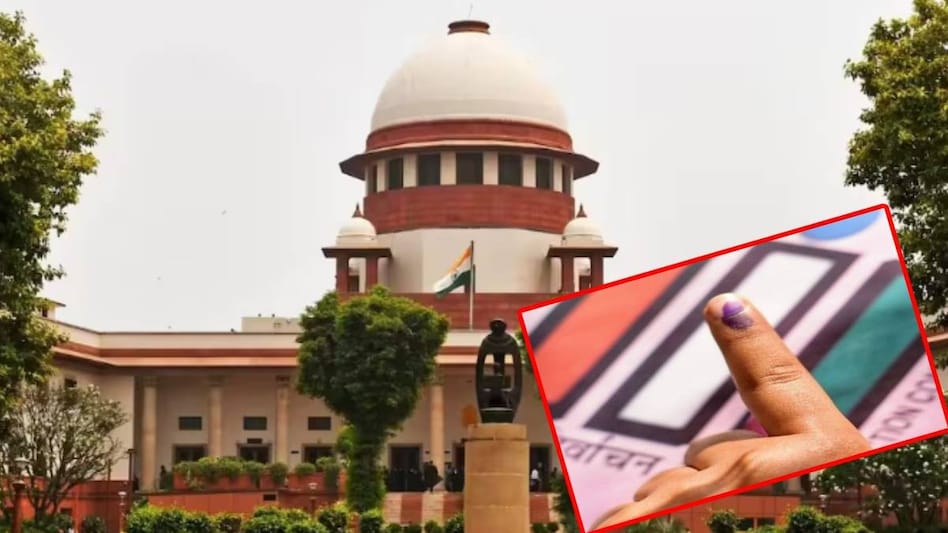
 What did the Supreme Court say about those under consideration in the tribunal?
The Supreme Court on Tuesday signalled that the long-standing two-child norm for contesting panchayat and other local body elections may no longer be justified given India’s falling fertility rates.
Court signals rethink on old rule
A bench of Justices P.S. Narasimha and Alok Aradhe, hearing a challenge to the disqualification of a Maharashtra sarpanch for having a third child, said it was prepared to examine the broader rationale for retaining such provisions in state laws.
The court appointed advocate Rukmini Bobde as an independent lawyer and asked her to help look into the demographic issues.
“What kind of useless policy is this? Javed vs State of Haryana needs reconsideration. The country has changed,” Justice Narasimha remarked, referring to the Supreme Court’s 2003 judgement that upheld the two-child norm in Javed Vs State of Haryana.
What the 2003 ruling said
The two-child norm for contesting local body elections was upheld by the Supreme Court in Javed Vs State of Haryana (2003), where it ruled that disqualifying candidates with more than two children was a reasonable restriction intended to promote family planning and did not violate constitutional guarantees.
Bench cites falling fertility rates
The bench noted that India’s total fertility rate has fallen to around 1.7 and pointed out that states such as Kerala and Tamil Nadu now have fertility rates lower than several Scandinavian countries.
“To perpetuate this policy to reduce population in the present situation could be completely unconstitutional,” the court observed, questioning the logic of applying a population control measure when some states face declining fertility.
“In your generation or my generation, it is a rarity to have three children. It is only one. This policy has lost its effect. It should immediately be withdrawn. Rival candidates use it as a weapon. We are concerned about this policy,” Justice Narasimha added.
READ ALSO: SC freezes Parsvnath Group's bank accounts, issues warrants against directors
Maharashtra sarpanch’s disqualification
The remarks came in the matter of former Maharashtra sarpanch Mangala Bhimrao Ingle, who was disqualified under Section 14(1)(j-1) of the Maharashtra Village Panchayats Act, 1959, which bars persons with more than two children from holding a panchayat member’s office.
Ingle, elected sarpanch of Kakoda Gram Panchayat in Buldhana District, was disqualified after a complaint alleging a third child.
High Court had upheld the order
The additional collector upheld the disqualification in October 2024. The Bombay High Court affirmed the decision in August 2025, holding that the birth certificate relied upon by the authorities was a public document carrying evidentiary value and that Ingle had failed to rebut it.
States asked to be examined
The bench asked Rukmini Bobde to determine how many states still retain similar disqualification clauses and whether legislatures have reconsidered them given changing demographics.
When Bobde submitted that fertility rates had primarily declined in urban areas, the bench asked her to examine the issue more closely before the next hearing.
Next hearing on July 28
The matter is listed for further hearing on July 28. Counsel for the petitioner, Pratik R. Bombarde, appeared for Ingle.

 OnePlus likely to exit India by 2027 amid Oppo’s restructuring plans
 RIL Q1 results 2026: Jio may add 70-95 lakh subscribers; Retail to log healthy growth
 'When you set ₹5 crore goal, you...': Zerodha's Nithin Kamath recalls when he wanted to retire in Goa
 Forget petrol! Why this ₹80/kg cow dung fuel is becoming India's latest energy bet
 Thailand back to being visa-free for Indians, but you will still need this document: Check details
 ₹100 Crore TN Palani Temple Land Row: FIR Filed After 1.4 Acres Registered To Private Buyers
 Government Revises Windfall Tax: Impact On ONGC, HPCL, BPCL & Oil Prices
 Arunachal Floods: Over 1 Lakh Affected, Roads Collapse, Relief Race Intensifies
 Seafood Exporters Expect UK-Driven Export Growth Ahead
 India’s First Hydrogen Train: PM Modi To Flag Off 10-Coach Green Rail On July 17
 Rupee fall: 65 quarters of Nifty earnings since 2009 reveal stocks to watchRIL Q1 results 2026: Jio may add 70-95 lakh subscribers; Retail to log healthy growth
 Dixon Technologies shares rise 7%, up 50% from 52-week low; here's why
 Wipro, TechM shares gain ahead of Q1 results today: Earnings preview
  Hindalco Industries, among FIIs' favourites, gets a fresh price target from Kotak; here's why









