








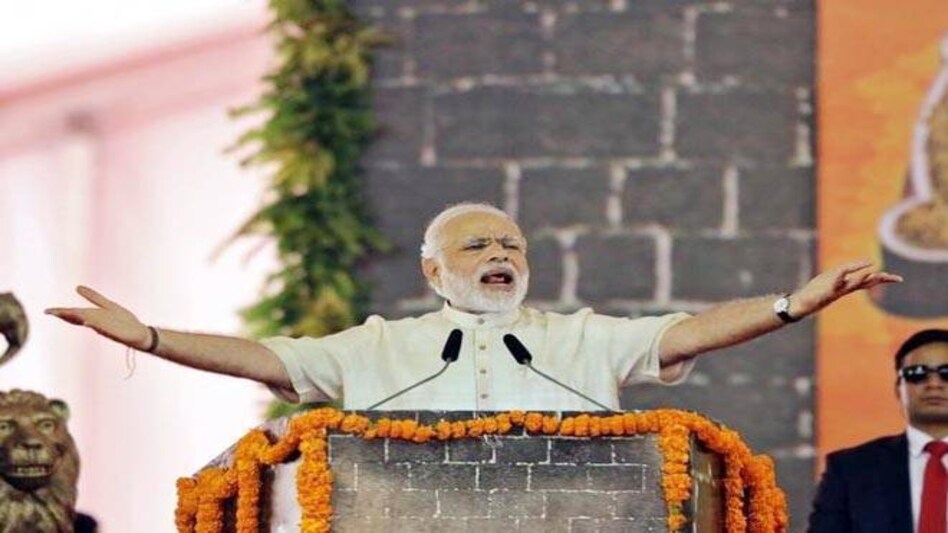
 PM Narendra ModiPM Narendra Modi
The 2014 election manifesto of Bharatiya Janata Party (BJP) packaged its promises as short-term and long-term, as specific targets and visionary goals. Among the most urgent issues that the BJP wanted to address were policy paralysis, inflation, black money and corruption. The long-term agenda included reforming the system - administrative, judicial, police and electoral - and bridging the rich-poor divide.
As Prime Minister Narendra Modi-led National Democratic Alliance (NDA) government completes three years in office, inflation is no longer a major worry. The government has succeeded in creating enough noise - from demonetisation to anti-corruption drive - to project itself as a crusader against black money and corruption. With the Modi government's ministers competing against each other to announce more schemes almost every day, one cannot blame the government for policy paralysis either.
The government's machinery and the ruling party are on an overdrive to publicise its achievements over the past three years. But the Opposition sees no merit in the government's performance so far. But such responses are not surprising; that is how ruling political formations and the opposition have always acted.
What we need to look at is how the government has performed. Were its achievements qualitative? Is it well on its way to fulfil the BJP's pre-election promises in the next two years?
Perception wise, the government has scored. It is seen as a government in action. And the majority of the promises that figure in the section requiring "immediate action", seems to have been attended to. The areas where its action has not been so effective include employment creation and entrepreneurship development. The promise of Team India remains rhetoric, the progress of the Goods and Services Tax (GST) Council being an exception.
The government is well aware of the promises the BJP has made. The schemes - new ones as well as the relaunched and the renamed - bear witness to that. The government has something to talk about regarding almost every sector and every segment that the manifesto touches upon. And this cuts across energy, agriculture, railways, transport, industry and taxation. The government will list a series of measures it has taken to address the problem of non-performing assets (NPAs) although the banks have to prove that the medicine works. The government can also highlight the investment-friendly measures undertaken on a regular basis, but real investments in job-creating sectors are needed to prove the perceived economic and societal benefits.
One of the major items that figured in the immediate agenda was to connect the missing links to increase the pace of governance. The third anniversary will be an appropriate time to see how far it has been achieved. "We have water but no pipeline to carry it; we have schools but no teachers; we have computers and machines but no electricity; we have scientists but no labs; we have instruments but no one to work on them," the manifesto had pointed out. The promise came next. "Focus on proper planning and execution for right outcomes. Strive for scale and speed with futuristic vision and build institutions for today and tomorrow."
It is now time for the government to start connecting the dots.
 Claims of sovereignty loss in India-US trade deal ‘absolute nonsense’: Piyush Goyal
 SEBI draws line between listing norms and RBI rules in guidance to PNB
 India’s US oil imports are strategic decisions, not trade pact obligations: Piyush Goyal
 Domestic airfares set to rise as IndiGo capacity cuts hit summer schedule: Report
 'True luxury is here to stay’: Isprava’s Dhimaan Shah
 BT Golf 2025-26 Kochi, Kerala Awards Ceremony Marks A High-Energy, Successful Conclusion
 Golf Is An Addiction. We Eat And Sleep Golf!
 The Fairway Fixes Everything. Mindset, Life, Relationships
 BT Golf LIVE: Join AU Small Finance Bank Presents BT Golf 2025-26 For Its 4th Leg In Kochi, Kerala
 AI Will Change MBAs, Not Leadership: IMD President On India’s Global Education Rise
 RIL, SBI, Kotak Bank, Kalyan, HAL, BEML, BDL among stocks in focus next week; here’s why
 NSE IPO may unlock mega gains for billionaire investors RK Damani, Premji
 SBI Q3 Results: Profit jumps 24% to Rs 21,028 crore; asset quality improves
 IDBI Bank stake sale: Kotak Mahindra Bank says ‘has not submitted a financial bid’
 BDL, Mazagon Dock, MRF, Hindustan Copper, RVNL, others to turn ex-dividend next week