








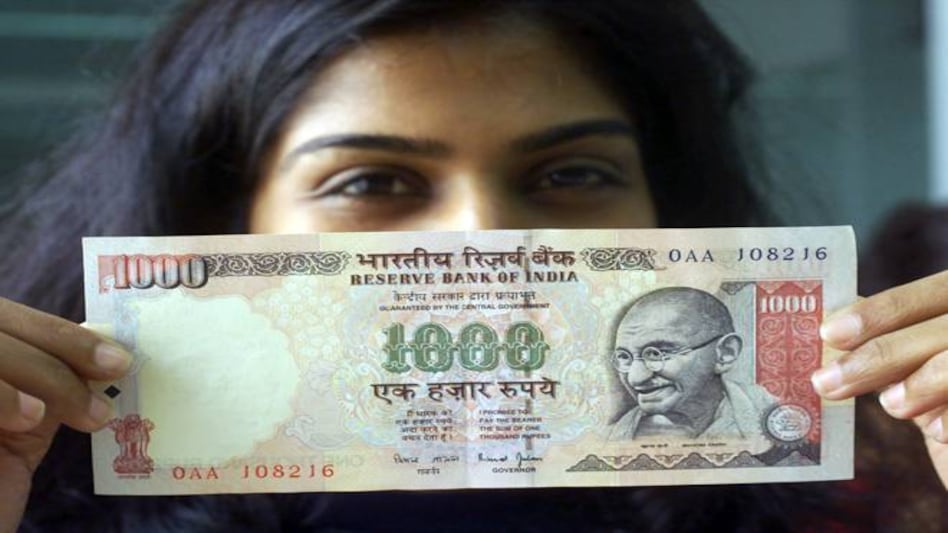
At the stroke of eight on 8th November night, Prime Minister Narendra Modi announced that all 500 and 1000 rupee notes that are in circulation will cease to be legal tender by the midnight. Lengthy queues in front of bank ATMs and the scramble to withdraw lower denomination currencies followed. High value denomination rupee notes losing validity were sold at huge discounts in wholesale markets across the country and people, in hundreds, with unaccounted cash in their hands, were left dumbstruck.
The fact that the announcement came from none other than PM Modi was enough indication of the critical nature of the problem. India was taking an unprecedented step of withdrawing or demonetizing 16.5 billion 500 rupee notes and 6.7 billion 1000 rupee notes - which together accounts for over 80 percent of the value of cash that was in circulation in India to tackle the twin menace of fake currency, and black money. In a press conference the same night, finance ministry officials made it very clear that the objective was to curb financing of terrorism through the proceeds of Fake Indian Currency Notes (FICN) and use of such funds for subversive activities such as espionage, smuggling of arms, drugs and other contrabands into India, and for eliminating black money which casts a long shadow of parallel economy on India's real economy.
ALSO READ: Five key impacts of currency announcement
THE PROBLEM OF FICN
In spite of the additional workload that he anticipates, Pradip Thakur (name changed) is happy about the government's decision to invalidate existing 500 and 1000 rupee currencies. As the branch manager of a public sector bank in Delhi, he was getting overtly worried about the fake currency problem. The counterfeit notes were increasingly becoming more difficult to detect, and his officials or key customers with mass customer interface (like petrol pumps) were increasingly losing money because they had to destroy such currencies. "Fake notes were becoming a bigger problem each day. While we are supposed to file police case against the customer if we detect more than five pieces of counterfeit notes in single transaction, we could not do that all the time as it puts our genuine customers - traders, hotel operators, petrol bunks, etc., in trouble. They have been coming across fake notes on a daily basis".
What made the problem worse was the increase in the supply of high denomination currencies. According to the finance ministry, while the total number of bank notes in circulation rose by 40 percent between 2011 and 2016, the increase in number of notes of Rs.500 denomination was 76 percent and for Rs.1,000 denomination was 109 percent during this period.
Thakur's worry is something that will resonate with the opinion of almost every bank manager in charge of retail operations across the country. The decision of the government to take the ultimate step to counter fake currency menace has only endorsed this reality. Or else, if one goes by the official statistics, there was no need for such a hard step as the seized and recovered fake FICN was only 0.003 percent of the Rs 1000 notes that were in circulation in the last three years (2015, 2014 and 2013). As percentage of notes in circulation, fake Rs 500 notes were also in the same range, o.002 percent in 2015 and 2014, and 0.003 percent in 2013. Fake 100 rupee notes accounted for about 0.001 percent of the total 100 rupee notes in circulation during these years.
The trends in FICN seizures points to the states where the fake currency problem was severe. While Delhi saw 66 police complaints filed in this connection in 2015, it was over 100 in Maharashtra and Andhra Pradesh. Overall, 788 fake currency related police cases were filed in India last year. The value of the currency, mostly 1,000 and 500 rupee notes, seized was Rs 30.44 crore. The fact that the value of seizures has been decreasing over the years - Rs 36.11 crore in 2014 and Rs 42.9 crore in 2013, thus do not reflect the magnitude of the problem.
The government has stated that the New Series bank notes of Rs.500 and Rs.2,000 denominations will be introduced for circulation from 10th November, 2016. Since the infusion of Rs.2,000 bank notes will be monitored and regulated by RBI and the new series of banknotes will be distinctly different from the current ones in terms of look, design, size and colour, the current move will bring be the strongest move to tackle the fake currency problem. Will that be a permanent solution? Especially if the source of fake currency is a hostile neighbouring country as is often reported? Hard to say, but there is no doubt about its positive impact in the short and medium term.
Thakur has a tough job ahead. He will have to do lot of due diligence while exchanging the invalid notes with either smaller denomination or freshly minted 500 rupee or 2,000 rupee notes of equivalent value for several weeks now. It is easy, when the amount that needs to be exchanged is small, but that may not always be the case as the cash that is lying outside the banking system is astronomically huge.
BLACK MONEY
Every bank manager in India will tell you, the locker facility is not only for securing your gold or valuable documents. Across the country, bank lockers also serve as a storage space for hard currency for some people who possess unaccounted money. As a study published by industry chamber Ficci last year indicates that India's black economy estimates can be anywhere between from 75 percent of the economy to 20 percent. Finance ministry quotes the World Bank study which pegged the size of the shadow economy for India at 20.7 percent of the GDP in 1999 and rising to 23.2 percent in 2007. And 20 percent of GDP means Rs 22.7 lakh crore, today. The large swathe of unaccounted hard currency, which forms part of the shadow economy, lying in outside the banking system - be it lockers or houses or offices, will now have to emerge or perish forever. Since the government has allowed exchange of old currencies only through the banking or post office channels, that too with proper documentation and KYC (know your customer) norms, banks will have a tough time managing such funds. By making the decision a surprise, the government has effectively plugged the possibility of hitherto loss making establishments earning huge revenues, and business suddenly flourishing to push some portion of such unaccounted money into the system.
As the Ficci study states, the sectors that are going to be most affected due to the purging of black money would be the real estate, manufacturing, jewellery and consumer goods segments, with real estate accounting for about a third of India's black money transactions. "We have just witnessed a tremendous step towards increased transparency in the Indian real estate industry. Stricter measures against black money have for long been required to help bring about greater transparency, give the Indian real estate sector more credibility and make it more attractive for foreign investors", says Anuj Puri, Chairman and India head of global real estate services firm Jones Lang LaSalle (JLL).
ON PREDICTED LINES
The government has been adopting a series of measures in the last two years, to curb the menace of black money in the economy. It began with the setting up of a Special Investigation Team (SIT) and the enactment of a law regarding undisclosed foreign income and assets. The amendment of the Double Taxation Avoidance Agreement between India and Mauritius and India and Cyprus followed and India reached at an understanding with Switzerland for getting information on bank accounts held by Indians with HSBC. It has been encouraging the use of non-cash and digital payments; amended the Benami Transactions Act and implemented the Income Declaration Scheme 2016. After the closure of the Income Disclosure Scheme, operational from 1st June to 30th September, 2016, the government had hinted that it would like to focus all our resources for bringing people with black money to books.
The ban on 500 and 1000 rupee notes is the latest. Will that be the end of black money?
Unlikely, though, with strict monitoring and enforcement of tax laws, the government can have a better control over the generation of black money, and to that extent, a welcome move.
 SEBI floats plan to cut red tape for AIFs stuck in disputes, seeks public feedback
 Bigger than Manmohan's 1991 reforms: Arvind Panagariya on why India's US, EU trade deals matter
 Markets snap 3-day winning run: Sensex falls 503 pts, Nifty below 25,650; what’s next?
 ICICI Bank share at Rs 1,750? Key overhang removed, stock a top banking buy, says MOFSL
 Tax 2026: How salaried employees can legally pay zero tax on income up to Rs 14.66 lakh in FY2026-27
 Metropolis Q3FY26 Growth Led By Specialty, Wellness Diagnostics
 Piyush Goyal Explains Roadmap Of India–U.S. Trade Deal | What Happens Next?
 #Promo | World Governments Summit 2026 Dubai: India Today Exclusive Coverage
 AI Hype Vs Reality: Ex-French Minister & VC Fleur Pellerin On What Comes Next
 Rahul Gandhi Vs Ravneet Bittu: “Traitor” Remark Sparks Sikh Row Outside Parliament
 Tata Motors PV reports net loss of Rs 3,486 crore in Q3 as JLR cyber hit weighs
  IndiGo shares fall on CCI probe trigger; here's what analysts advise
 Bharti Airtel Q3 earnings: Net profit at Rs 6,630 crore, revenue rises 19% ICICI Bank share at Rs 1,750? Key overhang removed, stock a top banking buy, says MOFSL
 Multibagger stock with zero debt is down 44% from record high; time to buy?