


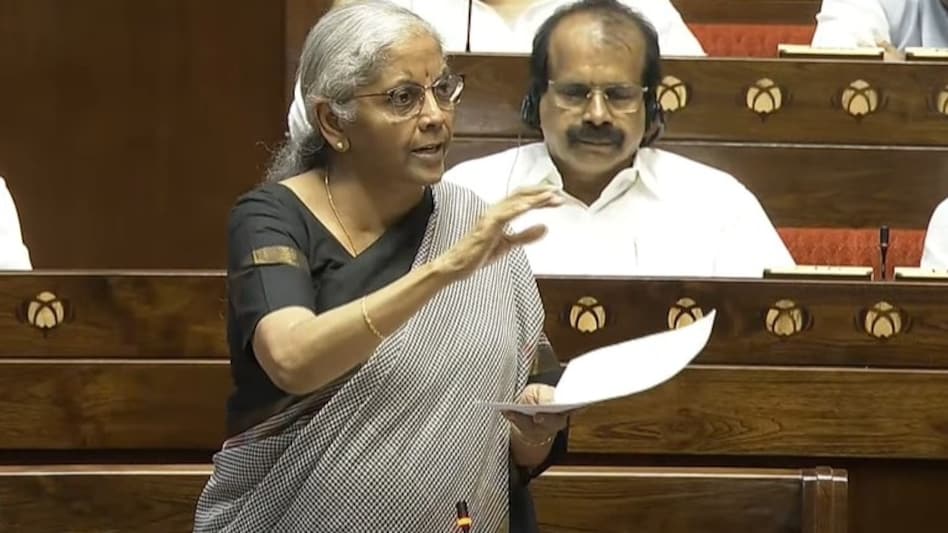
 Finance and Corporate Affairs Minister Nirmala Sitharaman
Finance and Corporate Affairs Minister Nirmala Sitharaman on Tuesday introduced a bill in the Lok Sabha to amend the Insolvency and Bankruptcy Code, 2016. The Insolvency and Bankruptcy Code (Amendment) Bill, 2025 has been referred to a select committee, which will make a report by the first day of the Winter Session of the Parliament.
The long-awaited Bill has introduced several amendments to the IBC, including creditor-initiated insolvency resolution process by amending Section 54A of the Act, group insolvency as well as cross-border insolvency.
“The proposed amendments aim to reduce delays, maximise value for all stakeholders, and improve governance of all processes under the Code. They seek to modify existing provisions to better align with the overall objectives of the Code and to introduce new provisions that follow global best practices for resolving insolvency,” said the Statement of Objects and Reasons of the amendment Bill.
The proposed legislation introduces a ‘creditor-initiated insolvency resolution process’ with an out-of-court initiation mechanism for genuine business failures to facilitate faster and more cost-effective insolvency resolution, with minimal business disruption, it further said, adding that once implemented, this will help ease the burden on judicial systems, promote ease of doing business, and improve access to credit.
The Creditor Initiation Insolvency Resolution process (CIIRP) for specified corporate debtors would be initiated by the financial creditor of a corporate debtor in case of a default by appointing a resolution professional. It would have a minimum interference of the Adjudicating Authority. However, the financial creditor would be expected to get approval from financial creditors of the debtor who represent 55% of the debt. The creditor would also be mandated to inform the corporate debtor of its intention to initiate the CIIRP and give it a period of at least 30 days to make any representation.
The creditor-initiated insolvency resolution process shall be completed within 150 days of commencement of the process, which would be extendable by the adjudicating authority by another 45 days.
Under Group Insolvency, the Bill has proposed that the Centre may prescribe the manner and conditions for conducting insolvency proceedings initiated against two or more corporate debtors that form part of a group. Such rules can provide for a common Bench for the insolvency proceedings of the corporate debtors that form part of a group; coordination between the insolvency proceedings of the corporate debtors that form part of a group, including the coordination between their committee of creditors and interim resolution professionals, resolution professionals, or liquidators; appointment and replacement of a common insolvency professional to facilitate coordination between the insolvency proceedings of the corporate debtors that form part of a group; as well as formation of a committee comprising of the committee of creditors of the corporate debtors that form part of a group.
“The group insolvency framework seeks to efficiently resolve insolvencies involving complex corporate group structures, minimising value destruction caused by fragmented proceedings and maximising value for creditors through coordinated decision-making,” said the statement and objects of reasons.
The cross-border insolvency framework seeks to lay the foundation for protecting stakeholder interests in domestic and foreign proceedings, promoting investor confidence, and aligning domestic practices with international best practices, it further said, adding that this will also pave the way for improved recognition of Indian insolvency proceedings in other jurisdictions.
A landmark legislation, the IBC was enacted to resolve insolvency and bankruptcy cases in a time-bound manner for maximisation of value of assets of individuals, partnership firms, and corporate persons. In the past, it has been amended half a dozen times. The consultations for the current amendments started three years ago, taking issues arising in the implementation of the Code as well as new concepts that have come up.

 Infosys, Tech Mahindra, TCS, Wipro: Why IT shares are down in a rising market today
  AI safety or market control? Anthropic, OpenAI, Google SpaceXAI accused of slowing AI progress
 Cyber hits to fake news: Vaishnaw warns of foul play against India’s semiconductor push
  Raymond, Welspun Living, Alok Industries shares rise up to 8%; here's why
  IIT-B prof to be summoned by police; Director signs 18-point charter amid students’ demands
 Gold Price Target 2026: Expert Sees MCX Gold At ₹1.8 Lakh By Year-End Amid Strong Demand
 Health Insurance: Why Pre-Existing Diseases And Waiting Periods Matter For Buyers
 Crude Oil Above $100: How High Energy Prices And Rupee Weakness Impact Gold Prices In India
 CEA On India’s Manufacturing Rise, Atmanirbhar Bharat And Modi’s Economic Policy
 Health Insurance Buying Guide: 7 Things First-Time Buyers Must Check Before Choosing A Policy
 NSE IPO: India's largest exchange gets 1.73x subscription on Day 3 so far; retail portion booked 94%
 SAMIL shares: Stock fall 2%; company buys 50.1% stake in aerospace & defence firm
 Airtel, NOCIL, Acutaas among top stocks to buy for short-term gains; check target prices & details
 Dilip Buildcon emerges L-1 bidder for Rs 1,265 crore transmission project; stock reactsRaymond, Welspun Living, Alok Industries shares rise up to 8%; here's why NSE IPO: India's largest exchange gets 1.73x subscription on Day 3 so far; retail portion booked 94%
 Apple layoffs: iPhone maker begins fresh job cuts, second round in two months
 BJP MP Nishikant Dubey issues defamation notice to former Finance Secretary Subhash GargSAMIL shares: Stock fall 2%; company buys 50.1% stake in aerospace & defence firmAirtel, NOCIL, Acutaas among top stocks to buy for short-term gains; check target prices & details












