


 Under the previous 2012 base series, inflation had firmed up toward the end of last year, rising to 1.33 percent in December from 0.71 percent a month earlier.
 India’s retail inflation stood at 2.75 percent in January 2026, the first reading under the newly introduced Consumer Price Index (CPI) series with base year 2024=100 .
According to the Ministry of Statistics & Programme Implementation, year-on-year inflation for January was 2.73 percent in rural areas and 2.77 percent in urban centres. The All-India CPI (General) index rose to 104.46 in January from 104.10 in December and 104.01 in November, marking three straight months of sequential gains.
Under the previous 2012 base series, inflation had firmed up toward the end of last year, rising to 1.33 percent in December from 0.71 percent a month earlier.
Food inflation, measured by the Consumer Food Price Index (CFPI), came in at 2.13 percent in January, with rural inflation at 1.96 percent and urban at 2.44 percent. Housing inflation was recorded at 2.05 percent during the month.
The new CPI series reflects significant structural changes in consumption patterns. Based on the Household Consumption Expenditure Survey (HCES) 2023-24, the revised basket expands the number of weighted items to 358 from 299 earlier, with goods rising to 308 and services to 50.
A key shift is the reduced dominance of food. The share of Food and Beverages in the combined index has declined to 36.75 percent under the 2024 series, compared with 42.62 percent under the 2012 structure. Non-food categories now account for over 60 percent of the basket, indicating a broader tilt toward housing, transport, health and services. Rural housing has also been included for the first time, with housing, water, electricity, gas and other fuels carrying a higher weight in the revised structure.
The updated series adopts the international COICOP 2018 classification framework, replacing the earlier six-group format with 12 divisions to enable more granular and globally comparable data. Price collection has also shifted to Computer Assisted Personal Interviewing (CAPI), alongside the use of administrative and online data sources for items such as airfares and streaming services.
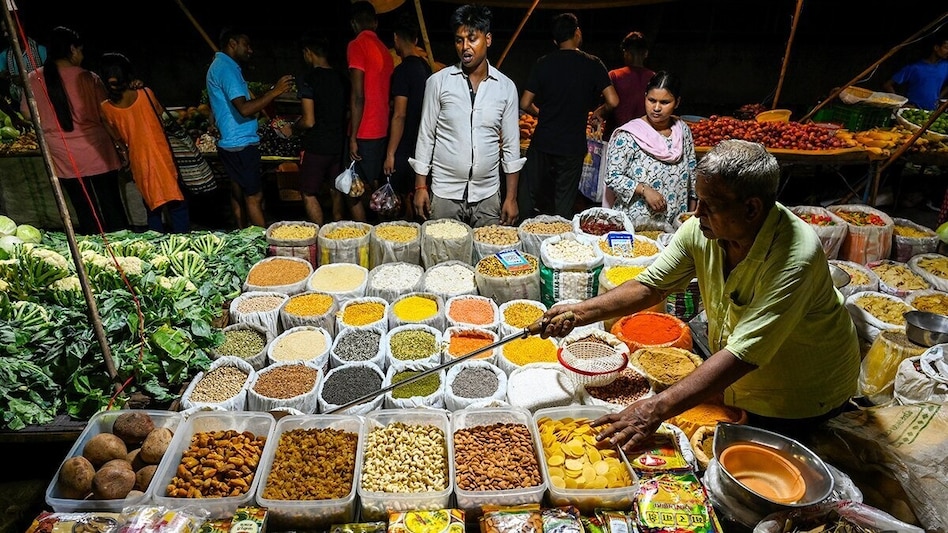
Among items, silver jewellery recorded the highest inflation at 159.67 percent in January, followed by tomato (64.80 percent) and coconut-based products. On the other hand, garlic (-53.05 percent), onion (-29.27 percent) and potato (-28.98 percent) saw sharp declines.
State-level data showed Telangana recording the highest combined inflation at 4.92 percent, followed by Kerala at 3.67 percent and Tamil Nadu at 3.36 percent.
The government said the CPI 2024 series represents a comprehensive strengthening of India’s inflation measurement framework, aligning it more closely with current consumption realities and global best practices .
The next CPI release for February 2026 is scheduled for March 12.

 Where are the jobs: Youth unemployment remains high; fewer jobs for those with higher education in India
 Infosys, OFSS, Coforge shares rally up to 4%; all 10 Nifty IT index stocks rise
 Nitin Gadkari moves Bombay High Court against viral E20 deepfakes, hits Meta with suit
  Brezza goes turbo: Maruti Suzuki packs more power, more tech to woo Gen Z SUV buyers with a starting price tag of ₹7.4 lakh
 Tata Consumer stock: Tata Group's FMCG arm reacts to Q1 earnings show
  Daily Calls: Ask Your STOCK MARKET TODAY QUERIES | Market Update | Share Market News Today
 Pharma, Hospitals Or Diagnostics? InCred CIO Reveals Best Healthcare Bets
 Active Vs Passive Funds: Where Should You Invest? | Mutual Fund Guide | Personal Finance | Money Today
 What’s Hot: Stocks, Gold & Big Money Moves | Daily Markets Show | July 27 | Business Today TV
 BT Infra Summit 2026: Policymakers & Leaders To Outline 'Infra India 2047' Vision In Delhi
 Canara Bank Q1 results: Net profit up 2% at Rs 4,856 crore; NII rises 13%
 Zen Technologies in bear grip: Triggers behind the 10% fall in the defence stock today
  Indo-MIM vs Lohia Corp vs Xtranet Tech: Check biddings status & latest GMPs for 3 IPOs
 Upcoming IPOs: Zepto, Shiprocket, Truhome & others eye to raise Rs 25,000 crore in August
 Caliber Mining shares extend rally, jump 18% to hit fresh high after strong listing; analysts advise caution
 How much does the Education Minister earn? Salary and official facilities explainedDaily Calls: Ask Your STOCK MARKET TODAY QUERIES | Market Update | Share Market News Today
 NFO alert: SBI MF floats Nifty Midcap 150 Momentum 50 ETF FOF; why should you choose itPharma, Hospitals Or Diagnostics? InCred CIO Reveals Best Healthcare BetsActive Vs Passive Funds: Where Should You Invest? | Mutual Fund Guide | Personal Finance | Money Today










