












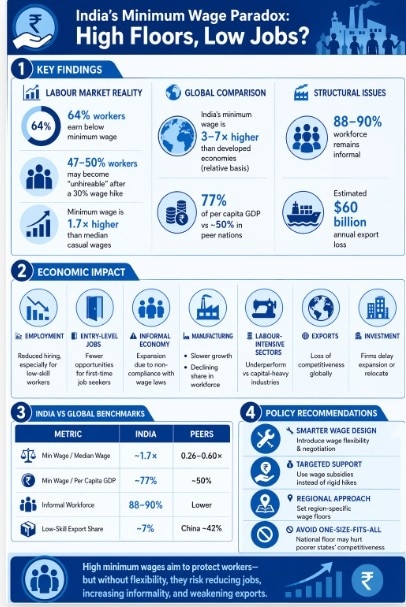



 India's minimum wage is estimated to be 1.7 times the median earnings of casual workers, compared to just 0.26–0.60 times in developed economies.
Minimum wage framework, designed to protect low-income workers, may be inadvertently harming the very group it aims to support, according to a new report by the Foundation for Economic Development (FED). The analysis, backed by global research and India-specific data, argues that high statutory wage floors are reducing employment opportunities, particularly for low-skilled workers, and distorting the labour market.
At the core of the report’s findings is a structural mismatch between mandated wages and actual earning capacity. Using Periodic Labour Force Survey (PLFS) 2023–24 data, the report highlights that nearly 64% of India’s workforce earns below the legal minimum wage, indicating that the floor is set above prevailing market wages.

 Apple launches iPhone 18 Pro, iPhone 18 Pro Max: Brings upgraded performance, camera, and more
 The iPhone folds! Apple unveils its first-ever foldable ‘iPhone Duo’ at Rs 2,99,900
 Apple AirPods 5 launched with best-in-class ANC, Siri AI and Live Translation
 'Comparing apples and oranges': CBIC responds to Subhash Garg's claim on GST growth
 Apple Watch Ultra 4 launched with new health sensing, 45-hour workout battery and AI features
 Tata Curvv EV: First Look At The Tech-Packed Electric SUV
 IDBI Bank Stake Sale: Fairfax Bid, ₹53,000 Cr Valuation & Deal Delay Explained
 Adani Group Plans $2.5 Billion Offshore Loan To Refinance Cement Acquisition Deb
 Sugar Exports Under Pressure: Tight Stocks, Ethanol Diversion & Weather Risks Cloud
 Brent Crude Crosses $100: India’s Oil Basket Hits $108.9; What It Means For Markets
 Index manipulation case: Sebi lifts trading ban on JPMorgan unit after Rs 2.96 crore deposit
 Dow considers exit from $20 billion Saudi Aramco chemicals venture Sadara
 Nifty IT tumbles 3%: Near-term trend weak; AI concerns, US rate worries weigh
 Cupid's Aditya Kumar Halwasiya ups stake again; buys 15 lakh shares
 ASM Technologies stock hits record high as RK Damani entity, Asha Mukul Agrawal back fund raising
 'If mahaprasad has to be stopped, tell us': Ganpati Mandals seek clarity on Maharashtra FDA food safety SOPs
 Have Rs 50 lakh in savings? Check Canara Bank’s new interest rate and what SBI, PNB, BoB offer
 This simple device is helping German renters cut their power bills
 Commercial real estate emerges as a credit hotspot despite higher risk weights: Report
 5 mutual funds bag five-star rating: How Invesco, HSBC, Axis and ITI funds performed


