








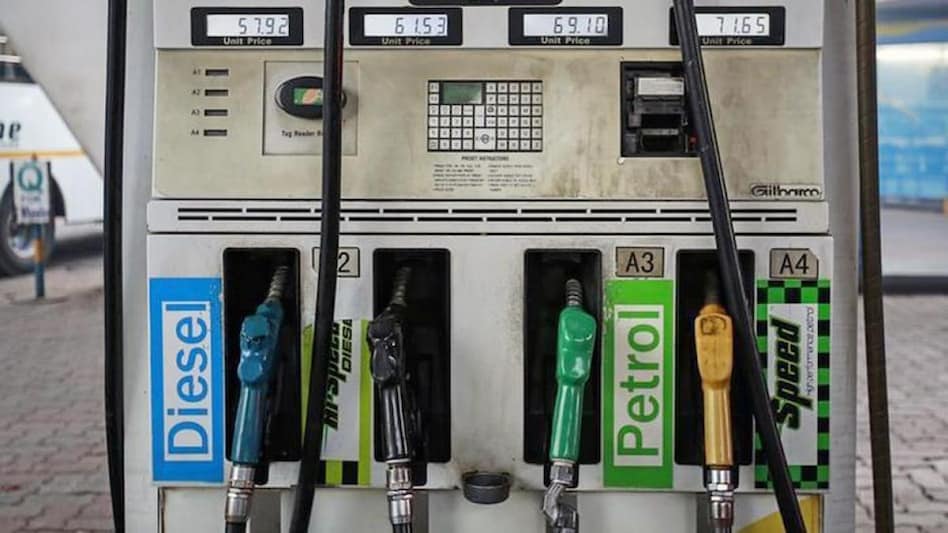
 The minister also added that the government has reduced the central excise duty on petrol and diesel by Rs 5 per litre and Rs 10 per litre respectively from November 4 last year.
 The minister also added that the government has reduced the central excise duty on petrol and diesel by Rs 5 per litre and Rs 10 per litre respectively from November 4 last year.
Minister of State for Finance Pankaj Chaudhary on Tuesday told the Rajya Sabha that the government is working towards making calibrated interventions as per requirement to safeguard the interests of the common man, with regards to fuel prices and excise duty.
He added that the government is keeping a close watch on the geopolitical developments as they evolve. The minister also added that the government has reduced the central excise duty on petrol and diesel by Rs 5 per litre and Rs 10 per litre respectively from November 4 last year.
State governments also reduced the value added tax (VAT) on petrol and diesel, leading to sobering of fuel prices across the country.
Chaudhary noted, “Government is keeping a close watch on these factors and the evolving geo-political developments and would make calibrated interventions as and when required to safeguard the interests of the common man.”
Chaudhary also explained that public sector oil marketing companies (OMCs) take appropriate decisions vis-à-vis petrol and diesel prices by factoring in international product prices, exchange rate, tax structure, inland freight and other cost elements.
“The Public Sector Oil Marketing Companies (OMCs) take appropriate decisions on pricing of petrol and diesel in line with their international product prices, exchange rate, tax structure, inland freight and other cost elements etc,” the Union Minister told the Upper House.
He further noted that crude petroleum and natural gas and fuel and power subgroup (which includes petrol and diesel) in the wholesale price index (WPI) are directly related to fluctuations in the prices of crude oil. The weight of the ‘crude petroleum and natural gas’ and ‘fuel and power’ subgroup in WPI is 2.41 per cent and 13.15 per cent respectively.
Chaudhary also talked at length about the policy measures taken by the government to soften the prices of the edible oil prices such as reducing the duty on edible oils with effect October 14, 2021. Basic duty on refined palm oil/palmolein, refined soyabean oil and refined sunflower oil has been reduced from 32.5 per cent to 17.5 per cent with effect from October 14, 2021.
Department of Food and Public Distribution has imposed stock limits on Edible Oils and Oilseeds for a period of March 31, 2022. “The Removal of Licensing Requirements, Stock Limits and Movement Restrictions on Specified Foodstuffs (Amendment) Order, 2021 has been issued w.e.f. October 8, 2021. It has also been directed to ensure that Edible Oils and Edible Oilseeds stock is regularly declared and updated on the portal of the Department of Food and Public Distribution,” the minister underscored.
He added that the changes in global crude oil prices have both direct and indirect impact on the different components of the WPI, which has not been codified in percentage terms.
On the food security front, the Minister of State for Finance also said that the government is providing subsidised food grains at Rs 3/kg for rice and Rs 2/kg for wheat to the bottom 67 per cent of the population under the Public Distribution System under National Food Security Act, 2013.
He said that the government has procured pulses in 2020-21 and 2021-22 from farmers’ producer’s organisations (FPOs) to ensure effective intervention during price rise through utilisation of buffer stocks. Tur and urad have been kept under the ‘free’ import category till March 31 to augment domestic availability of pulses.
Basic import duty and agriculture infrastructure and development cess on masur have also been brought down to zero and 10 per cent respectively and 5-year MoUs have been inked with Myanmar for annual imports of 2.5 LMT and of urad and 1 LMT of tur, and with Malawi for annual import of 0.50 LMT of tur. The MoU with Mozambique has been extended for another 5 years for annual import of 2 LMT tur.
 Claims of sovereignty loss in India-US trade deal ‘absolute nonsense’: Piyush Goyal
 SEBI draws line between listing norms and RBI rules in guidance to PNB
 India’s US oil imports are strategic decisions, not trade pact obligations: Piyush Goyal
 Domestic airfares set to rise as IndiGo capacity cuts hit summer schedule: Report
 'True luxury is here to stay’: Isprava’s Dhimaan Shah
 BT Golf 2025-26 Kochi, Kerala Awards Ceremony Marks A High-Energy, Successful Conclusion
 Golf Is An Addiction. We Eat And Sleep Golf!
 The Fairway Fixes Everything. Mindset, Life, Relationships
 BT Golf LIVE: Join AU Small Finance Bank Presents BT Golf 2025-26 For Its 4th Leg In Kochi, Kerala
 AI Will Change MBAs, Not Leadership: IMD President On India’s Global Education Rise
 RIL, SBI, Kotak Bank, Kalyan, HAL, BEML, BDL among stocks in focus next week; here’s why
 NSE IPO may unlock mega gains for billionaire investors RK Damani, Premji
 SBI Q3 Results: Profit jumps 24% to Rs 21,028 crore; asset quality improves
 IDBI Bank stake sale: Kotak Mahindra Bank says ‘has not submitted a financial bid’
 BDL, Mazagon Dock, MRF, Hindustan Copper, RVNL, others to turn ex-dividend next week