








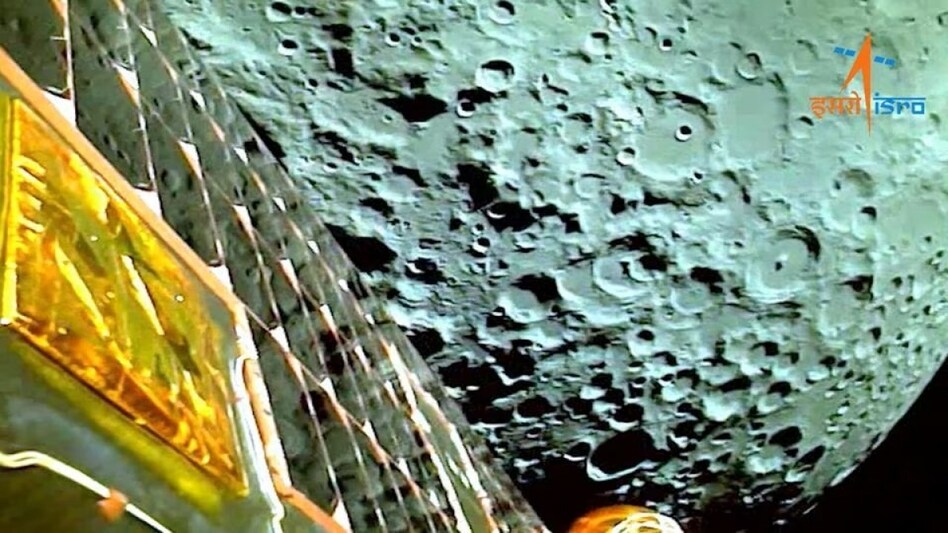
 Chandrayaan-3, which is currently in 25 km x 134 km orbit, is scheduled to land on the south pole of the Moon around 6:04 pm on August 23, Wednesday.
 Chandrayaan-3, which is currently in 25 km x 134 km orbit, is scheduled to land on the south pole of the Moon around 6:04 pm on August 23, Wednesday.
Ahead of Chandryaan-3's planned landing on the lunar surface, a former astronomy professor on Monday shed light on some of the crucial experiments the rover payloads will carry out after its touchdown on the Moon. Chandrayaan-3, which is currently in 25 km x 134 km orbit, is scheduled to land on the south pole of the Moon around 6:04 pm on August 23, Wednesday.
Mayank N Vahia, a former astronomy professor at Tata Institute of Fundamental Research, on Monday spoke extensively about India's lunar mission, which began in October 2008 with Chandrayaan-1. He said the first Chandrayaan mission conclusively established that there's water on the Moon. Since then, he said, the Chandrayaan-2 mission was supposed to put a lander on the southern pole of the moon, where there is a lot of water.
"But for some reason, things didn't work out properly. But the modular mission for Chandrayaan-2 has been remarkably successful and has worked extremely well to the extent that Chandrayaan-3 does not even have an orbiter. It is going to use the Chandrayaan-2 orbiter to communicate with Earth...to tell us all the data and understandings it will generate about the Moon," Vahia said while speaking to news agency ANI.
Also read: Chandrayaan-3: Russian Consul General wishes luck to India’s Moon mission after Luna-25 crash
The scientist, who retired from the Department of Astronomy and Astrophysics in October 2018 after nearly four decades, further said that all previous successful missions on the Moon have landed on the equator, which is smoother and therefore easy to land on. "But there are a lot of mountains, meteor-impact craters, and the surface is dangerously uneven," he said.
"To give you an idea of how difficult it is to land on (the south pole of) the Moon, you can see that the Russians with so much experience did not succeed in landing Luna-25," Vahia added referring to the tragic failure of Russia's first lunar mission in 47 years. Russia's Luna-25 was supposed to land on the south poll on August 21 but it deviated from the path as the lander's engine reportedly did not shut off as planned and crash-landed on the Moon.
WATCH: Chandrayaan-3: Here's How Its Mission Components Stack Up
The professor said that the Indian Space Research Organisation (ISRO) has a great challenge ahead of it, and they have learned a lot from past mistakes. He sounded confident that Chandrayaan-3 will successfully land on August 23. He said once the lander module lands there, the lander and rover will give the scientists "a phenomenal amount of data about water which will be crucial for any human habitation on the Moon".
"Chandrayaan-3 will help us understand water, water sources, and minerals in the southern pole," the former professor said.
 Cyber attacks, AI misuse and data privacy rules emerge as top boardroom risks for India Inc
 'India has played it pretty safe, deal is very balanced': Top agri economist on India–US trade agreement
 NSE IPO may unlock mega gains for billionaire investors RK Damani, Premji
 'The real sting is the monitoring': Brahma Chellaney flags risk for India in Trump's Russian oil order
 Moltbook hype unravels: Viral posts were human-written, not AI, finds MIT Technology Review
 BT Golf 2025-26 Kochi, Kerala Awards Ceremony Marks A High-Energy, Successful Conclusion
 Golf Is An Addiction. We Eat And Sleep Golf!
 The Fairway Fixes Everything. Mindset, Life, Relationships
 BT Golf LIVE: Join AU Small Finance Bank Presents BT Golf 2025-26 For Its 4th Leg In Kochi, Kerala
 AI Will Change MBAs, Not Leadership: IMD President On India’s Global Education Rise
 RIL, SBI, Kotak Bank, Kalyan, HAL, BEML, BDL among stocks in focus next week; here’s whyNSE IPO may unlock mega gains for billionaire investors RK Damani, Premji
 SBI Q3 Results: Profit jumps 24% to Rs 21,028 crore; asset quality improves
 IDBI Bank stake sale: Kotak Mahindra Bank says ‘has not submitted a financial bid’
 BDL, Mazagon Dock, MRF, Hindustan Copper, RVNL, others to turn ex-dividend next week