


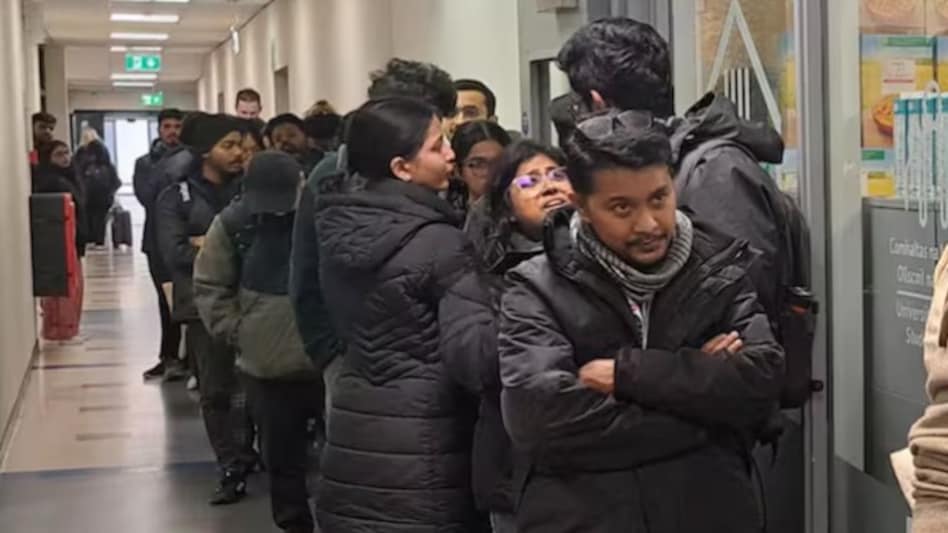
 The article instead focused on the growing number of students — across backgrounds — struggling with rent, groceries and energy costs.
 A photograph of students queuing outside a campus food pantry in Ireland has ignited an online debate — less about student poverty and more about assumptions viewers made from the image.
The picture accompanied a February 21 report by The Irish Times on mounting pressure at a student-run food bank at the University of Galway. The article described how the service, grappling with rising demand amid a worsening cost-of-living crisis, has been forced to turn away hundreds of students each week.
Soon after publication, the photograph began circulating widely on X, where some users speculated — without evidence — that many of those in line were Indian nationals on student visas. Posts questioned why international students would access such services, shifting attention away from the broader issue of student hardship.
One widely shared post claimed that “90%+” of those pictured were Indian students and questioned their ability to support themselves. Another user, referencing visits to London School of Economics and University College London, alleged that free food initiatives there were also dominated by foreign students.
However, the original report did not identify the nationalities of those in the queue, nor did it attribute the food bank’s shortages to international students. The article instead focused on the growing number of students — across backgrounds — struggling with rent, groceries and energy costs.
Similar Controversy in Canada
The debate echoed a separate incident in Canada in April 2024, when an Indian-origin graduate student, Mehul Prajapati, faced backlash after posting a video about using student food banks to cut personal expenses.
Prajapati, who was pursuing a master’s degree while working as a data scientist at TD Bank, shared a clip describing how he saved “hundreds of bucks” each month by relying on food banks operated by charities, churches and student groups. The video showed bags of groceries including produce and canned goods.
After the clip went viral, critics online argued that food banks were intended for those in financial distress, not salaried professionals. Social media users circulated posts highlighting his employment and alleged income, fuelling outrage and harassment that reportedly led him to remove his LinkedIn profile.
Both episodes illustrate how quickly online narratives can form around images or short videos, often detached from the original context. In the Galway case, what began as a report on student poverty evolved into a polarised discussion about immigration and entitlement — despite no evidence linking nationality to the strain on services.

 US-Iran pause attacks for second day; Trump 'giving talks some space' as Hormuz deal discussed
 New paper leak bill in Lok Sabha today, proposes harsher punishment; MPs given draft
 US-Iran war: Red Sea shipping traffic falls, Hormuz traffic remains low amid security concerns
 BEL Q1 results today: What consensus estimates, target prices suggest
 Zen Technologies: High altitude anti-drone system's launch puts defence stock in focus
  AI Data Centers, Aerospace & Gas Turbines: What's Powering Indo-MIM's Future Growth?
 Best Healthcare Stocks: Gaurang Shah's Outlook On Apollo Hospitals, Fortis & The Manipal Health IPO
 Is Indo-MIM's IPO Valuation Justified? Here's Why The Company Sees Strong Growth Ahead
 Treasury Bills Explained: Why T-Bills Are One Of The Safest Short-Term Investment Options
 FDs vs Markets: Where Should You Keep Your Short-Term Money?
 Market opens higher after four days, investor wealth up by Rs 4 lakh crore; here's why
  REC, JK Cements, HAL among top trading picks for short-term gains; check targets & more
 Coforge shares gain ahead of Q1 results: Profit may rise 80-90%; Encore integration eyed
 Nifty, Bank Nifty outlook: Avoid fresh longs; check key support & resistance levels
 YES Bank, Inox Wind, MCX: Top stocks to trade— Key levels, target price, stop loss & moreMarket opens higher after four days, investor wealth up by Rs 4 lakh crore; here's why REC, JK Cements, HAL among top trading picks for short-term gains; check targets & moreCoforge shares gain ahead of Q1 results: Profit may rise 80-90%; Encore integration eyed
 India's first hydrogen train covers 900 km in 5 days — tickets still Rs 10–25, zero emissions, water vapour onlyNifty, Bank Nifty outlook: Avoid fresh longs; check key support & resistance levels









