


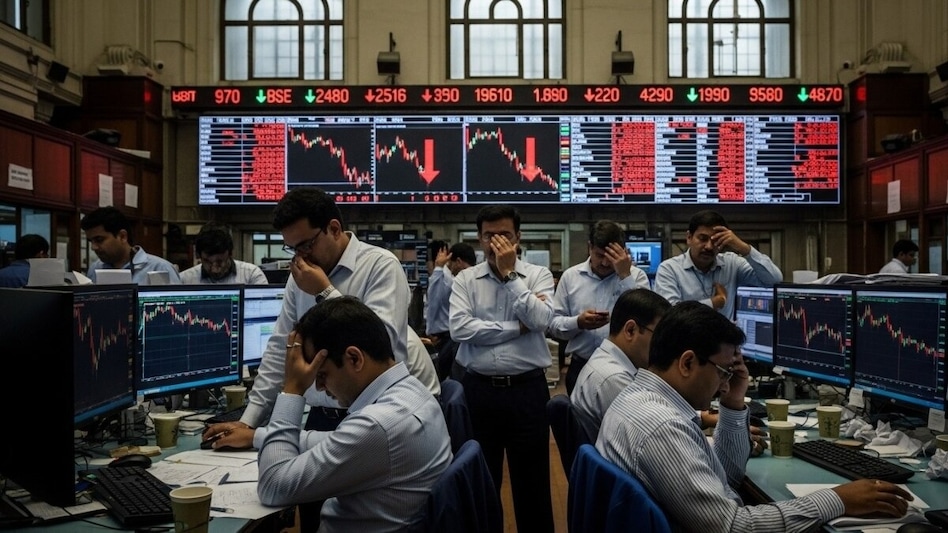
 Reliance Industries: The stock has fallen 4.70 per cent in two sessions. (Image: AI generated image for representational purpose only)
Shares of Reliance Industries Ltd (RIL) declined 3.41 per cent on Monday to settle at Rs 1,304.75. At this closing level, the stock has fallen 4.70 per cent in two sessions.
Deven Choksey, Managing Director at DRChoksey FinServ Pvt, said the fundamentals for RIL remain in shape. "I don't see anything wrong with the fundamentals. Yes, to a certain extent, you might have a little adversity in the raw material prices and the resulting impact. That is from the oil to chemical business, but you can't generalise it across the board for all the products of Reliance. I don't think that Jio Platforms or the retail segments are facing anything adverse. So from that perspective, the stock remains pretty okay," the market veteran told Business Today.

 Bahrain Court rejects claims by investors in Credit Suisse AT1 bonds case against HDFC Bank
 It's official: Xi Jinping will attend BRICS Summit in New Delhi
  Insolvency regulator sounds alarm over misuse of bankruptcy law; tells professionals to dig deeper
 Coforge after OP Bhatt: Advent’s growing influence puts board dynamics under spotlight
 Westinghouse plans 18 nuclear power plants in India by 2047
 Manipal Cards IPO: Management Shares Growth Roadmap, Financial Outlook & Key Plans
 Market Guru: Finding Value In Indian Stocks Amid Market Volatility | George Thomas
 Hero Motors IPO Full Review | Business, Financials, EVs & Global Expansion
 ESDS Stock Surge | Exclusive: CMD Piyush Somani On IPO Success, Growth Strategy & Future Plans
 Market Commentary: Chandan Taparia On Nifty, Stocks & The Next Big Move
 Power stocks: Nuvama picks ACME Solar, NTPC, Power Grid; check target prices
 FII outflows, market correction: Client Associates’ Himanshu Kohli on where investors should put their money now
 MSCI India rebalancing went well under CAS, says SEBI chief: Report
 HFCL share price: Why recent rally is a red flag; analyst says this on fresh entry
 Sell IRFC on rallies, railway stocks may stay subdued despite fresh orders, says analyst
 Swiggy’s LYNK exit: non-core asset cleanup, with a bet on Udaan’s IPO
 ‘Time for India’s manufacturing to pick up’: Anant Goenka flags opportunity from global supply-chain shifts
 Bank holiday alert: Check where SBI, HDFC Bank, ICICI and PNB branches will be shutPower stocks: Nuvama picks ACME Solar, NTPC, Power Grid; check target prices
 Noida airport’s first foreign aircraft landing: 3 Russian military planes arrive for BRICS Summit












