















 RJio extended its subscriber market share leadership with 70 basi points YoY increase to reach 46.5 per cent, followed by Bharti (up 50 bps YoY) at 36.6 per cent. Vodafone Idea lost another 120 bps YoY market share in FY26.
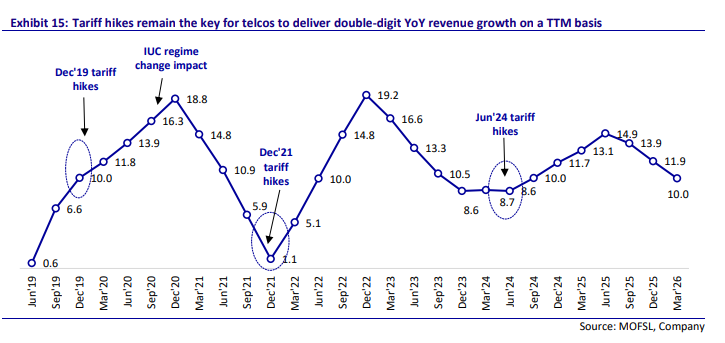
Tariff hikes hold the key for telecom players such as Vodafone Idea Ltd and Bharti Airtel Ltd to deliver double-digit year-on-year (YoY) revenue growth in FY27, MOFSL said on Monday. The brokerage noted that more than 50 per cent of Reliance Jio’s subscribers have now opted for 5G and felt the free unlimited 5G offerings, which acted as a headwind to data monetisation, must stop. Telcom operators including Bharti Airtel, Rjio and Vodafone Idea are seen starting monetising higher data consumption on 5G.
MOFSL said the benefits of the tariff hikes now in the base and the wireless revenue growth moderated to 7 per cent YoY in Q4. In the absence of a tariff hike soon, the wireless revenue growth for private telcos could remain subdued over the next few quarters.

 BT BIG STORY: India has failed to build an ecosystem of battery cells. Can a new PLI change this?
 BT Explainer | Jio IPO Day 2: How you can apply under two categories with one PAN card
 Jio IPO Day 2: Can Akash Ambani repeat Dhirubhai Ambani's legacy of wealth creation?
 Critical PHP vulnerabilities: What is it, how it can affect websites & what should users know?
 BT Explainer: China’s critical mineral refining edge - What India must do to catch up
 Amit Goel Bets On Nifty, RIL & HDFC Bank As Large Caps Offer A Fresh Opportunity
 Amit Goel On Indian Markets: 20% Upside, Cheap Nifty Valuations & The AI Bubble Risk
 Love, Obsession & Horror: 5 New Films Releasing This Friday | Theater Releases This Week | Movies |
 U.S.-India Trade Deal: Why Markets Remain Cautious During Marco Rubio’s Visit
 Market Volatility: Pankaj Pandey Sees Buying Opportunities In Midcaps And Smallcaps
 BT Explainer | Jio IPO Day 2: How you can apply under two categories with one PAN card
 Diwali Muhurat trading 2026: Can one special session make a difference to your investment returns?Jio IPO Day 2: Can Akash Ambani repeat Dhirubhai Ambani's legacy of wealth creation?
 Jio Platforms IPO: SBI Focused Fund leads mutual fund anchor allotments at ₹315 crore
 Jio IPO explained: Can subscriber scale and profit growth justify its premium valuation over Airtel?
 The Young and the Restive: Are there enough jobs for the educated young
 Google’s former CEO reportedly owns 1% of Anthropic: How Eric Schmidt’s investment is a lesson in wealth creation
 Quote of the Day by Deepinder Goyal: 'Have a learning mindset. The three hardest words in the world are: I don't know'
 'Exercise due caution': India warns citizens in France as violent protests prompt local curfewsCritical PHP vulnerabilities: What is it, how it can affect websites & what should users know?


