MUST READ | 300-350 mm rainfall alert: IMD issues extreme warning for next 24 hours as vortex forms near Mumbai
From the towering Western Ghats and the moisture-rich Arabian Sea to high tides and a city built largely on reclaimed land, multiple factors combine to create what many describe as Mumbai's "bathtub effect" — where rainwater accumulates faster than it can drain away.
How the Western Ghats squeeze out rain
Mumbai's location on India's west coast puts it directly in the path of moisture-laden southwesterly monsoon winds. Just inland, the Western Ghats rise abruptly like a giant wall stretching parallel to the coast.
When these moisture-heavy winds collide with the mountains, they are forced upwards. As the air rises, it cools rapidly, causing water vapour to condense into dense rain clouds that release torrential rainfall over Mumbai and the Konkan coast. Meteorologists call this orographic rainfall, and it is one of the primary reasons the region receives some of India's heaviest monsoon rain.
The Arabian Sea 'moisture pump'
The Arabian Sea acts as a vast reservoir of warm, moisture-rich air throughout the southwest monsoon.
Persistent southwesterly winds continuously transport moisture towards Mumbai, effectively "recharging" the atmosphere. Even after one spell of heavy rain passes, fresh moisture quickly replaces it, allowing new rain bands to form. This near-constant supply of water vapour explains why the city can experience prolonged periods of heavy rainfall lasting several hours — or even days.
Rain magnet off Konkan coast
Another crucial ingredient is an offshore trough — an elongated zone of low pressure that frequently develops parallel to the Konkan coastline during the monsoon.
DO CHECKOUT | Mumbai rains disrupt formal launch of bullet train tunnel-boring work; Rail ministry orders immediate start
This trough acts like a conveyor belt for rain. It pulls in additional moisture from the Arabian Sea, encourages cloud formation and slows the movement of rain-bearing weather systems. Instead of moving inland quickly, these systems often linger over Mumbai, producing repeated spells of heavy to extremely heavy rainfall.
When low-pressure systems or cyclonic circulations develop over western India or the adjoining Arabian Sea, the offshore trough becomes even more active, significantly increasing rainfall over the Mumbai Metropolitan Region.
A city built on reclaimed land
Nature explains why Mumbai receives intense rainfall. Geography explains why the city struggles to cope with it. Modern Mumbai was created by joining seven islands through centuries of land reclamation. Many reclaimed areas sit only a few metres above sea level, making them naturally vulnerable to flooding.
Several flood-prone locations — including Hindmata, Sion, King's Circle, Kurla, Milan Subway, Andheri Subway and parts of Dadar and Bandra — are situated in low-lying areas where water naturally collects during heavy rain.
High tide blocks the city's drains
Mumbai's stormwater drainage network ultimately empties into the Arabian Sea. But during high tide, seawater pushes against drainage outfalls, reducing or completely blocking the flow of rainwater into the sea.
If an intense downpour coincides with high tide, rainwater has nowhere to escape. It backs up through drains and spreads across roads, railway tracks and residential neighbourhoods. This combination of heavy rain and high tide has been responsible for many of Mumbai's worst flooding episodes.
Large parts of Mumbai's stormwater drainage system were originally designed during the British era to handle rainfall intensities significantly lower than those seen today.
Although the Brihanmumbai Municipal Corporation (BMC) has expanded and upgraded the network many sections continue to rely on ageing infrastructure. Plastic waste, silt and debris further reduce drainage capacity, slowing the movement of water during peak rainfall.
Too much rain in too little time
Mumbai receives an average of around 2,200 mm of rainfall each year, with most of it arriving between June and September.
Increasingly, however, the challenge isn't the seasonal total but the intensity. Climate experts say short-duration, high-intensity rainfall events are becoming more common.
When more than 100-200 mm of rain falls within just a few hours, even upgraded drainage systems struggle to cope. The sheer volume of water reaches the ground faster than it can be carried away.
Urban sponge struggle
Mumbai once had extensive mangroves, wetlands, salt pans and open spaces that naturally absorbed excess rainwater before it reached roads and drains.
Rapid urbanisation has steadily reduced these natural buffers. Concrete roads, buildings and paved surfaces now dominate much of the city, leaving little room for rainwater to seep into the ground.
Instead, runoff rushes into stormwater drains almost immediately, overwhelming infrastructure designed for far less intense rainfall.
Mithi River bottleneck
The Mithi River is one of Mumbai's most important flood channels, carrying excess rainwater into the Arabian Sea. Over the years, encroachments, narrowing of the river channel, pollution and siltation have reduced its ability to transport large volumes of water efficiently.
As a result, areas around Kurla, Saki Naka, Bandra-Kurla Complex (BKC), Dharavi and adjoining neighbourhoods remain especially vulnerable during intense rainfall.
Scientists say climate change is increasing the likelihood of extreme rainfall events along India's west coast. Warmer sea surface temperatures over the Arabian Sea allow the atmosphere to hold more moisture. When favourable weather systems such as offshore troughs, cyclonic circulations or low-pressure areas develop, they can release enormous amounts of rain over short periods.
Can Mumbai fight back?
Authorities have invested in larger stormwater drains, pumping stations, flood gates, desilting operations and real-time weather monitoring to reduce flood risks.
Experts, however, say engineering solutions alone are unlikely to be enough. Restoring wetlands and mangroves, protecting natural drainage channels, improving waste management, preventing construction on floodplains and planning future development around the city's natural hydrology will be equally important.
When these forces coincide, Mumbai's drainage system is overwhelmed. Rainwater has nowhere to go, pooling rapidly across roads, rail lines and neighbourhoods. That is why, year after year, India's financial capital transforms into what residents have come to know as a giant "bathtub" every monsoon.


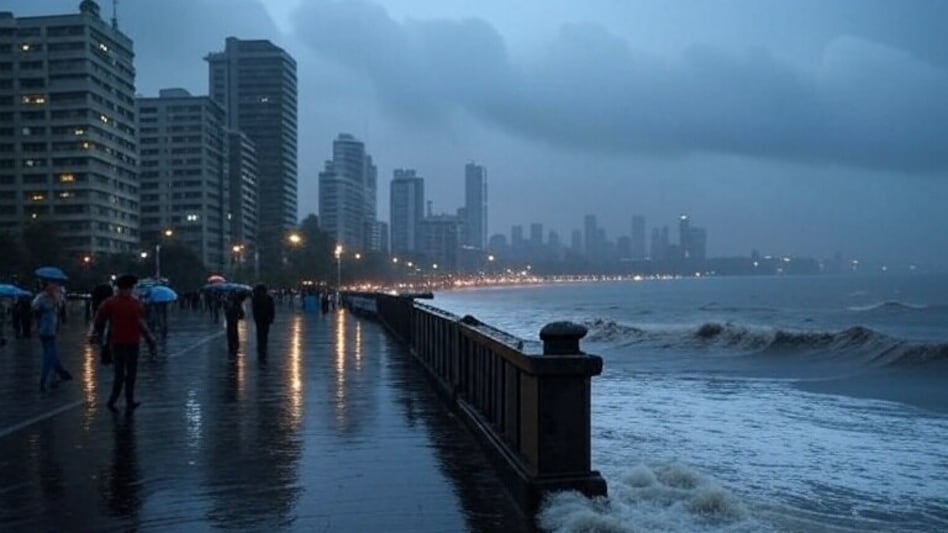 The latest spell of heavy rainfall has once again left several parts of the city waterlogged, even as weather agencies warn that more rain could follow.
  BT Big Story: Why India Inc is warming up to non-English-speaking executives
  Govt may consider auto PLI applications from firms with Chinese investments: Report
 G20 Summit: PM Modi expected to travel to US; bilateral with Trump likely on the cards, say sources
 SS Retail, Jindal Supreme make solid stock market debut; Hero Motors disappoints with a weak listing
 Tata Sons IPO battle: Why Shapoor Mistry has so much at stake
 Macro Volatility Vs Earnings: Why Earnings Matter More Than Valuations | Anshul Saigal
 India’s CDMO Opportunity: Anshul Saigal Spots Underappreciated Names
 IT Stocks Under Pressure: What Next For Indian Markets? | Chakri Lokapriya
 Karnataka’s Welfare Schemes Under Pressure As Finance Department Flags New Challenges
 Family Disputes Can Hold Businesses Back: Nirmala Sitharaman’s Message To Family Firms
 PC Jeweller shares jump 9% to hit 52-week high; stock gains 83% in six months
 Ola Electric shares jump over 12% today; what analysts say
 Elevate Campuses IPO opens today: Should you subscribe? Check price band, reviews, fresh GMP & more
 ITC share price: Recent recovery raises investors' hopes; price targets, technicals and more
  Apple’s next big health gadget could be a screenless fitness band
 Apple October Event: From OLED iPad mini to Home Hub, here’s what Apple may launch
 ₹50 fine for methi in tiffin? Maharashtra school faces civic body notice, parents' food concerns grow












