


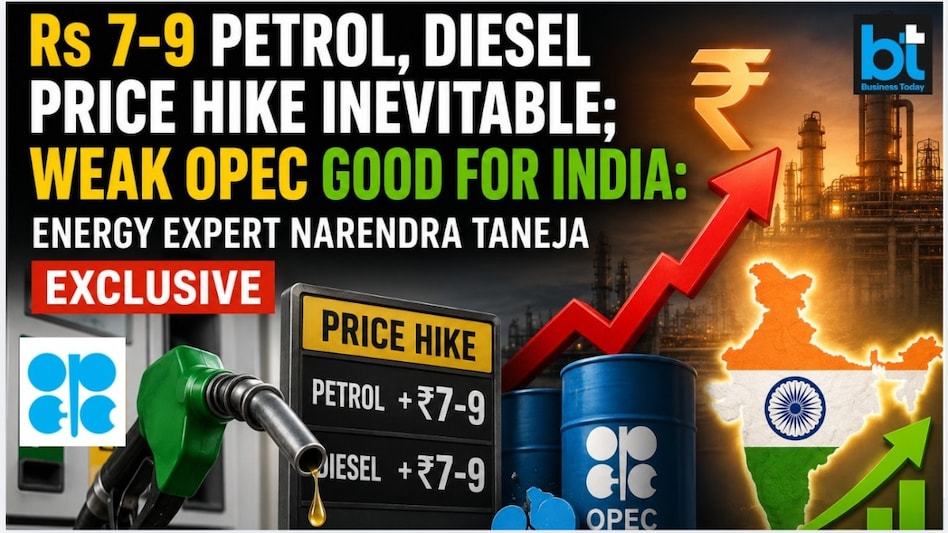
 Fuel price hike: Phased implementation - Rather than a sudden, one-time shock, Taneja suggests the govt will likely opt for a "middle path," implementing gradual, smaller hikes (e.g., 50 to 90 paise at a time) to manage the impact on the public .
Renowned energy expert Narendra Taneja in a exclusive conversation on Business Today Television (BTTV) during Market Masters show with Shailendra Bhatnagar, Chief Analyst & Editor, Markets, discussed the inevitability of fuel price hikes in India due to the ongoing global energy crisis. Here are the key takeaways from the discussion:-
Inevitable Price Increase:
FAQs
Why are petrol and diesel prices in India likely to go up, according to Narendra Taneja?
Narendra Taneja said a fuel price hike is inevitable because of the ongoing global energy crisis. He expects petrol and diesel prices in India to rise by around ₹7 to ₹9 per litre overall, as oil companies are under financial pressure.
How may the Indian government implement the expected fuel price hike?
Instead of a sharp one-time increase, the government may take a middle path and raise prices in phases. Taneja suggested smaller hikes of about 50 to 90 paise at a time so that the burden on consumers is more manageable.
Why is a weaker OPEC seen as good news for India’s energy security?
Taneja believes a weakened OPEC is positive for India because it reduces the influence of oil cartels on global supply and pricing. For a major energy-importing country like India, stronger direct ties with countries such as the UAE can support more stable and strategic energy security.

 India must move from assembly-led growth to end-to-end manufacturing capability: N Chandrasekaran
 Will RBI hike repo rate? MPC begins 3-day meet as surging crude oil, inflation test policy limits
 HDFC Bank shares rise, m-cap swells Rs 12,027 crore as Anup Bagchi named MD & CEO
 Beyond tax slabs: FM Sitharaman signals upcoming GST Council push for process reforms
 Up 1,050% in 9 months! Nirmal Bang sees 40% upside in this multibagger stock; here's why
 Gold Vs Silver: Which Should Investors Buy? Ajay Kedia Shares His 70:30 split Strategy
 Can You Sell Bonds Before Maturity? Liquidity, Exit & Penalties Explained
 Bonds Vs FDs: Are Bonds A Better Alternative For Higher Returns? Risks Explained
 Should You Buy Gold Now? Festive and Wedding Season Strategy Explained
 Direct Vs Regular Mutual Funds: Why the Right Advisor May Matter More Than 1% Cost
 LG Electronics shares jump 6% to hit record high; what's fuelling the rise?
 L&T shares advance 2% on bagging orders across Saudi Arabia, UAE and India
 Suzlon, BHEL, Adani Power, Tata Power, Waaree, Inox Wind, NTPC: Q2 results preview; likely hits & misses
  South Indian Bank stock gains 3% on Q2 business update, can it breach record high?
 Electrical products maker Biocon Electric files DRHP with SEBI to launch IPO; key details
 Festive season travel shocker: IndiGo hikes fuel surcharge across all routes
 Will MDR help UPI become sustainable?LG Electronics shares jump 6% to hit record high; what's fuelling the rise?
 ‘No amount of whataboutery can...’: Justice Ujjal Bhuyan on denying voting rights amid SIR rowL&T shares advance 2% on bagging orders across Saudi Arabia, UAE and India












