












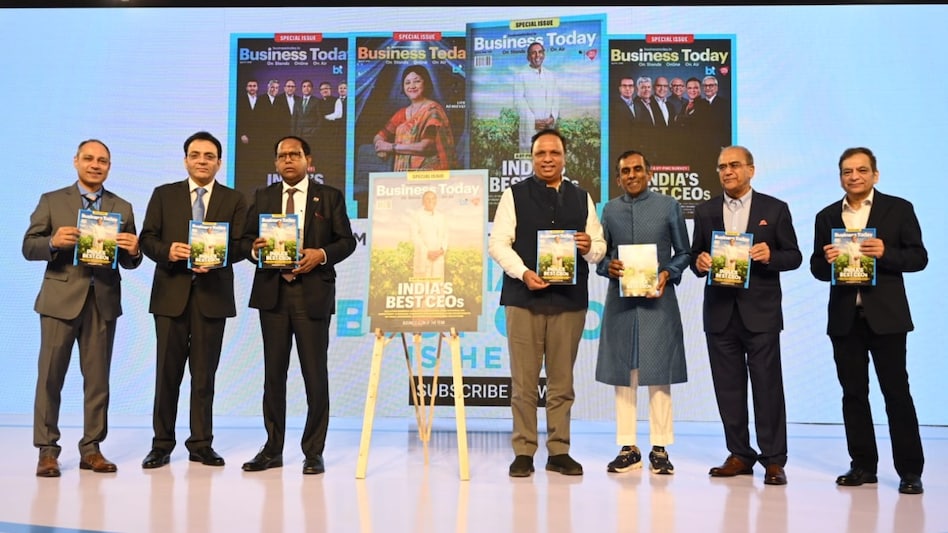
 (Second from right) Aroon Purie, Chairman and Editor-in-Chief of India Today Group, reflected on how dramatically the global environment has changed over the years.
 (Second from right) Aroon Purie, Chairman and Editor-in-Chief of India Today Group, reflected on how dramatically the global environment has changed over the years.
Global uncertainty, trade disruptions, and geopolitical tensions are reshaping the business landscape, demanding faster decisions and deeper reforms from India Inc, a theme that dominated the 14th edition of the Business Today MindRush & Best CEOs Awards.
Opening his remarks, Aroon Purie, Chairman and Editor-in-Chief of India Today Group, reflected on how dramatically the global environment has changed over the years. “When we held the business today, first business today mind rush 14 years ago. The world felt far more predictable than it is today,” he said, recalling a time when there was “a broad sense that global economic progress and the era of open trade… would continue to move in one direction.”
That optimism, he noted, has since faded. “Last year, we were hit by the Trump trade tsunami… this year… we have an unprecedented crisis next door,” he said, pointing to the cascading effects on global supply chains. He added that the conflict “has global ramifications” and the world is “currently experiencing its severe impact on our oil and gas supplies coupled with price shocks, shortages and shutdowns.”
Even amid these disruptions, Purie underscored the potential for opportunity. “I believe opportunity often comes wrapped in adversity,” he said, citing how US trade policies forced India to diversify export markets. “In about 12 months we've tied up five trade free trade agreements and more are in the works,” he added, expressing hope that the current crisis will also push India to reassess its energy strategy.
Raising concerns about India’s competitiveness, Purie did not mince words on regulatory bottlenecks. “One of the biggest hurdles… is our suffocating regulations which constrain our business and stifle our entrepreneurial capabilities,” he said, noting that while a deregulation commission has been set up, “they have a long way to go.”
Reiterating a point he has made before, he said, “deregulation must be an act of surgery, not homeopathy. And I still maintain that,” even suggesting the need for sharper institutional intervention, albeit “without the excesses of Elon Musk.”
Purie emphasised that reform must go hand in hand with accountability. “Real entrepreneurs… don't need protection from competition. They need freedom from friction,” he said, while cautioning that “deregulation without accountability means chaos” and could lead to “rent seeking and market manipulation.”
Calling for greater foreign investment, he said India must address on-ground challenges. “Ask any serious foreign investor… they will not say our talent is insufficient… They will point to the wide gulf between well-intentioned policy and… on ground practices,” he noted.
On the shifting global order, Purie observed, “Today geopolitics is no longer in the background of business decisions. It is in the center of them,” adding that such periods “tend to separate those who move early from those who spend too long interpreting what is happening.” His message was clear: “India must move among those who move swiftly.”
He also offered a frank assessment of India’s performance in leveraging global shifts. Referring to the “China plus one” opportunity, he said, “On paper, India had all the advantages… And yet, other nations have moved faster in many spheres.” Stressing urgency, he added, “Opportunities do not wait indefinitely. Windows open and windows close.”
Despite these concerns, Purie struck an optimistic note. “Although I belong to a profession known to be of skeptics, I remain optimistic about India,” he said, pointing to tangible strengths. He highlighted that “the expansion of the consumer base is real,” that “digital public infrastructure has created efficiencies on a scale that very few countries have managed,” and that younger Indians are “more global, more confident and less constrained.”
Reflecting on leadership, Purie said the most effective CEOs are those who maintain clarity in uncertain times. “Clarity of purpose and more important… clarity of values… clarity about what they would not compromise on,” he said, adding that “the leaders we honor tonight have passed that test.”
He underscored the importance of trust in business, stating, “In the long run, trust is the only currency that compounds,” and cautioned, “fortunes can be made and unmade, but reputations once lost is lost forever.”
Looking back at India’s economic journey, Purie recalled founding India Today during a period of scarcity and Business Today in the wake of liberalisation. While acknowledging progress, he warned against complacency. “The risk is not that we fail to grow. The risk is that we assume growth is inevitable. It is not,” he said, stressing that growth “requires continuous effort, constant adjustment, and a willingness to confront what is not working.”
He concluded by congratulating the award winners, noting that they have “set high standards” and urging them to keep raising the bar, even as India navigates an increasingly complex global landscape.
 'EV penetration to hit 50% in next 5-7 years': Mahindra Group CEO Anish Shah
 India more resilient than many economies due to strong domestic consumption: Salesforce South Asia CEO Arundhati Bhattacharya
 'No immediate fertiliser shortage risk for next crop cycle': Coromandel’s Arun Alagappan
 ‘Disruption is normal now’: Himadri Speciality Chemical CMD on turning crises into opportunity
 Pharma not immediately hit by oil crisis, but big disruption looms in coming 2-3 months: Sharvil Patel of Zydus Lifesciences
 A Leader’s Journey | Arundhati Bhattacharya On SBI Transformation & Digital India
 Powering India’s Fertiliser Resilience | Arun Alagappan On Agri Strategy & Growth
 The Corner Office: Leading Through Disruption | CEOs Decode Strategy & Risk
 Navigating The Dire Straits | India Inc On Trade, Inflation & Global Disruptions
 Capital Markets At The Crossroads | NSE’s Ashish Chauhan On India’s Market Future
 Why Goldman Sachs cut its Nifty target - Check new target
 JSW Steel, Coal India, Paytm, Sammaan Capital, Thermax among stocks in focus next week; here’s why
 ‘Excess equity returns globally to correct’: Shankar Sharma bets on hard assets
 Exceptional market returns are made when you invest in times like this: Madhusudan Kela
 Sensex, Nifty outlook for Monday, March 30: What to expect from stock market? Key levels, trading strategy & more