












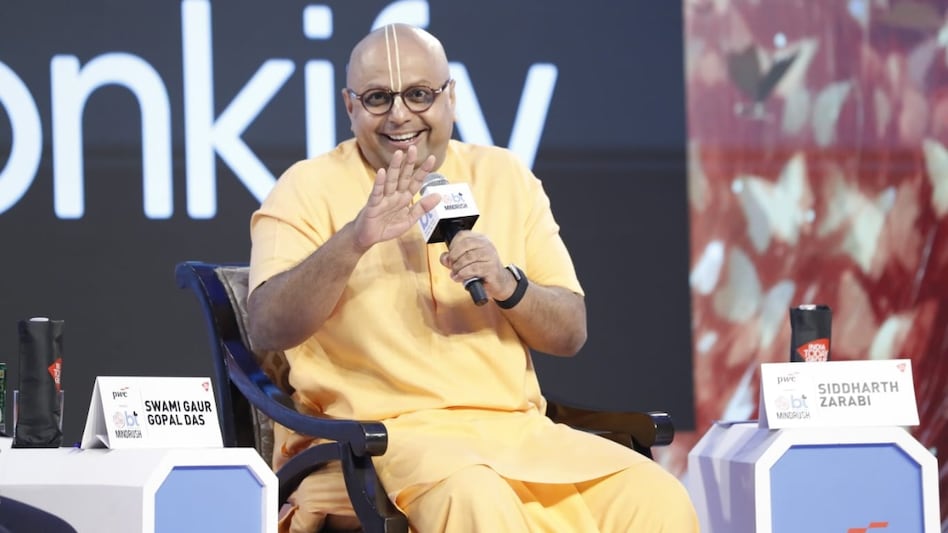
 Drawing from the Bhagavad Gita, he described stillness as a leadership tool. “In stillness, you can reflect better… prioritise better… respond better.”
  Drawing from the Bhagavad Gita, he described stillness as a leadership tool. “In stillness, you can reflect better… prioritise better… respond better.”
 At the Business Today MindRush & India’s Best CEOs Awards, monk and author Gaur Gopal Das delivered a clear message to business leaders: in times of uncertainty, restraint matters more than reaction.
Speaking at a session titled “The Inner Anchor in Turbulent Times”, Das focused on how leaders can maintain clarity and balance amid global disruptions, economic volatility and workplace pressures.
Opening with an anecdote about being stuck in traffic before the session, Das used it to highlight a broader leadership flaw — impulsive decision-making under pressure.
“The most certain thing to do is not be impulsive,” he said, adding that leaders often chase “instant closures” to ease mental discomfort, even if it leads to poor outcomes.
He stressed that reacting quickly does not necessarily mean responding effectively. Das framed resilience as a deeper cultural strength, not just a function of growth or policy.
“We are talking about the India advantage in terms of psychological and civilizational strength,” he said, noting that India’s ability to pause, reflect and recover has helped it navigate repeated crises.
Drawing from the Bhagavad Gita, he described stillness as a leadership tool. “In stillness, you can reflect better… prioritise better… respond better.”
A key takeaway from his address was the need to distinguish between controllable and uncontrollable factors.
“What is the point in being focused on the uncontrollables? All we will get is stress,” he said, urging leaders to redirect energy toward actionable decisions.
‘Keep the ship afloat’
On managing businesses during prolonged uncertainty, Das said leaders should focus on immediate steps rather than complete clarity.
“Clarity is about what’s my next step in keeping the ship afloat,” he said, likening crisis management to a “treasure hunt” where each step reveals the next. “Right now, it’s not about growth… it’s about making sure that we don’t sink.”
Das cautioned against extreme leadership styles — either overly authoritative or excessively soft. A strong leader, he said, must balance decisiveness with empathy, especially when teams are under pressure.
“People whose morale is high will deliver more than what is expected of them.”
Handling tough decisions
On layoffs and crisis-driven decisions, Das acknowledged that leaders may be forced to take difficult calls. “Sometimes hard decisions have to be made… because the situation demands it,” he said.
However, he stressed the importance of intent, communication and support for affected employees, including helping them transition where possible.
Das closed by calling for a shift in how corporate leaders view mental well-being and decision-making.
“Spirituality is not a luxury. It is a necessity,” he said, referring to practical tools like mindfulness that help improve clarity and perspective.
 'EV penetration to hit 50% in next 5-7 years': Mahindra Group CEO Anish Shah
 India more resilient than many economies due to strong domestic consumption: Salesforce South Asia CEO Arundhati Bhattacharya
 'No immediate fertiliser shortage risk for next crop cycle': Coromandel’s Arun Alagappan
 ‘Disruption is normal now’: Himadri Speciality Chemical CMD on turning crises into opportunity
 Pharma not immediately hit by oil crisis, but big disruption looms in coming 2-3 months: Sharvil Patel of Zydus Lifesciences
 A Leader’s Journey | Arundhati Bhattacharya On SBI Transformation & Digital India
 Powering India’s Fertiliser Resilience | Arun Alagappan On Agri Strategy & Growth
 The Corner Office: Leading Through Disruption | CEOs Decode Strategy & Risk
 Navigating The Dire Straits | India Inc On Trade, Inflation & Global Disruptions
 Capital Markets At The Crossroads | NSE’s Ashish Chauhan On India’s Market Future
 Why Goldman Sachs cut its Nifty target - Check new target
 JSW Steel, Coal India, Paytm, Sammaan Capital, Thermax among stocks in focus next week; here’s why
 ‘Excess equity returns globally to correct’: Shankar Sharma bets on hard assets
 Exceptional market returns are made when you invest in times like this: Madhusudan Kela
 Sensex, Nifty outlook for Monday, March 30: What to expect from stock market? Key levels, trading strategy & more