












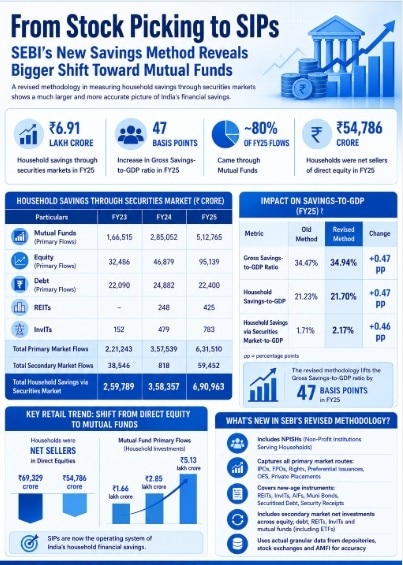



 Of the ₹6.91 lakh crore invested by households through securities markets in FY25, nearly four-fifths came through mutual funds, according to Sebi data. (AI Generated Image)
India’s understanding of household savings may have been significantly underestimated until now. A revised methodology developed by SEBI in consultation with the Reserve Bank of India (RBI) and the Ministry of Statistics and Programme Implementation (MoSPI) has revealed a much larger picture of how households invest through India’s securities markets, highlighting a major shift toward mutual funds and broader financial assets.
Household securities investments

 NSE IPO fully subscribed on Day 2; QIB, NII quotas booked 1.3 times each
 Nestle faces FSSAI crackdown over baby food formula claims. What the regulator found
  Warren Buffett steps down as Chairman after 60 years: What changes at Berkshire Hathaway now
 Jefferies' Christopher Wood sees gold at $10,000 'sooner or later'; likes India's small, midcaps
 Satya Nadella highlights India’s AI talent, sees massive developer community emerging by 2030
 BTTV Exclusive | Jefferies’ Chris Wood On AI, US Bonds, Oil & India’s Market Outlook
 LIVE What’s Hot: Stocks, Gold & Big Money Moves | Daily Markets Show | September 17 | Business Today
 From NPAs To Infrastructure: CEA On How India’s Economy Has Changed Under PM Modi
  “PM Modi Is Architect Of Economic Policy”: CEA V. Anantha Nageswaran On India’s Growth Journey
 iPhone Sale Sparks Overnight Rush As Buyers Queue Across Delhi, Mumbai, Bengaluru
  Jefferies' Christopher Wood sees gold at $10,000 'sooner or later'; likes India's small, midcaps
 NSE IPO: Applying for short-term gains from share sale? Analyst says this
 STT collections jump 52.9% to Rs 40,214 crore in FY27 so far; key details
 Kaynes Technology stock needs breakout confirmation; Moschip preferred semiconductor pick: Analyst NSE IPO fully subscribed on Day 2; QIB, NII quotas booked 1.3 times eachWarren Buffett steps down as Chairman after 60 years: What changes at Berkshire Hathaway nowSatya Nadella highlights India’s AI talent, sees massive developer community emerging by 2030
 Teach judgement over technique to survive AI wave: CEA Nageswaran urges B-schoolsJefferies' Christopher Wood sees gold at $10,000 'sooner or later'; likes India's small, midcapsNSE IPO: Applying for short-term gains from share sale? Analyst says this


