A key differentiator lies in the fund’s active allocation strategy. During the equity rally in 2025, exposure was increased from 48% to 69% (Feb–Nov 2025) to capture upside. As risks emerged—particularly geopolitical tensions and valuation concerns—the fund reduced equity to 59% by February 2026.
This tactical approach removes the burden of market timing for investors while allowing participation in upside phases and protection during corrections.
The equity portfolio itself is large-cap tilted (~40%), supplemented by selective mid- and small-cap exposure, balancing stability with growth potential.
ALSO READ: SEBI removes solution-oriented funds: How it impacts your long-term investment strategy
Portfolio positioning
The fund’s sector allocation reflects a bias towards domestic demand-driven themes, with key exposures including:
Financial Services (18.9%)
Automobiles
FMCG
Healthcare
This positioning signals a preference for earnings visibility and structural growth, rather than high-beta or speculative sectors.
Stability layer
On the fixed income side, the fund maintains a moderate duration of ~1.8 years and a yield to maturity (YTM) of 6.56%, aiming to balance accrual income with interest rate risk management.
Commodities—primarily gold and silver—form a strategic allocation in the 12.5%–18% range, acting as a hedge against inflation and global shocks. The fund actively shifts between the two metals based on macro signals and price trends.
ALSO READ: Which sectors look attractive after the market correction? Pranav Haridasan of Axis Securities explains
Performance of Axis Multi Asset Allocation Fund
The fund delivered 26.56% returns over the past year, outperforming the Nifty 50 TRI (15.12%), though marginally trailing its benchmark. Over a 3-year horizon, it has generated a 17.13% CAGR, reinforcing its ability to navigate multiple market cycles.
However, recent performance highlights the nature of the category:
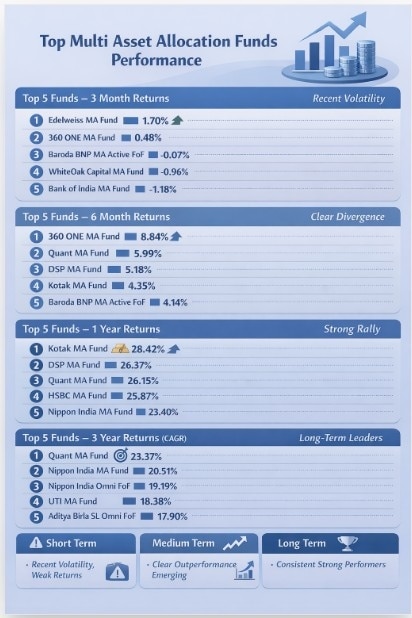
3-Month: Muted returns across peers, with most funds flat or negative—reflecting near-term volatility
6-Month: Early divergence emerges; allocation decisions begin to impact outcomes
1-Year: Strong returns driven by equity rally and gold tailwinds
3-Year: True test of consistency, with select funds delivering sustained outperformance
Peer comparison: Where Axis stands across timeframes
A deeper look at category peers across multiple time horizons highlights an important reality: multi-asset fund performance is highly time-frame dependent, and short-term rankings can be misleading without context.
3-month performance
Over the past three months, returns across the category have been muted to negative, with Edelweiss Multi Asset Allocation Fund leading at just 1.70%, while several peers slipped into negative territory.
This phase reflects synchronous corrections across asset classes—equities saw intermittent drawdowns, while commodities, particularly silver, witnessed volatility after a sharp rally.
For investors, this period is statistically insignificant in evaluating fund quality. Multi-asset funds are structurally designed to reduce volatility, not chase short-term alpha, and hence tend to lag during sharp directional market moves.
ALSO READ: Indian stocks boom as guns fall silent in West Asian ceasefire; oil plunges, Hormuz opens
6-month performance
At the six-month mark, dispersion in returns becomes more evident. 360 ONE leads with 8.84%, followed by Quant and DSP, indicating early signs of allocation efficiency and tactical positioning.
This is the phase where fund manager decisions—such as timing equity exposure, commodity allocation, and arbitrage usage—begin to reflect in performance.
However, from an evaluation standpoint, six months still sits in a transitional zone. While it offers better insight than 3-month data, it can still be influenced by temporary macro trends, such as commodity cycles or short-lived equity rallies.
1-year performance
The one-year period captures a more complete market phase, with Kotak (28.42%), DSP, and Quant emerging as top performers.
This strong performance is largely attributable to:
A broad-based equity rally, particularly in mid- and small-caps
Gold tailwinds, driven by global uncertainty and central bank demand
Effective risk-on positioning during favourable market conditions
For investors, this timeframe offers a clearer view of fund capability, especially in capturing upside. However, it is essential to acknowledge that 1-year returns can be cyclical and influenced by favourable macroeconomic tailwinds, which may not persist.
Where Axis fits in the peer set
Axis positions itself as a balanced allocator with a tactical overlay, rather than an aggressive return chaser. Its strengths lie in:
Dynamic equity allocation aligned with market conditions
Meaningful commodity exposure for hedging
A large-cap bias, which may limit upside in sharp bull phases but enhances stability
Relative to peers like Quant (more aggressive and tactical) or DSP/Kotak (strong cyclical capture), Axis appears more calibrated and risk-aware, which may lead to slightly moderated returns but smoother volatility over time.
What investors should note
The peer comparison reinforces a critical principle: short-term rankings are often noise, while long-term consistency reflects true fund quality.
3-month and 6-month data: Useful for tracking trends, not decision-making
1-year data: Indicates cycle participation, but can be macro-driven
3-year data: Most reliable measure of fund manager skill
From a portfolio construction lens, Quant, DSP, and Kotak stand out on consistency and return delivery, while Axis offers a more balanced, risk-managed approach suited for investors prioritizing stability alongside growth.
















 Axis Multi Asset Allocation Fund dynamically raised equity from 48% to 69% during the 2025 rally and trimmed it to 59% by Feb 2026 amid rising geopolitical risks.
 Japan’s semiconductor push in India: Why Japanese companies are betting on materials, equipment and technology
  Tata Steel seeks fresh UK government funding as Port Talbot project faces delays
 How big is Apple Pay? US payment giant to enter India as UPI dominates digital payments
 Delhi airport gets its third runway operational; optimise aircraft movement
 Tata Sons crisis: Why the 1-1 split among Tata Trust nominees matters
 CEA On India’s 7.8% Growth, Rural Incomes And Government’s Job Creation Push
  Gold Price Outlook: Why Dollar Weakness Could Keep Gold And Silver Prices Attractive Ahead
 Gold vs Silver Investment Strategy: Is This The Right Time To Buy For Long-Term Returns?
 Corporate Vs Personal Health Insurance: Which Is Better On A Budget?
 Gold Price Outlook: Why Gold Could Rise Despite Global Interest Rate Hikes | Silver Market Update
 Jindal Supreme, SS Retail, Hero Motors IPOs subscribed up to 181 times on final day; details here
 Sensex, Nifty post sixth weekly loss; TCS, Titan among top laggards, slip up to 4%
 How AI collapse could benefit Indian equity market; Jefferies' Christopher Wood explains
  Banks are no more secular growth story, prefer NBFCs: Chris Wood
 Jefferies' Christopher Wood sees gold at $10,000 'sooner or later'; likes India's small, midcaps
 High prices not a downer: iPhone 18 Pro series demand surges in India despite premium tag
 Greater Noida hit-and-run case: Car crashes into students near GNIOT College, driver held
 Lalbaugcha Raja receives ₹3.18 crore in 3 days: Check gold, silver and cash breakdown


