The softening of food inflation has had its effect on
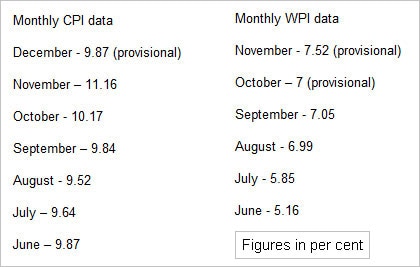
overall inflation . Figures released by the government on Monday (January 13) showed the consumer price index (CPI) having risen by 9.87 per cent in December 2013 as compared to the corresponding month the previous year. This is lower than the November CPI rise, which was 11.16 per cent.
All categories in the CPI list, except sugar, have shown a price increase. The items registering the maximum price rise are vegetables (38.76 per cent), fruits (14.64 per cent), egg, meat and fish (12.64 per cent) and cereals and products (12.14 per cent). Overall, the food and beverages basket registered an increase of 12.16 per cent, higher than the other two categories in the list - clothing, bedding and footwear (9.25 per cent) and fuel and light (6.98 per cent).
Some of the smaller states and union territories such as Sikkim, Nagaland, Mizoram, Andaman & Nicobar Islands and Meghalaya, however, ran contrary to the overall trend and saw their inflation numbers going up in December as compared to the previous month.
The rate of CPI inflation in rural India (10.49 per cent) was higher than in urban areas (9.11 per cent).
The
RBI , which has been keeping a close eye on inflation, will be relieved. Last month, RBI governor Raghuram Rajan surprised all when he kept the repo rate unchanged at 7.75 per cent despite inflation being high. But the status quo in the rates was accompanied by a warning. "If the expected softening of food inflation does not materialise and translate into a significant reduction in headline inflation in the next round of data releases, or if inflation excluding food and fuel does not fall, the Reserve Bank will act including on off policy dates if warranted," the RBI statement said.
Experts say that the December WPI (wholesale price index) number, which is expected to be announced on Wednesday, now holds the key to the direction interest rates will take in the next few months. Since June last year, the WPI has been on the rise (see table). Says Ashima Goyal, professor, Indira Gandhi Institute of Development Research (IGIDR): "Food inflation is very critical. The decline in CPI was expected and that is why RBI kept the monetary policy on pause mode. But the inflation rate is still high. It needs to come down further."



 Infosys, Tech Mahindra, TCS, Wipro: Why IT shares are down in a rising market today
  AI safety or market control? Anthropic, OpenAI, Google SpaceXAI accused of slowing AI progress
 Cyber hits to fake news: Vaishnaw warns of foul play against India’s semiconductor push
  Raymond, Welspun Living, Alok Industries shares rise up to 8%; here's why
  IIT-B prof to be summoned by police; Director signs 18-point charter amid students’ demands
 Gold Price Target 2026: Expert Sees MCX Gold At ₹1.8 Lakh By Year-End Amid Strong Demand
 Health Insurance: Why Pre-Existing Diseases And Waiting Periods Matter For Buyers
 Crude Oil Above $100: How High Energy Prices And Rupee Weakness Impact Gold Prices In India
 CEA On India’s Manufacturing Rise, Atmanirbhar Bharat And Modi’s Economic Policy
 Health Insurance Buying Guide: 7 Things First-Time Buyers Must Check Before Choosing A Policy
 Dilip Buildcon emerges L-1 bidder for Rs 1,265 crore transmission project; stock reacts
 Tata Capital shares: Systematix retains 'Buy'; sees scope for valuation gap to narrow; check target
 Weather forecasting push: Ceinsys Tech, Genesys International, MapmyIndia in focus; stocks move up to 6%
 Jindal Supreme IPO: How to check allotment status on Bigshare, BSE, NSE, fresh GMP & listing date












