












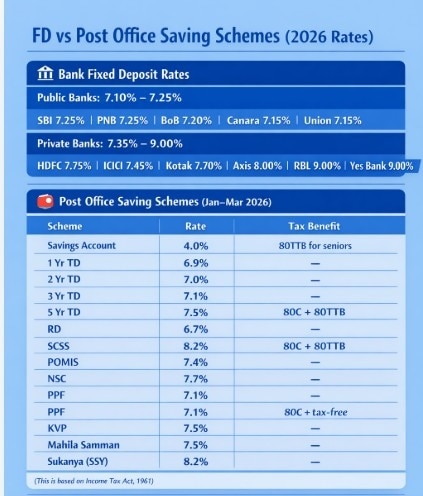



 If you want safety but also want better efficiency from your money, Post Office and small savings schemes can be strong alternatives.
For decades, fixed deposits (FDs) have been the default savings option for most Indian investors. If you wanted safety, guaranteed returns, and peace of mind, you simply opened an FD with your bank and left the money there. But today, many investors like you are beginning to realise that keeping all your savings in FDs may not be the smartest move anymore.
With interest rates on bank deposits largely in the 7%–8% range, several government-backed savings schemes are offering similar safety but with better returns, tax benefits, and stronger long-term compounding. Because these schemes are backed by the Government of India, they provide the same sense of security that attracts investors to FDs in the first place.

 India to face 100% tariffs? US House moves Russia Sanctions bill, final vote tomorrow
 NSE IPO: SEBI decision on CAS acceptable, focus stays on implementation, says Ashishkumar Chauhan
 Paytm, Pine Labs share price targets as MDR charges on UPI above Rs 2,000 introduced
 Brent crude futures fell 93 cents to $107.82 a barrel even amid supply risks: Here’s what’s happening
 Mecca on air alert: Saudi Arabia issues first-ever warning amid Houthi attacks in West Asia
 Crude Oil Price Surge: Will Petrol And Diesel Prices Rise In India?
 Market Commentary: Sharad Avasthi On Nifty, Stocks & The Next Big Move
 RBI Files Caveat In Bombay HC Ahead Of Tata Sons Appeal | Tata Group Stocks | Tata Chemical Shares
 NSE IPO Explained: Price Band, Valuation, Growth Potential And Key Risks
 Stock Market Falls As Crude Oil Nears $110 & Weak Rupee | Stock Market News
 Exide Industries shares rise 2% on pact with ExCom for European battery market
 Kanohar Electricals listing: Stock makes debut at 8% premium to IPO price
  Prasol Chemicals listing: Stock slips 10% to IPO price, opens at Rs 611
 eMudhra shares zoom nearly 37% in two days; here's the trigger
 Glass Wall Systems shares list at nearly 7% premium over IPO priceExide Industries shares rise 2% on pact with ExCom for European battery market
 OpenAI to retire GPT-5.5 from ChatGPT, Work and Codex on October 14: What changes to expectKanohar Electricals listing: Stock makes debut at 8% premium to IPO price Prasol Chemicals listing: Stock slips 10% to IPO price, opens at Rs 611eMudhra shares zoom nearly 37% in two days; here's the trigger


