












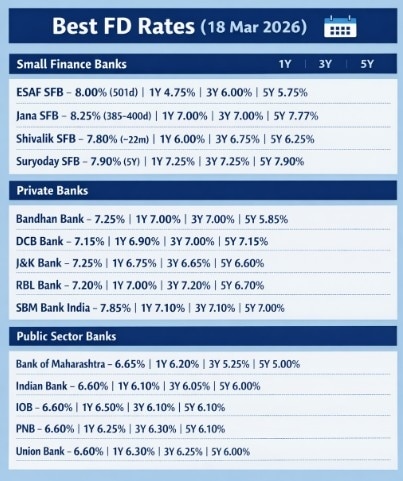



 Fixed deposits, often seen as outdated in the era of equities and gold, are once again gaining attention as market volatility rises.
For decades, Indian households have relied on traditional savings avenues such as bank deposits, fixed deposits (FDs), gold and small savings schemes to secure their financial future. These instruments offered predictable returns, low risk and a simple way to plan long-term goals such as education, marriage and retirement. However, over the past few years, household investments have steadily shifted towards market-linked instruments like stocks, equity mutual funds and other high-return products, reflecting a growing appetite for risk among younger investors.
The change became more visible after the pandemic, when strong equity market returns and the rise of financial influencers encouraged investors to move away from conventional options. Higher potential returns, easy access to trading apps and a surge in online investment content pushed many first-time investors toward equities, often with limited understanding of market volatility.

 AI revenue is surging at Indian IT firms, but how much is adding to growth?
 Festive spending in urban India to drop 6% to ₹1.97 lakh crore amid inflation: Survey
 India to overtake Japan as world’s fourth-largest economy in 2027: IMF projections
 BT Explainer: What the SC verdict on Yes Bank’s AT-1 bonds means for the lender and will it alter AT1 bonds as such?
 Stock market: India back on investors’ radar as they warm to ‘non-AI stories’, says HSBC
 Jio IPO: Mukesh Ambani's Big ₹30,213 Crore Bet, Reliance Employees Asked To Invest?
 Flying Cars Are Here? Elon Musk Shows Tesla Roadster Flying Through Air In Stunning Demo
 Ramakrishna P, CEO, India Mobile Congress Talks To Us About India’s Next Digital Frontier
 Market Recovery: Gaurang Shah Picks Banking, Defence, Power And Cement Stocks For Fresh Bets
 Will IDBI Employees Lose Jobs? DIPAM Secretary Arunish Chawla Clears The Air On Pension & Benefit

 CCL Products shares fall 9% on Q2 results; brokerages see up to 30% upside
 PNB Q2 earnings: Net profit rises 13%, asset quality improves
 BT Explainer: What changes for investors post revision of new Closing Auction System
 PC Jeweller shares hit 52-week high; stock jumps 75% YTD; what analysts say
 Federal Bank Q2 earnings: Net profit at record high, asset quality improves
 India’s 10-year bond yield may rise to 7.6% as US Treasury yields remain elevated: SBI Research
 Saif Ali Khan rents out two commercial units in Mumbai for ₹22.76 lakh per month
 How Mukesh Ambani Is Tapping Reliance’s 4.2 Lakh Workforce To Boost Jio's Record IPO
 Jailer 2 Box Office: Rajinikanth Scores ₹125 Crore Opening, But Coolie Still Rules
 Should India Reconsider LTCG Tax? NITI Aayog VC Ashok Lahiri Responds


