












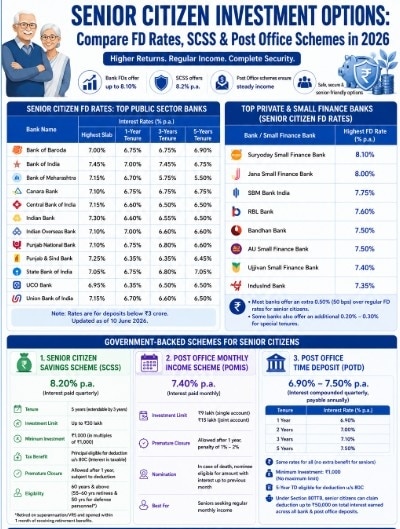



 Most banks provide resident senior citizens aged 60 years and above an additional 50 basis points over regular FD rates.
Senior citizens looking for stable and predictable income have a wide range of options in 2026, with fixed deposit (FD) rates offered by banks and NBFCs ranging from 2.5% to 8.10% annually. In addition to bank deposits, government-backed schemes such as the Senior Citizen Savings Scheme (SCSS) and Post Office Monthly Income Scheme (POMIS) continue to offer attractive returns and regular income.
Most banks provide resident senior citizens aged 60 years and above an additional 50 basis points over regular FD rates. Some lenders also offer special deposits that provide an extra 20-30 basis points for specific tenures.

 NSE IPO update: SEBI approval likely next week; Check expected dates of price band and listing
 SEBI begins hearings to recover gains linked to Adani-Hindenburg trades: Report
 Sensex, Nifty snap four sessions of losing streak; RIL, Tata Steel, Bajaj Finance boost sentiment
  7.8% GDP row: ‘Need to compare apples to apples, not apples to oranges,’ says MoSPI Secretary
 ₹10 lakh crore liquidity surplus: Why FCNR-B inflows could push bank funding costs lower, says Jefferies
 “High Sugar, Salt, Fat”: FSSAI CEO On Proposed Red Warning Labels On Food Packs
 How Many Mutual Funds Should You Own? Expert Recommends 4-5 Equity Funds
 Pakistan’s Mohsin Naqvi: The Civilian Power Broker Linked To Asim Munir’s Rise
 Olectra Greentech’s 8,500+ Bus Order Book; Why Electric Trucks Could Be Its Next Growth Engine
 Scuba Diving, Skiing & Trekking: Does Travel Insurance Cover Adventure Sports Accidents?
 56% rally in TBZ stock: Upper circuit led to record high today; here's why Sensex, Nifty snap four sessions of losing streak; RIL, Tata Steel, Bajaj Finance boost sentiment
  Physicswallah shares jump 9% as Motilal Oswal sees 66% upside
 KEC International: At 52-week low, Geojit expects more downside in infra stockNSE IPO update: SEBI approval likely next week; Check expected dates of price band and listing
 EPF interest after leaving job: Will your provident fund balance keep earning until 58?
 Activist Swatantra Bhardwaj detained in UP as Jantar Mantar assault case intensifies56% rally in TBZ stock: Upper circuit led to record high today; here's why
  Air India Phuket-Delhi flight lost all three hydraulic systems at 36,000 feet, 24 injured: Report
 Volkswagen India begins major restructuring, plans 12% workforce reduction in major 3-year cost overhaul: Report


