









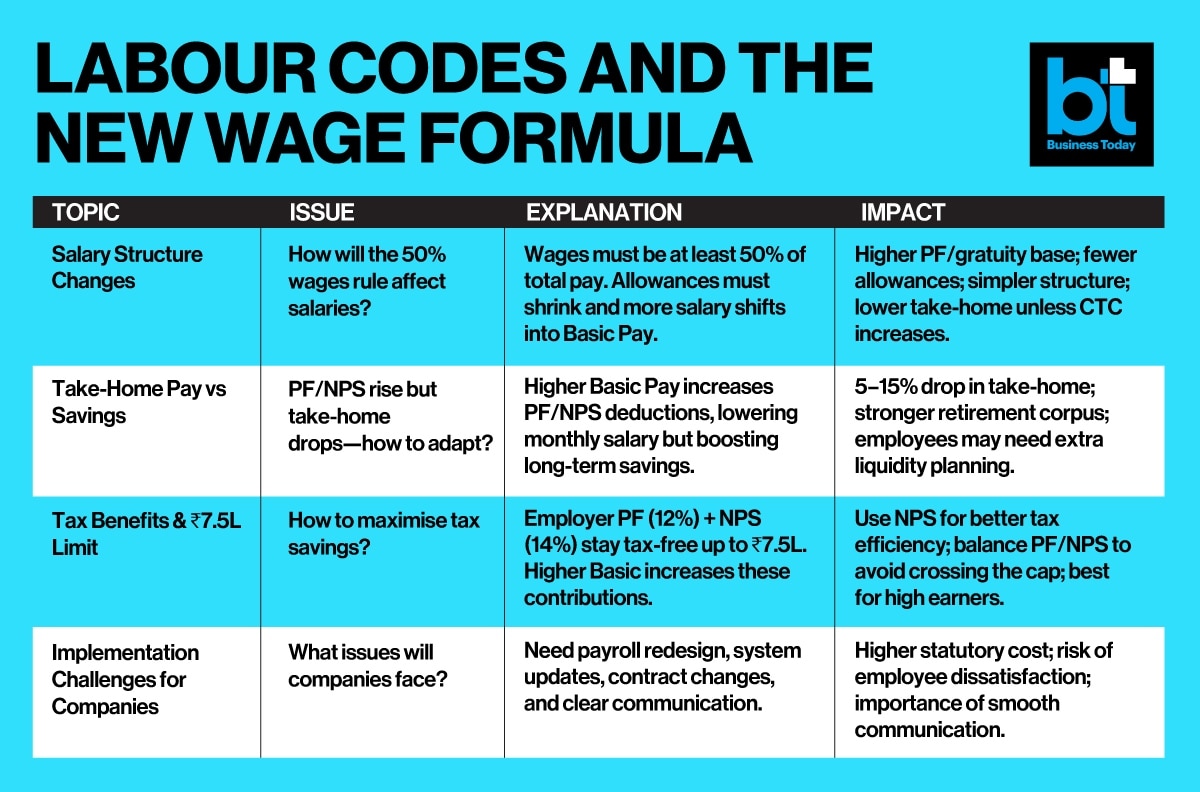



 According to experts, employers will need to rebalance salary break-ups, especially for employees who currently draw large allowances or flexible components.
If you’re a salaried employee, the new labour codes that kicked in on November 21 are likely to reshape the way your salary looks — and even how much you take home each month. While these codes don’t introduce brand-new tax deductions, they do change how your salary is defined, and that alone will have a big impact on PF, gratuity, pensions and your overall tax planning.
At the heart of the change is the Code on Wages, 2019. It introduces a single, uniform definition of “wages” — something experts say will completely reset how statutory benefits are calculated.
Ramachandran Krishnamoorthy, Director – Payroll Services at Nexdigm, explained that wages — consisting of basic pay, dearness allowance (DA) and retaining allowance — will now need to make up at least 50% of your total salary. “This will simplify salary structures and expand the scope of social security,” he said, adding that many allowances employees currently use for tax saving may no longer serve the same purpose under the new system.
What this means for you
The most immediate impact will be on compulsory savings. Because contributions to PF, gratuity and pension are linked to the wage component, these amounts will automatically rise. This could lead to a dip in monthly take-home pay, but experts believe the trade-off is worth it.
According to Pankaj Savla, Director at NPV Labour Law Solution, mid-career employees might end up with 20–30% higher retirement benefits over their lifetime. “Employees should treat the reduction in take-home salary as forced savings,” he said. He added that with its equity exposure and tax efficiency, NPS could become even more popular among those aiming for better long-term returns.
Choosing between new and old tax regimes
Here’s where things get interesting. With a higher basic salary, employer contributions to PF and NPS also increase — and these are exempt under the new tax regime. Krishnamoorthy pointed out that this makes the new regime more appealing for people who don’t claim many deductions.
But the old tax regime isn’t out of the game. A higher basic salary also increases HRA exemption, which is especially helpful for those paying high rents in big cities. Savla added a note of caution: allowance-heavy salary structures will need to be reworked because non-wage components cannot exceed 50% of total pay.
PF–NPS balancing act
There’s also a tax cap you need to keep in mind. Employer contributions to PF and NPS together cannot exceed Rs 7.5 lakh a year.
Krishnamoorthy explained this simply:
You hit the limit for PF-only contributions at a basic salary of Rs 62.5 lakh,
And for NPS-only contributions at Rs 53.57 lakh.
He suggests balancing contributions between PF and NPS based on your tax-saving needs and return expectations.
What employees should prepare for
The transition won’t be just theoretical — companies need to overhaul payroll software, restructure salary packages and communicate clearly with employeesm experts said. Krishnamoorthy said this overhaul will lead to cleaner, more predictable salary structures. Savla, however, warned that a lack of clear communication might leave employees frustrated, especially if their take-home pay falls suddenly.
The changes extend beyond full-time staff — contract and gig workers will also see revisions as 29 existing labour laws merge into four broad codes covering wages, industrial relations, social security and workplace safety.
As the 2025 rollout gathers pace, both experts say the reforms should be viewed as a long-term investment in employee well-being. Yes, the short-term adjustment may feel uncomfortable, but the outcome is expected to be a stronger retirement foundation and more transparent, future-ready payroll systems.

 Exam reforms: Tech titan Nandan Nilekani picked by PM Modi to fix national public examination system
  'Tax officers struggled for own land': Nirmala Sitharaman slams laidback attitude of govt depts
 CBDT issues new crypto reporting guidance: No new tax, but exchanges must track and report all transactions
 Did Cockroach Janta Party's 'Chalo Sansad' 2.0 threat trigger Dharmendra Pradhan's resignation? What we know so far
 'Will discharge my responsibilities with complete humility': Pralhad Joshi after being appointed Education Minister
 AI Data Centers, Aerospace & Gas Turbines: What's Powering Indo-MIM's Future Growth?
 Best Healthcare Stocks: Gaurang Shah's Outlook On Apollo Hospitals, Fortis & The Manipal Health IPO
 Is Indo-MIM's IPO Valuation Justified? Here's Why The Company Sees Strong Growth Ahead
 Treasury Bills Explained: Why T-Bills Are One Of The Safest Short-Term Investment Options
 FDs vs Markets: Where Should You Keep Your Short-Term Money?
 Gland Pharma stock: Price target of Rs 3,250 likely in medium term, says analyst
  Metal recycling stocks to buy: Gravita, Pondy Oxides, Jain Resource among top picks
 TRIL shares: Should you average the falling stock? Here's 'fixed and final' stop loss
 Adani Power: 45 GW target, Rs 2 lakh crore capex plan among conference call highlights
  ITC Hotels, Chalet, Ventive, IHCL, SAMHI: Hotel stocks to buy despite travel disruptions
 'Ashamed of it...': Manoj Muntashir calls Adipurush his biggest mistake, seeks country's forgiveness Exam reforms: Tech titan Nandan Nilekani picked by PM Modi to fix national public examination system 'Tax officers struggled for own land': Nirmala Sitharaman slams laidback attitude of govt depts
 Delhi targets traffic bottlenecks on Aruna Asaf Ali Marg with ₹1.97 crore elevated road studyAI Data Centers, Aerospace & Gas Turbines: What's Powering Indo-MIM's Future Growth?