












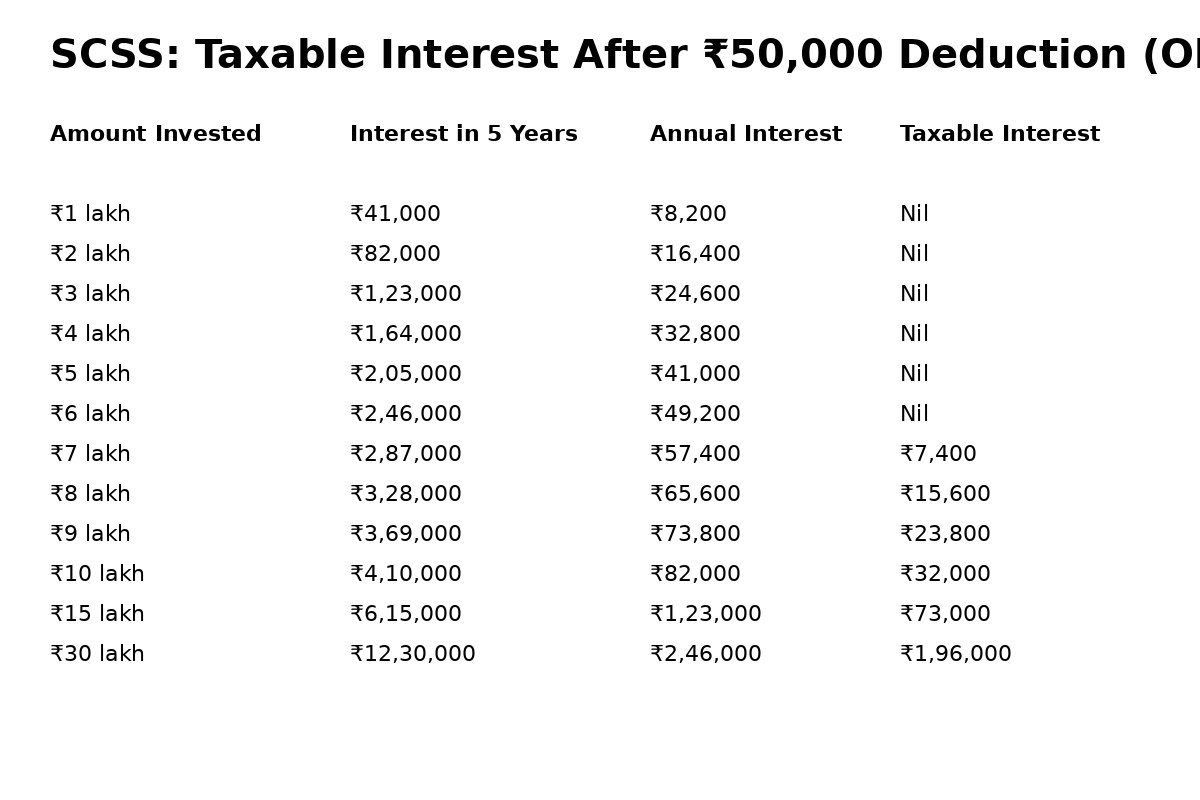



 Budget 2025 further widened the appeal of the new tax regime by making income up to Rs 12 lakh tax-free from FY 2025–26, which was applicable on senior citizens too.
The Senior Citizens Savings Scheme (SCSS) continues to be one of the most popular fixed-income options for elderly investors in India, offering a combination of assured returns, sovereign backing and tax benefits. However, after the tax changes announced in recent Budgets, especially the expansion of the new tax regime in 2025, the actual tax outgo on SCSS investments now depends heavily on which regime a senior citizen chooses.
The Union Budget 2025, presented by Finance Minister Nirmala Sitharaman, introduced a revamped new tax regime for FY 2025-26 (AY 2026-27), effective April 1, 2025. Key changes include making income up to Rs 12 lakh completely tax-free via rebates, extending to Rs 12.75 lakh for salaried individuals (including a Rs 75,000 standard deduction).

 GDP is not enough: UN expert group proposes 31 indicators to measure a nation's progress
 Russia ready to supply as much oil as India needs: Kremlin envoy blasts 'pressure tactics' on New Delhi
 RPG Life Sciences to launch GLP-1 drug in October after ₹215 crore API acquisitions
 Adani stocks: GQG searching for buyers for stake sale? What you need to know
 Monsoon update: Satellite imagery tracks final lap over North India before south shift
  ASUS Jelly75 Keyboard Review
 AI SANA | Tech News Of The week | Dyson Toothbrush, iPhone 18 Pro Colours | Business Today
 Luxury Car Market Growing 9-10%; Mercedes-Benz Weighs Further Price Hikes
 Metropolis Healthcare Bets On AI, Expansion And Deeper Penetration
 Delhi PG Collapse: Unsafe Buildings, Missing Safety Checks & The Accountability Question
 TBZ shares jump 72% in six sessions: What's driving the rally?
 HFCL stock hits upper circuit; order book expansion, defence revenue target and more
  Shyam Metalics shares rise 2% as August sales data signal strong growth
  Chivas Regal, Absolut Vodka maker Pernod Ricard picks 4 bankers for over $1 billion India IPO: ReportAdani stocks: GQG searching for buyers for stake sale? What you need to know
 Will the US increase H-1B visa fee to $200,000? Here’s what we know
 Motorola launches Edge 70 Plus, Moto Watch Ultra and Moto Snap Wireless Charger at IFA 2026
 Can you really visit another country from India for under ₹50,000? Check these seven options before bookingTBZ shares jump 72% in six sessions: What's driving the rally?
 132 crore and counting: How Mirzapur turned an OTT gamble into a box-office shock


